
HK Compliance: RWA Tokenisation, IRAs & KYT Controls

RWA tokenisation is back on every board agenda. In Hong Kong, the opportunity is real — but so are the AML expectations. If you’re issuing, custodying, or trading tokenised assets or stablecoins, you’ll need an Institutional Risk Assessment (IRA) that stands up to audit, and Know Your Transaction (KYT) controls that actually catch risk in real time.
Why this matters now
- FATF Recommendation 15 requires jurisdictions to regulate VASPs and address ML/TF risks tied to pseudonymity and rapid value transfer. Hong Kong has been aligning accordingly (see the SFC’s VASP regime and ongoing proposals). Reference: FATF Rec. 15; FSTB’s public consultation on VA custodians acknowledging layering risks.
- Hong Kong’s latest policy direction explicitly calls out a legal/regulatory review on tokenisation and alignment with the OECD Crypto-Asset Reporting Framework for tax transparency.
- Consultations on stablecoin AML have underscored transparency, traceability, and risk mitigation; some FATF members even require identification of any stablecoin holder at rollout — a cautious baseline that could influence Hong Kong’s implementation.
What this means in practice: tokenised RWAs and stablecoin rails will be judged on traceability, wallet controls, and on/off-ramp surveillance.
Designing an IRA that fits RWA tokenisation Your IRA should do more than describe “we use Chain A.” It must quantify risk by use case and control.
- Scope by activity: issuance, primary distribution, secondary trading, corporate actions (e.g., coupon), redemption, and custody model (self vs third-party).
- Asset-specific risk: Are you tokenising credit, real estate, funds, or trade finance? Each carries different valuation/oracle, concentration, and illicit finance risks.
- Flow mapping: Where do fiat legs occur? Which OTCs or banks are used? These are the layering points flagged in VA OTC and custodian consultations.
- Counterparty profiles: professional investors vs retail; direct clients vs intermediated; cross-border exposure.
- Technology stack: chain selection, privacy features, smart contract upgradability, freeze/blacklist functions, Travel Rule interoperability.
Illustrative IRA scoring (set weights to total 100)
| Risk Factor | Example Metrics | Weight | Residual Risk |
|---|---|---|---|
| Counterparty KYC depth | Per-transaction KYC, periodic refresh | 25 | Medium |
| On-chain exposure | % flow touching sanctioned/mixer clusters | 20 | Low |
| Custody setup | Segregation, controls, insurer | 20 | Medium |
| Valuation/oracle | Independent sources, fallback logic | 15 | Low |
| Jurisdictional risk | High-risk country exposure | 10 | Low |
| Redemption controls | Cooling-off, banked rails only | 10 | Medium |
Two rules of thumb
- Update the IRA at least annually and upon trigger events (new chain, new asset class, new jurisdiction, material incident).
- Record keeping: 5 years under Hong Kong’s AMLO. Build audit-ready evidence for every control.
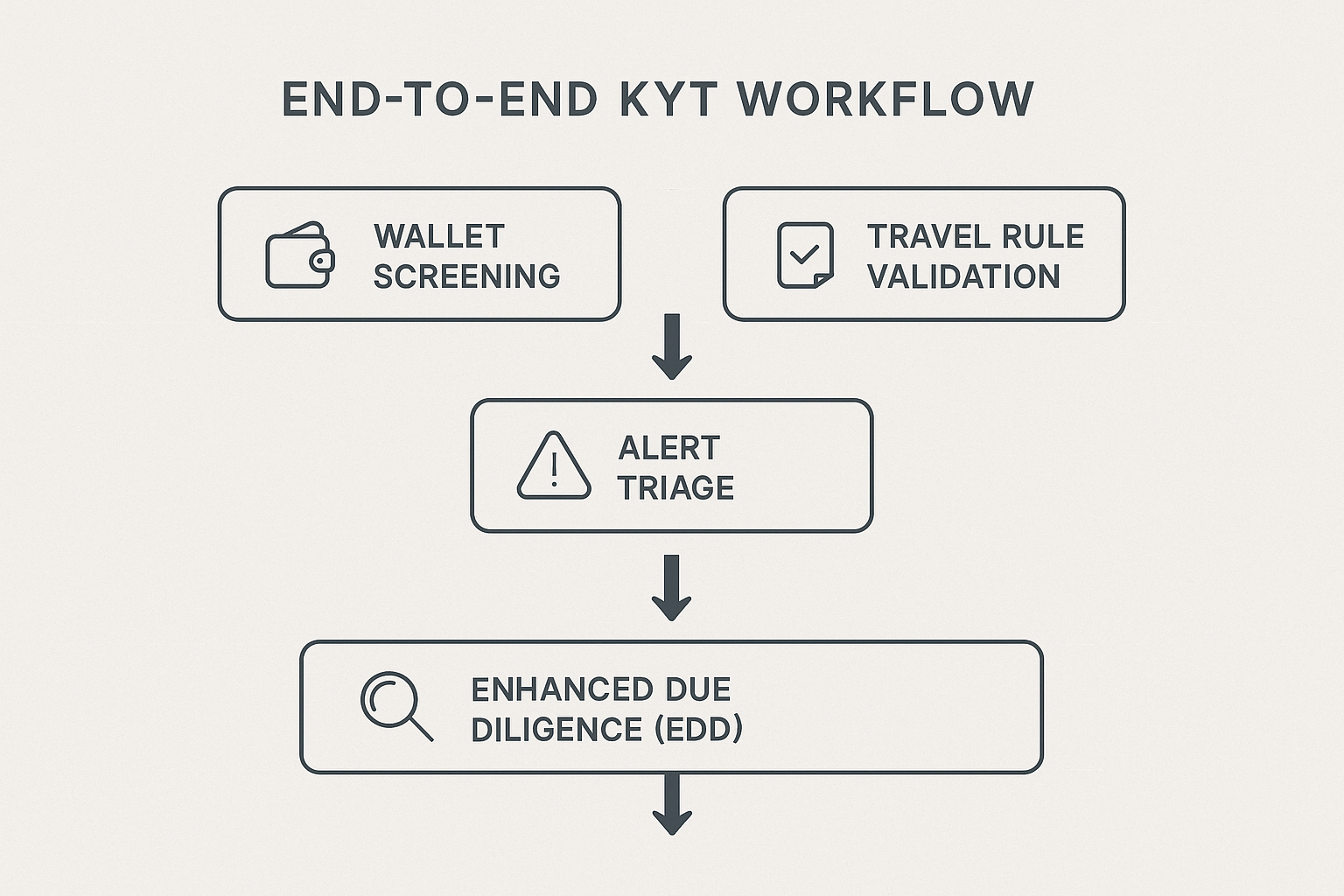
KYT that actually works Your KYT engine should combine blockchain analytics, fiat monitoring, and case management.
Core controls to implement now
- Wallet screening at onboarding and on every change event (first inbound, first outbound, and each 90 days thereafter). Auto-block exposures with >1% cumulative link to sanctioned entities or mixers (illustrative threshold).
- Travel Rule compliance for VASP-to-VASP transfers. Require originator/beneficiary data before release of funds; hold-and-review for missing or unverifiable data.
- Stablecoin-specific triggers: enhanced due diligence for mints/burns above HKD 500,000 (illustrative), clustering analysis to detect “holder splitting,” and device/wallet-type flags for self-hosted or hardware wallets.
- Fiat on/off-ramp surveillance: match redemption accounts to KYC profiles; reject third-party redemptions; apply name screening and geofencing.
- Case governance: risk scores, narratives, and SAR/escalation workflow baked into the case tool; independent QC on at least 5% of alerts monthly (illustrative).
Anticipate stablecoin ID expectations Consultation feedback highlights that some regimes require identification of any stablecoin holder from day one. If you’re building an HK-facing stablecoin or integrating one into an RWA pipeline, plan for:
- Holder-level KYC for primary issuance and redemptions.
- Non-custodial wallet controls: tiered limits, just-in-time KYC at risk thresholds, and explicit blacklisting ability in contracts.
- Clear disclosures on traceability and freezing policies.
90-day execution plan
- Week 1–2: Map flows and draft the IRA scope. Decide risk weights and thresholds.
- Week 3–6: Implement wallet screening, Travel Rule connectivity, and mint/burn monitors. Integrate with case management.
- Week 7–10: Run back-tests on 90 days of data; tune thresholds; document procedures.
- Week 11–12: Board approval of the IRA and KYT standards; train ops; schedule independent testing.
If you can’t evidence it, it didn’t happen.
References
- FATF Recommendation 15: https://www.fatf-gafi.org/en/recommendations/rec15.html
- SFC AML/CFT resources for VASPs: https://www.sfc.hk/en/Rules-and-standards/Anti-Money-Laundering-and-Counter-Financing-of-Terrorism
- FSTB policy statement on virtual assets and subsequent updates: https://www.info.gov.hk/gia/general/202210/31/P2022103000529.htm
- OECD Crypto-Asset Reporting Framework: https://www.oecd.org/tax/exchange-of-tax-information/crypto-asset-reporting-framework/
- HKMA stablecoin resources: https://www.hkma.gov.hk/eng/key-functions/international-financial-centre/fintech/stablecoins/


