HK Compliance: RWA Tokenisation, HKMA Stablecoins, Audits

HK Compliance: RWA Tokenisation, HKMA Stablecoins, Audits
Hong Kong’s digital asset push is shifting from pilots to production. If you’re building in 2025—whether tokenising real‑world assets (RWA), preparing a fiat‑referenced stablecoin, or running custody—you’re now inside a maturing policy perimeter, not a regulatory vacuum.
Audits are now a licensing issue, not a marketing slide.
RWA tokenisation: where Hong Kong is leaning in
The Government’s Policy Statement 2.0 confirms a clear direction: expand tokenisation beyond bonds into funds, revenue streams, and even precious metals, while keeping investor access and sustainability data in scope (Policy Statement 2.0). Expect the first wave of scale to track what already works:
- Bonds first: the framework review starts with bonds, which have moved beyond proof‑of‑concept, and will inform other RWAs.
- Funds and cash-flow RWAs: under the HKMA’s Project Ensemble—co‑led with the SFC for asset management participation—use cases include tokenised money market funds and revenue streams (HKMA: Project Ensemble).
- Precious metals: explicitly named as a next frontier.
What regulators will look for in a tokenised product approval or authorisation process (illustrative, based on recent cases we’ve handled):
- On-chain/off-chain consistency: corporate actions, coupon schedules, and reserve data must reconcile deterministically. Automate reconciliation; don’t rely on manual updates.
- Whitelisted distribution: controlled investor access, product suitability and robust KYC/AML. If retail is targeted, expect SFC product-level scrutiny.
- Settlement finality and record‑keeping: clear legal effect of on‑chain records versus traditional registers, with immutable logs fit for audit.
- Transparent oracles: documented data sources and failover. Avoid a single oracle admin with upgrade power.
HKMA stablecoin regime: what to assume in 2025 planning
While the legislative process is still evolving, the design principles are consistent across consultations: HKMA licensing for fiat‑referenced stablecoin issuers, with full backing, strong governance, and custody rules that mirror traditional financial expectations. Notably, if an issuer carries on custody of its own stablecoins, it will be under HKMA’s ongoing supervision, with investor protection requirements such as asset segregation, adequate audit, record‑keeping, and full AML/CFT coverage (consultation context).
Plan for:
- 1:1 high‑quality reserve backing in the same currency; no crypto‑collateral for fiat‑referenced coins.
- Independent reserve attestations and annual audits; prompt redemption and disclosure of liquidity profiles.
- Segregated customer assets; robust governance over mint/burn keys, with multi‑sig, time‑locks, and incident playbooks.
- Distribution via regulated intermediaries consistent with SFC guidelines if offered to the public.
Smart contract auditing: the minimum viable evidence pack
Regulators won’t read your solidity, but they will expect proof you’ve controlled operational and financial risks. Build an audit pack that covers:
- Code and upgrade safety
- Independent code audit with severity‑rated findings and fixes verified.
- Proxy/upgrade controls: time‑locks, multi‑sig, and emergency pause procedures tied to governance.
- Economic/security modelling
- Oracle manipulation, liquidity crunch, and redemption‑run scenarios.
- Formal verification for critical invariants (e.g., total supply = sum of balances + fees).
- Change management
- Signed release notes, versioning, and reproducible builds.
- Segregation of duties; production access logging and monitoring.
- Runtime monitoring
- On‑chain alerts for abnormal flows, admin actions, oracles, and supply changes.
- Bug bounty with scope and response SLAs.
- Compliance mapping
- Link smart‑contract controls to SFC/HKMA expectations on safekeeping, segregation, and record‑keeping.
- Evidence that AML/CFT controls align with token flows (e.g., travel rule coverage by intermediaries).
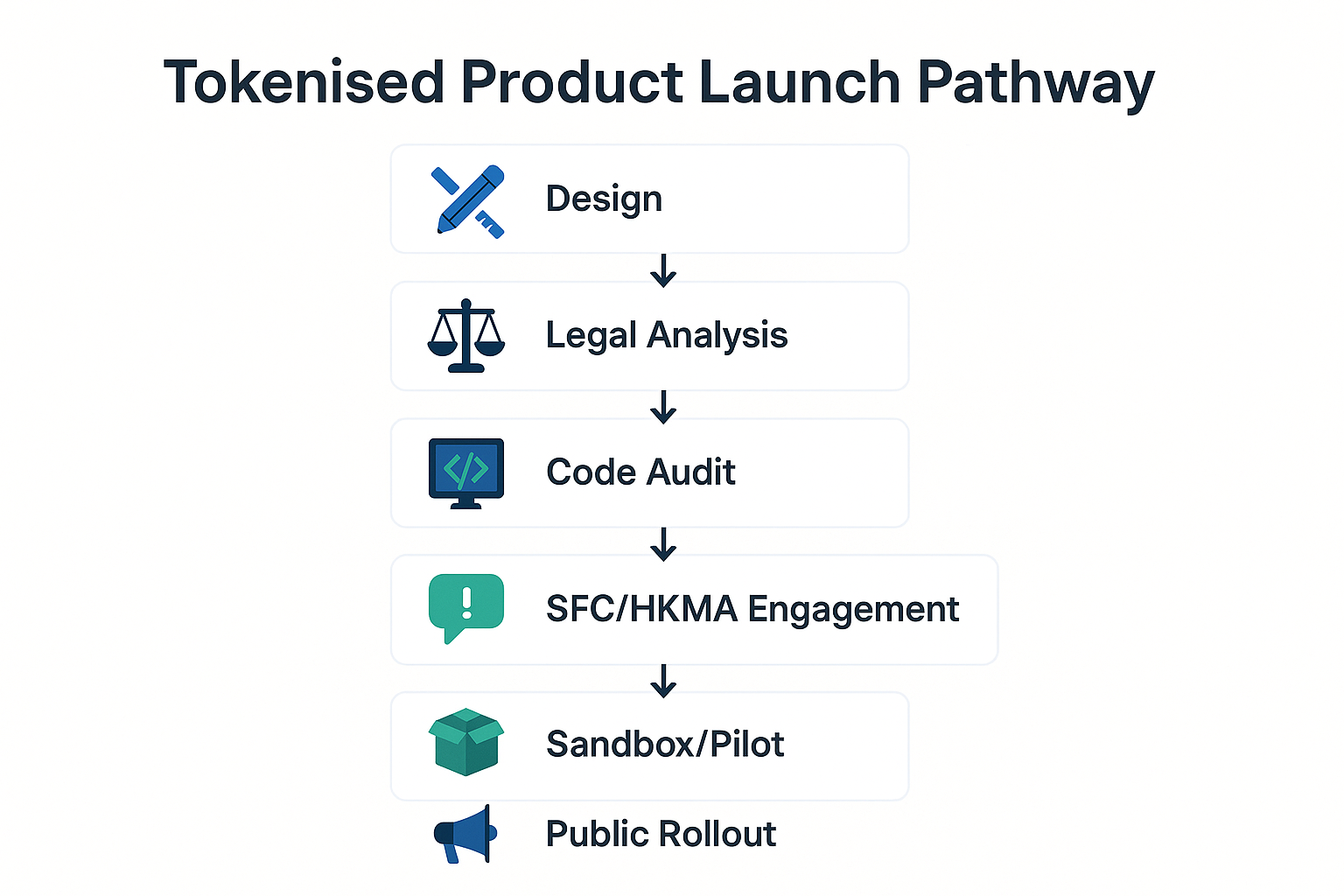
2025 quick‑reference table
| Topic | Core expectation | Practical proof to prepare |
|---|---|---|
| Tokenised bonds/RWAs | On‑chain/off‑chain parity; controlled distribution | Reconciliation reports; oracle design docs; investor eligibility checks |
| Stablecoin issuance | Licensed issuer; 1:1 reserves; asset segregation | Reserve policies; third‑party attestations; key management runbooks |
| Custody (incl. self‑custody by issuers) | Ongoing supervision; audit and record‑keeping; AML/CFT | SOC‑type reports or equivalent controls mapping; immutable logs; AML procedures |
What to do now
- Map your product to either SFC product rules (tokenised funds/securities) or HKMA issuer rules (stablecoins). Avoid straddling both without clear perimeter.
- Stand up monitoring before pilots. A 30‑day pre‑launch telemetry window often surfaces issues early (illustrative: 3–5 critical alerts per week).
- Document everything. If it’s not evidenced, it didn’t happen.
Hong Kong is no longer experimenting for experimentation’s sake. With Policy Statement 2.0, Project Ensemble, and the stablecoin regime maturing, the bar is clear: real assets, real controls, real audits.
If you’re unsure where your build sits, get a regulatory mapping done before you write more code.