
HK Compliance: Risk-Based Crypto Custody & Tokenisation

HK compliance is moving from “can we do this?” to “can we evidence the risk we’re taking?” That shift is most obvious in custody and tokenisation.
Why this matters: supervisors are aligning Hong Kong rules with international baselines from IOSCO, the FSB, Basel and the OECD CARF. If you run custody, a tokenised product line, or stablecoin rails, your control design now needs to be demonstrably risk-based, not just policy-deep.
What Hong Kong expects (and why)
- International alignment. See IOSCO’s Crypto and Digital Asset Market recommendations, the FSB’s global framework, Basel’s prudential standard for banks’ crypto exposures, and the OECD Crypto-Asset Reporting Framework for tax transparency. Hong Kong’s Policy Statement on Digital Assets 2.0 commits to this alignment.
- Local regimes catching up. The Government has consulted on a licensing regime for Virtual Asset Custodian Services with core pillars: client asset segregation, robust audit and records, and full AML/CFT scope. Stablecoin issuers that self‑custody would sit under HKMA supervision. VATPs remain under SFC’s AMLO licensing.
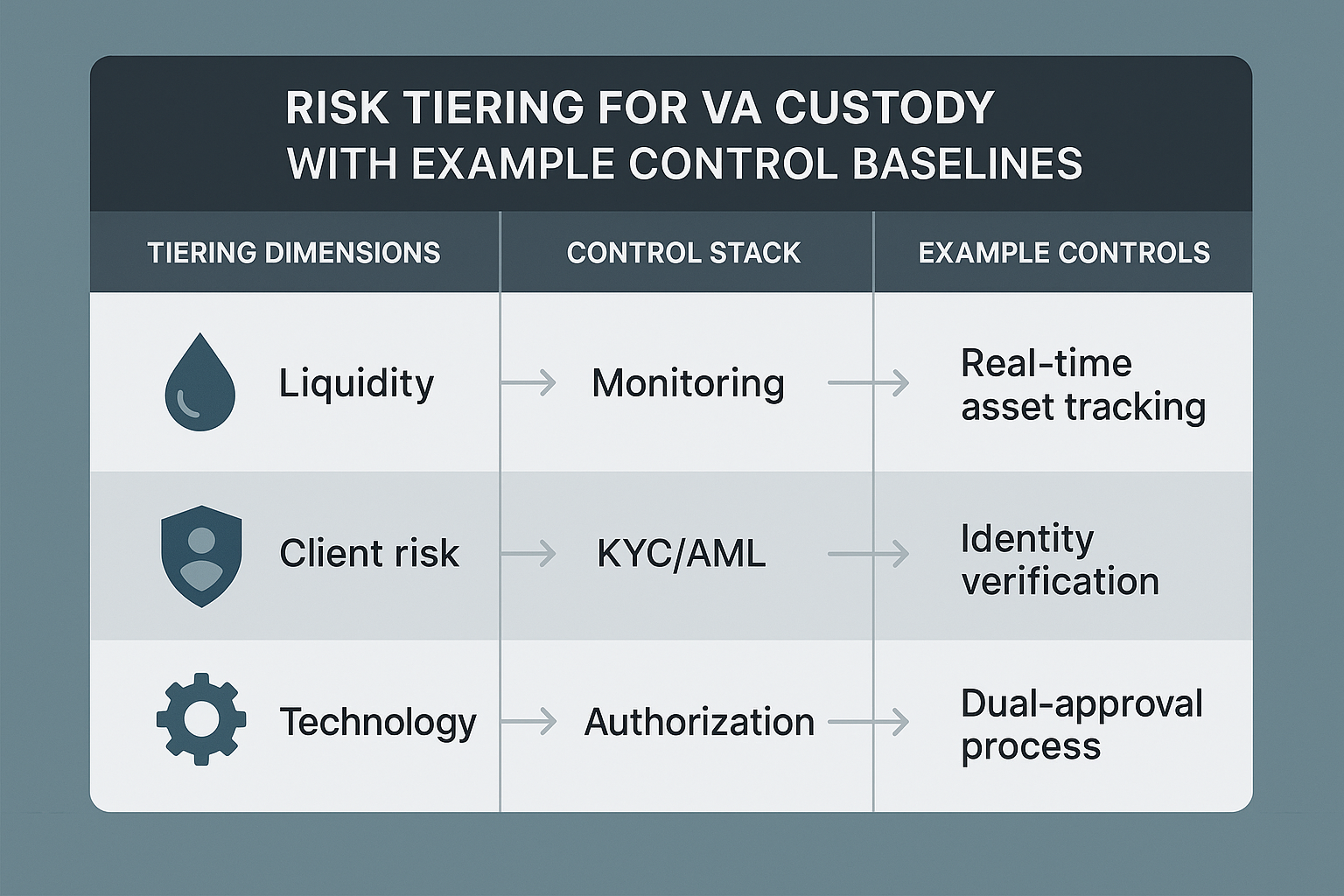
A risk-based custody blueprint You’ll be asked to show how asset, client, and technology risks translate into concrete controls. Here’s a concise, defensible mapping you can implement now.
-
Tiering dimensions (illustrative):
- Asset liquidity/volatility (e.g., BTC/ETH vs. thin-cap tokens)
- Client risk (retail/professional; jurisdiction; PEP/sanction exposure)
- Technology surface (hot/warm/cold; MPC vs HSM; smart contract reliance)
-
Control stack by tier (illustrative thresholds):
- Hot wallets (≤5% AUC; 24–48h rolling cap): real-time monitoring, velocity limits, dual-approval, address screening, 24/7 SOC, HSM/MPC with quorum 2/3.
- Warm wallets (10–20% AUC): time-locked withdrawals, additional approver independent of operations, pre-signed emergency transactions, automated balance reconciliation 4x/day.
- Cold custody (≥75% AUC): offline HSMs, geographically separated shards, 3/5 quorum with segregation of duties, monthly external reconciliation, quarterly independent audit of key ceremonies.
- Across all tiers: client asset segregation on-chain and in books, daily proof-of-reserves/liabilities reconciliation, incident playbooks with RTO/RPO targets (e.g., RTO 8 hours hot; 48 hours cold).
What about stablecoins and unhosted wallets? Hong Kong’s consultation conclusions on AML for stablecoins emphasise:
- Due diligence on the institution providing the custodial wallet to the holder (FI or VASP): licensing status, solvency, operational resilience, and controls around reserves and redemption.
- Additional controls for unhosted wallets: enhanced KYC, address risk scoring prior to first deposit/withdrawal, transaction-pattern monitoring, and documented rationale for whitelisting.
Actionable steps you can deploy within 60–90 days
- Map controls to international standards:
- IOSCO market integrity: pre-trade/post-trade surveillance for on-chain transfers and exchange activity; market abuse alerts tuned to token liquidity.
- FSB/safeguards: board-approved risk appetite for custody loss, with KRIs (e.g., failed withdrawal attempts, policy quorum breaches).
- Basel (if bank-affiliated): capture crypto exposures and operational risk in ICAAP with scenario losses (illustrative: smart contract exploit HKD 30–50m).
- OECD CARF: inventory wallet address ownership and implement data capture to support future CARF/CRS-style reporting.
- Tighten wallet risk management:
- Travel Rule end-to-end testing with counterparty VASPs; bounce unknown originator/beneficiary data.
- Unhosted flows: set lower limits, require source-of-funds proofs on first use, and block risky clusters (mixers, sanctioned bridges).
- Evidence segregation:
- On-chain proofs plus external auditor comfort (SOC 2 Type II or ISAE 3402) over key management and reconciliation.
- Tokenisation governance:
- Apply “same activity, same risk” to tokenised securities. Treat the token as a new depository wrapper, not a regulatory loophole.
- Document the smart contract threat model, oracle dependencies, and upgrade rights. Disclose these in offering docs and client agreements.
- For permissioned chains, implement participant KYC, transfer restrictions, and corporate actions playbook (e.g., pause/burn/mint protocols).
Practical watchouts
- Don’t over-rely on MPC marketing. Regulators care how you govern quorum keys, not the acronym.
- Warm wallets are where most operational incidents start; give them the scrutiny usually reserved for cold storage.
- Tokenisation adds operational complexity; keep redemption and corporate actions boring and auditable.
If you can tie each risk to a control, and each control to a test, you’re aligned with where Hong Kong is heading—and frankly, already expects you to be.
References
- Policy Statement on the Development of Virtual Assets in Hong Kong (Digital Assets 2.0): https://www.fstb.gov.hk/en/financial-services/policy-statement-VA.htm
- IOSCO Crypto and Digital Asset Market recommendations: https://www.iosco.org/news/pdf/IOSCONEWS705.pdf
- FSB global framework for crypto-asset activities: https://www.fsb.org/2023/07/fsb-finalises-global-regulatory-framework-for-crypto-asset-activities/
- Basel Committee press on prudential standard: https://www.bis.org/press/p230713.htm
- OECD Crypto-Asset Reporting Framework: https://www.oecd.org/tax/exchange-of-tax-information/crypto-asset-reporting-framework-and-amendments-to-the-common-reporting-standard.htm
- Public consultation on Virtual Asset Custodian Services: https://www.info.gov.hk/gia/general/202402/08/P2024020800442.htm
- SFC VATP licensing info: https://www.sfc.hk/en/Virtual-asset-trading-platforms


