
HK Compliance: Retail Stablecoins, Risk Matrix, ESG

Hong Kong’s retail stablecoin moment is finally getting definition. With the Government’s stablecoin issuer regime commencing on 1 August 2025, policy signals are clear: support payment use cases and tokenisation, but anchor them in prudential guardrails, real redemption, and wallet risk controls. If you’re building issuance, distribution, or custodial rails, here’s how to be licence‑ready and bankable.
Retail stablecoins in 2025: what’s actually changing The regime for licensed issuers is the cornerstone. It bakes in reserve asset management, stabilisation mechanics, redemption processes, and prudential risk management — the prerequisites for payments and capital markets use. Expect retail access to be conditioned on whether a coin’s issuer is licensed and whether distribution channels meet AML/CFT and wallet‑risk standards.
Two practical implications:
- Issuers: plan for licensing and public redemption at par in reasonable timeframes. Assume independent assurance over reserves and governance.
- Distributors (FIs/VASPs): admission criteria will likely prioritise licensed issuers with transparent reserves, robust redemption SLAs, and segregation of client assets. Until formal SFC/HKMA notices, maintain conservative retail access policies and be ready to pivot once “eligible stablecoin” parameters are announced.
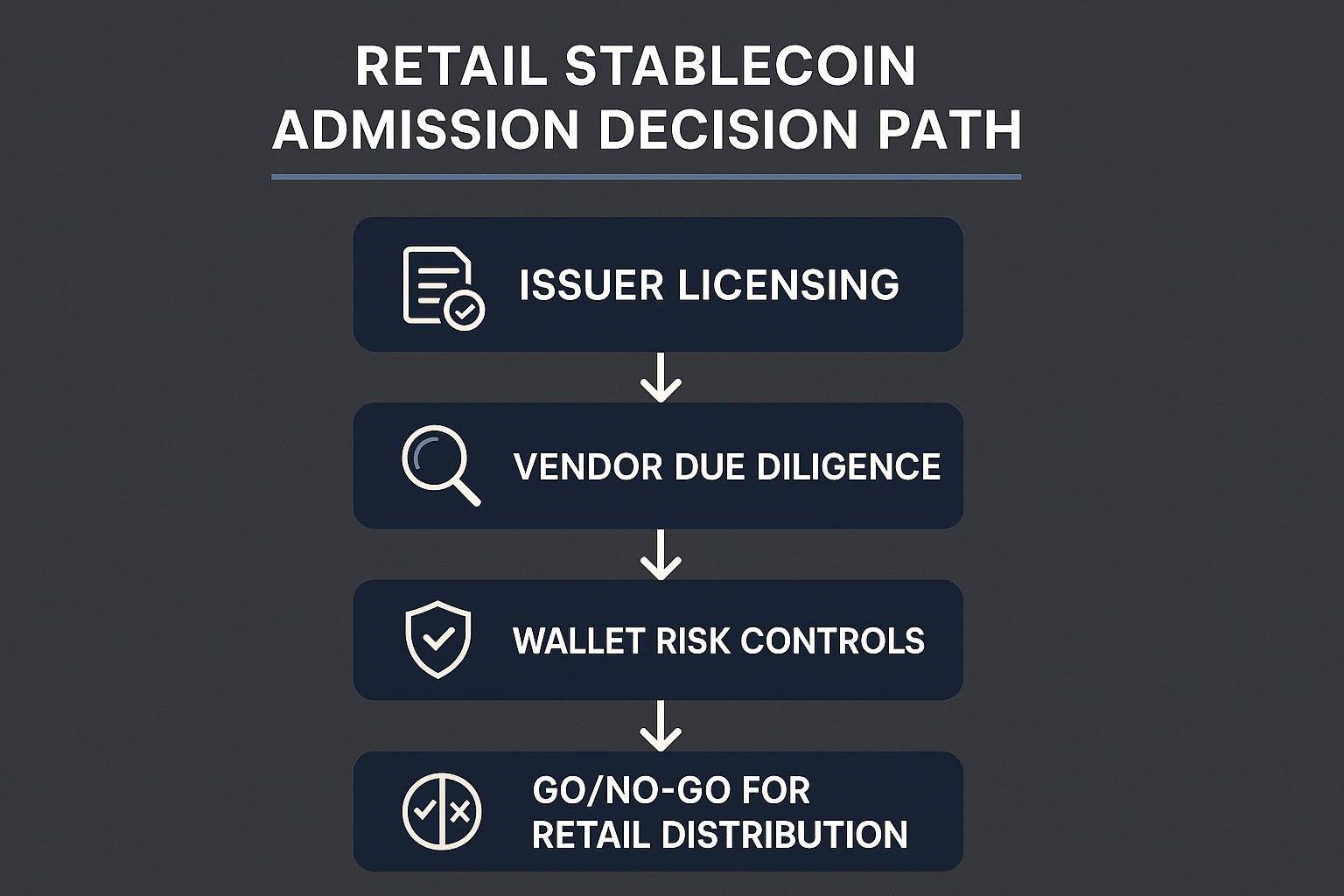
Custodial wallet due diligence and unhosted wallet controls Consultation conclusions emphasise two specific duties: (i) due diligence on the institution providing the custodial wallet; and (ii) additional controls for unhosted wallets. Translate that into tangible checks:
For custodial wallets (your own, or a partner FI/VASP):
- Legal and structure: client asset trust/segregation, insolvency remoteness, governing law, location of custodians.
- Operational resilience: hot/cold key management, HSM standards, dual control, disaster recovery, incident reporting timelines.
- Assurance: SOC 2 Type II/ISO 27001, chain‑of‑control over keys, independent reconciliations, monthly reserve/position attestations.
- AML/CFT: Travel Rule compliance, sanctions/originator checks, typology coverage for stablecoins (pegging, redemption arbitrage, on/off‑ramp mixing).
- Redemption handling: operational runbooks for T+0/T+1 redemption, liquidity buffers, and counterparty settlement risk.
For unhosted wallets:
- Proof‑of‑control: signed message or micro‑transaction verification before first transfer.
- Risk‑based thresholds: enhanced due diligence and manual review for high‑value, high‑velocity, or cross‑jurisdiction flows.
- Counterparty screening: blockchain analytics for exposure to mixers, sanctioned services, darknet markets; adaptive risk scoring by coin and chain.
- Ongoing monitoring: heuristics for smart‑contract interactions, bridges, and MEV patterns; targeted cooling‑off periods for abnormal flows.
Onboarding risk matrix you can deploy tomorrow
| Risk factor | Low risk | Medium risk | High risk | Mitigants (illustrative) |
|---|---|---|---|---|
| Customer type | Licensed FI | Licensed VASP | Unregulated entity | Licence verification, regulatory status checks |
| Jurisdiction | HK/CFT‑compliant | Partially compliant | High‑risk/FIU alerts | EDD, senior sign‑off, limited functionality |
| Wallet type | Custodial (your FI) | Third‑party custodial | Unhosted | Custodian DD; proof‑of‑control; transaction limits |
| Transaction profile | < HKD 50k/month | HKD 50k–1m | > HKD 1m or spikes | Tiered KYC; source of funds/use; analytics flags |
| Token eligibility | Licensed issuer | In review | Unlicensed/unknown | Admission committee, block until licensed |
ESG‑compliant token structures: what “good” looks like Tokenisation and stablecoin projects can integrate sustainability without green‑washing:
- Governance and disclosure: publish reserve composition, custody locations, and redemption SLAs; include climate risk disclosures relevant to reserve assets and operations.
- Chain energy profile: disclose network energy intensity; where feasible, prefer energy‑efficient chains or purchase renewable energy for node operations.
- Emissions accounting: report Scope 2 for custody infrastructure and validator/node operations; provide third‑party assurance annually.
- Responsible reserves: adopt issuer‑level exclusions (e.g., no reserve placements with entities on deforestation or severe human rights screens); disclose treasury counterparties.
- Impact‑linked features (for tokenised assets): align with recognised taxonomies where applicable and provide use‑of‑proceeds and post‑issuance reporting.
What to do now
- Map your role: issuer, distributor, or infrastructure. Your obligations differ.
- Build the wallet control stack: custodian due diligence pack, unhosted wallet SOPs, blockchain analytics, and Travel Rule integration tested end‑to‑end.
- Draft admission criteria: define what makes a stablecoin “retail‑eligible” on your platform pending formal notices.
- Prepare ESG disclosures: publish a concise sustainability note with your system description and assurance roadmap.
The policy direction is pro‑innovation, but with teeth. If you get wallets, redemption, and disclosures right, retail stablecoins can be a feature — not a finding.
References:
- Hong Kong Government Policy Statement 2.0 on the Development of Digital Assets (stablecoin issuer regime from 1 Aug 2025)
- Consultation conclusions on AML/stablecoin wallet risk management and unhosted wallet controls


