HK Compliance: Remote Onboarding, Tokenised Funds & KYT
StanCompliance
October 26, 2025
Hong Kong digital assets compliance
FATF June 2025
HKMA stablecoin AML
Know Your Transaction (KYT)
Non-face-to-face onboarding
Tokenisation of funds
Transaction monitoring and sanctions screening

HK compliance is moving fast on three fronts that matter to every digital asset business: non-face-to-face onboarding, tokenised funds, and Know Your Transaction (KYT). If you run a VASP, fund manager, or payment firm in Hong Kong, here’s how the rules are shifting—and what to build now.
Remote onboarding: acceptable, but only if you can prove control
- What’s changed: Hong Kong supervisors are comfortable with non-face-to-face onboarding, provided you compensate for impersonation, device spoofing, and mule risks. The latest Financial Action Task Force (FATF) June 2025 emphasis on “technology for fraud and error protection” pushes firms to validate recipient details before funds move—think name/number matching for fiat and address validation for crypto. See FATF guidance at fatf-gafi.org.
- Practical build: combine liveness + NFC HKID reads, device intelligence, and triangulation (SMS/utility bill/bank micro-deposit). For corporate onboarding, add registry pulls and beneficial owner verification.
- What to evidence: false-positive rate from sanctions/PEP screening (target: 3–5%, illustrative), step-up triggers for high-risk profiles (e.g., PEPs, cross-border VA users), and review of out-of-pattern device fingerprints.
Tokenised funds: operational readiness beats slideware
- Policy direction: Policy Statement 2.0 signals continued support for tokenisation—initially bonds, with lessons applied to other RWAs and fund units. Authorities are exploring integration with digital money to cut settlement friction and broaden market access. See FSTB/HKMA policy materials at fstb.gov.hk and hkma.gov.hk.
- What this means: If you plan a tokenised share class, your transfer agency, fund accounting, and registrar functions must work with DLT. NAV, corporate actions, and investor register updates need deterministic, audit-ready workflows.
- Controls to add: private key governance for any on-chain interaction, reconciliations between the token ledger and the fund register, and disclosures on smart contract risks. Keep investor communications plain-English: what is on-chain vs off-chain, settlement timelines, and what happens on forks or chain halts.
KYT for stablecoins and beyond: don’t treat it as just “TM”
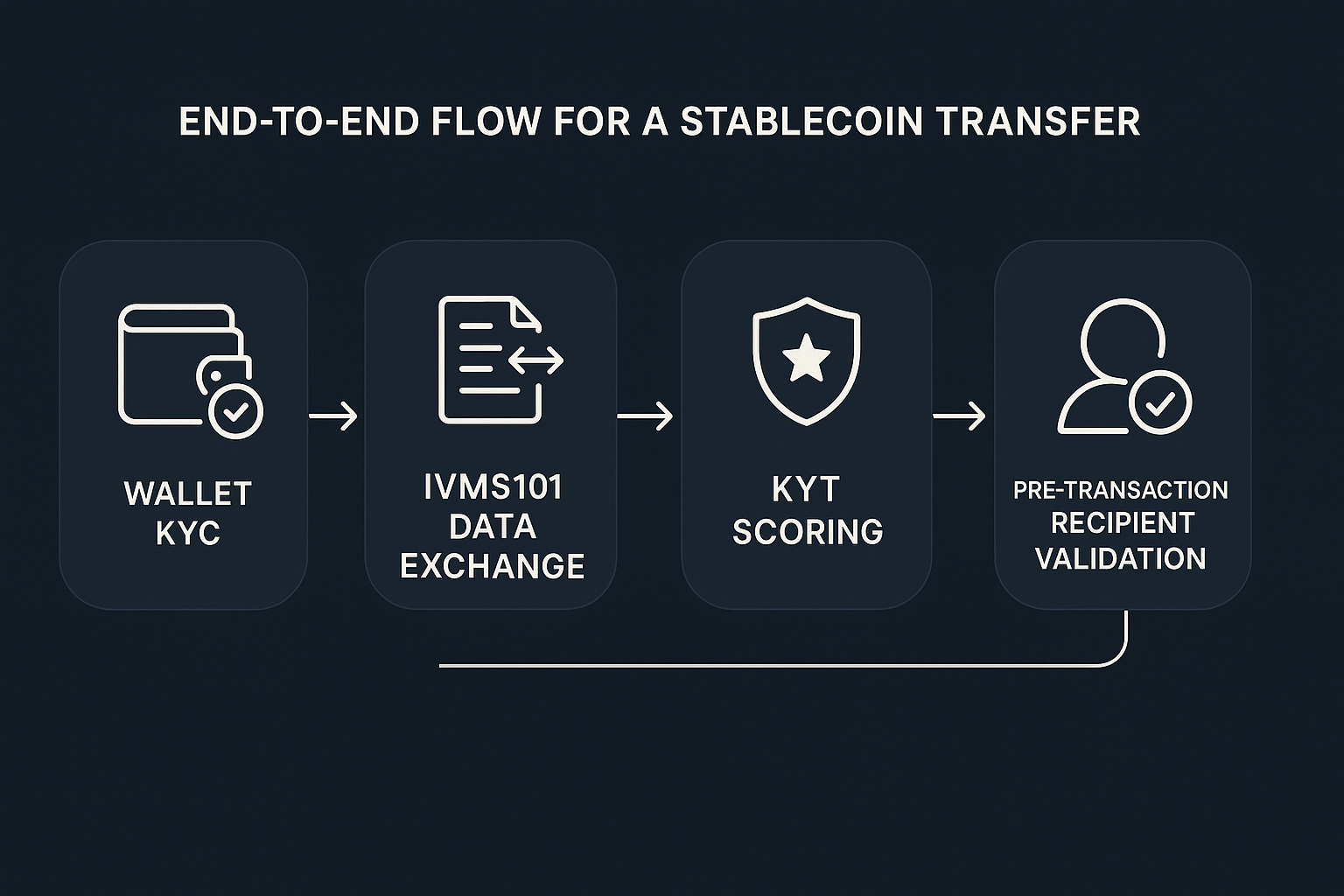
- Regulatory signal: Consultation conclusions on stablecoin AML expect institutions participating in a stablecoin transfer to access essential information for transaction monitoring, sanctions screening, and risk mitigation. Some FATF members start conservatively—KYC on every stablecoin holder—so expect stringent counterpart verification when the HK regime lands.
- Implementation shape: build data ingestion from blockchain analytics plus the message layer (e.g., IVMS101 fields where available): originator/beneficiary names, wallet addresses, VASP identifiers, stablecoin issuer, chain, and contract. Screen all of it—names, addresses, issuers—against UN/HKSAR sanctions and internal watchlists.
- Add FATF June 2025 controls: recipient verification before release. For fiat legs, run beneficiary name/account checks; for VA legs, verify whitelisted addresses with proof-of-ownership challenges for large-value transfers.
90‑day playbook
Sanctions and screening hygiene
- Always screen the originator, beneficiary, wallet, issuer, and smart contract. Not just the name.
- Maintain an allowlist for repeatedly used corporate wallets and re-verify quarterly.
- Tune scenarios to stablecoin specifics: rapid in/out patterns, mules bridging CEX-to-CEX, and sanctioned exchange exposure.
Where to read more
- FATF Recommendations and updates: https://www.fatf-gafi.org
- HKMA AML/CFT resources: https://www.hkma.gov.hk/eng/key-functions/banking/anti-money-laundering-and-counter-financing-of-terrorism/
- SFC circulars and AML guidelines: https://www.sfc.hk
Bottom line
- Remote onboarding is fine—as long as you can show controls that actually reduce impersonation and mule risk.
- Tokenised funds will get momentum, but only managers who’ve solved register, key, and reconciliation controls will pass due diligence.
- KYT is no longer “post-trade monitoring.” With stablecoins, it moves pre-transaction. Build for that now.