
HK Compliance Playbook: SOW & CBDC in Remote Onboarding

HK Compliance Playbook: SOW & CBDC in Remote Onboarding
If you onboard customers remotely in Hong Kong—bank, EMI, brokerage, or VASP—you now sit at the intersection of three moving parts: proving source of wealth (SOW), accepting central bank digital currency (CBDC) payments, and controlling wallet risk (especially stablecoins and unhosted wallets). The regulators are explicit: stablecoins carry ML/TF and sanctions vulnerabilities (see BIS’ emphasis and FATF’s concerns on unhosted wallets’ anonymity and mobility), and institutions must have the information needed for transaction monitoring and sanctions screening during transfers. That changes how you design non-face-to-face (NFF) onboarding.
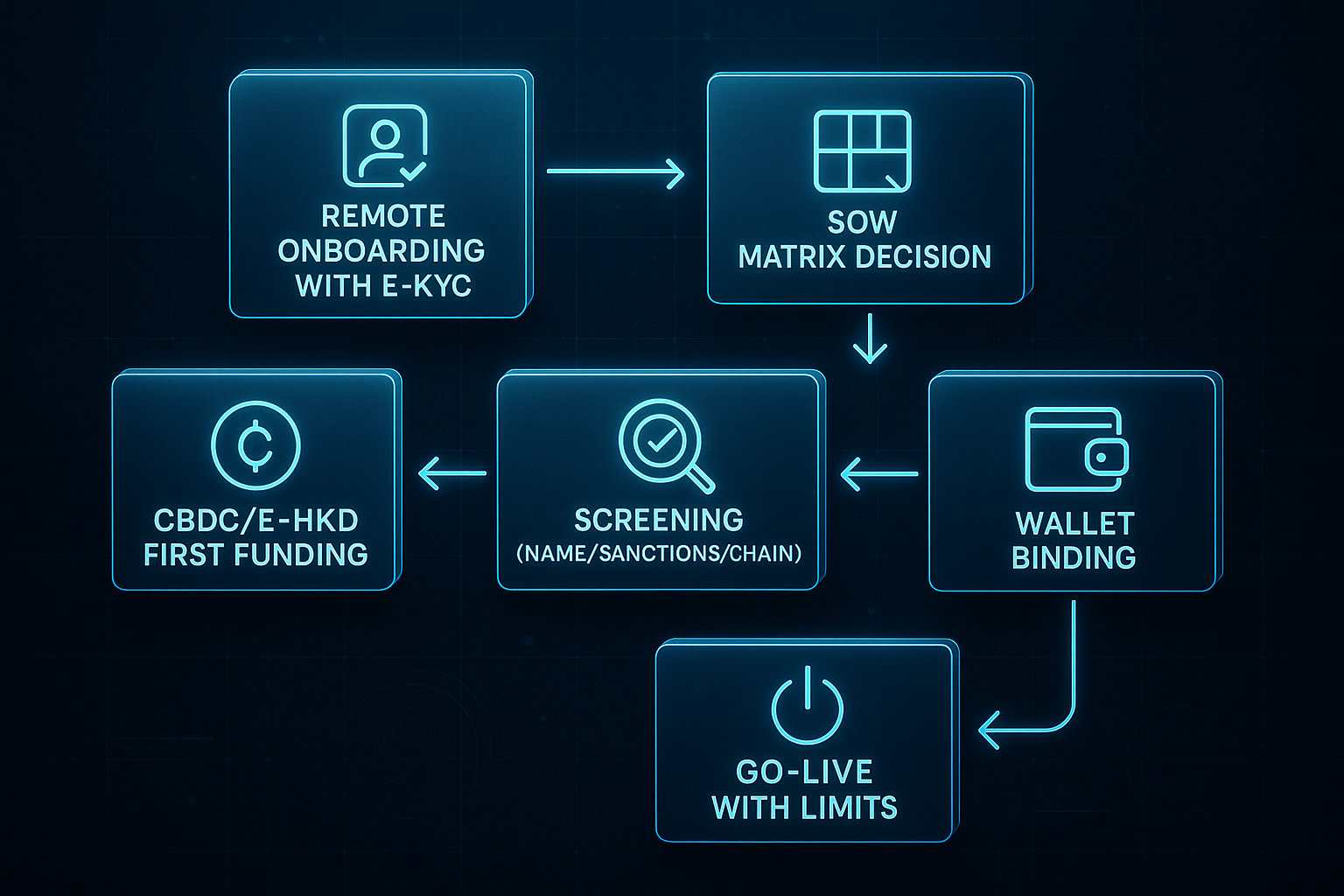
What this means in practice: build an onboarding flow that can justify the money, bind the wallet, and screen the transfer—without losing the customer in minute three.
Why this matters now
- Stablecoin and unhosted wallet risk: Authorities expect additional controls where customers use self-hosted wallets, versus where FIs/VASPs provide custodial wallets.
- Custody risk is in focus: Hong Kong’s consultation on virtual asset custodians highlights fraud and cyberattack risks—expect strong governance, segregation, and incident playbooks.
- Digital asset policy tailwinds: Policy Statement 2.0 backs tokenisation pilots (including funding via Cyberport), but it comes with scrutiny on AML/CFT guardrails.
- CBDC is live for experimentation: HKMA’s e-HKD pilots and technical work give FIs tools to tie funding events to identity, limits, and auditable metadata.
The playbook: Non-face-to-face onboarding with SOW and CBDC
- Prove the person remotely (and don’t stop there)
- Identity: Capture HKID with NFC where available, selfie liveness/3D face, and device intelligence. Where appropriate, bind iAM Smart.
- Address: Two-channel verification (document + micro-deposit reference or postal code match).
- Fraud controls: SIM/device age checks, known mule vectors, and IP/velocity rules. Record explainability for audit.
- Tier SOW evidence to the risk Use a SOW matrix that escalates based on product risk, funding source, and wallet type.
| Customer profile (illustrative) | Initial funding | Wallet type | Minimum SOW evidence | When to escalate |
|---|---|---|---|---|
| Retail, salaried | ≤ HKD 80,000 | Custodial at FI/VASP | 3 months payslips + bank statements; MPF summary | If total inflows > HKD 500k/90 days |
| Professional, mixed income | ≤ HKD 500,000 | Custodial | Tax demand notes + audited accounts/CPA letter; proof of dividends | If income-docs mismatch >20% vs declared |
| Crypto-native | Any | Unhosted | On-chain provenance report + exchange withdrawal history + tax filings | If mixing/tumblers, sanctioned nexus, or privacy coin hops |
| HNW | > HKD 1,000,000 | Any | AUM/brokerage statements; sale and purchase agreements; inheritance/will | Always enhanced due diligence |
Note: thresholds are illustrative to show tiering logic. Calibrate to your risk appetite and HKMA/SFC AML guidelines.
- Bind CBDC and make it work for AML
- CBDC as first funding: Accept e-HKD for initial top-up with payer verification, wallet binding to the customer profile, and purpose code in the payment reference. See HKMA’s e-HKD work for implementation context.
- Programmable controls: Apply per-transaction and daily velocity limits for first 30 days (e.g., HKD 50k/day; illustrative), with alerts when combined inflows exceed SOW-consistent ranges.
- Screening: Name screening on account owners, sanctions screening on payment metadata, and monitoring for structuring.
- Handle stablecoins and unhosted wallets with guardrails
- Custodial wallets: Strong KYC, segregation of client assets, and transaction monitoring by the FI/VASP. Share required transfer information (e.g., IVMS101 fields) so counterparties can perform sanctions screening and monitoring.
- Unhosted wallets: Apply additional controls—risk scoring on addresses, sanctions and exposure screening, proof-of-proceeds checks (exchange withdrawal trails), and on-chain analytics for clustering and mixer exposure. Consider allowlists and cooling-off periods.
- Sanctions screening: Screen names, wallet addresses, and on-chain indicators before crediting. Log rationales for overrides.
- Operationalise the “travel rule” data
- Ensure you can send/receive originator/beneficiary information for virtual asset transfers with enough fields for counterparties to monitor and screen. This is core to how regulators want institutions to mitigate risk during transfers.
What good looks like (and what fails)
- Wins we’ve seen (illustrative): 35% faster onboarding time after moving to tiered SOW, 48% fewer remediation tickets by binding first funding via CBDC with pre-set limits, and 0 unresolved travel-rule exceptions at go-live.
- Where firms stumble: accepting unhosted inflows without provenance, treating CBDC like anonymous cash, and keeping SOW documents in unsearchable PDFs that audit can’t trace.
Useful references
- HKMA AML/CFT resources (expectations on remote onboarding)
- SFC AML/CFT standards for licensed corporations and VA platforms
- FATF guidance on virtual assets and VASPs (incl. unhosted wallet risks)
- BIS commentary on stablecoin vulnerabilities
- HKMA e-HKD programme
Bottom line Remote onboarding in 2025 Hong Kong isn’t just eKYC. It’s SOW that stands up in an audit, CBDC funding that’s identity-bound and screened, and wallet controls that treat unhosted risk as different from custodial. Do those three well, and the rest of your AML stack finally clicks.


