
HK Compliance Guide: Wholesale Stablecoin Custody & Trust

HK Compliance Guide: Wholesale Stablecoin Custody & Trust
If you’re building a wholesale stablecoin in Hong Kong—think bank-to-broker settlement or treasury cash management—the fastest way to de‑risk your launch is to get custody and trust structure right on day one. The regulator cares about safekeeping, segregation, and AML/CFT. Your institutional users do too.
What the rules say (2025 snapshot)
- HKMA licensing: Stablecoin issuers licensed by the HKMA that also custody the coins they issue will be under ongoing HKMA supervision, with investor protection via safekeeping, segregation of client assets, audits, record‑keeping and full AML/CFT requirements. See HKMA’s AML/CFT resources and stablecoin materials for context: https://www.hkma.gov.hk/eng/key-functions/anti-money-laundering-and-counter-financing-of-terrorism/
- Custodial wallet obligations: The consultation conclusions clarify that financial institutions or VASPs providing the custodial wallet for stablecoin holders must perform due diligence and implement controls for issuance and redemption flows, including additional measures to mitigate risks of unhosted wallets.
- Role separation: The AML/CFT Guideline now notes that licensees may or may not provide custodial services to holders of their stablecoins. Practically, this means you can keep issuance and custody separate—often cleaner for risk and governance.
Why trust arrangements matter for wholesale
Segregation on paper is not enough. You want insolvency‑remote client asset protection that can survive a bad day. Hong Kong’s VASP regime for trading platforms already demonstrates a workable pattern: client virtual assets held on trust, daily reconciliations, cold‑storage standards, and audits under the SFC’s Guidelines for Virtual Asset Trading Platform Operators (https://www.sfc.hk/en/Rules-and-standards/Guidelines/Guidelines-for-Virtual-Asset-Trading-Platform-Operators). While the HKMA stablecoin regime is distinct, the same safeguards are persuasive for banks and institutional clients.
A practical custody–trust blueprint
- Trust structure
- Declare a trust over client stablecoins and private keys with a Hong Kong trustee (often an associated entity) to achieve segregation and insolvency remoteness.
- Trust deed must cover beneficial ownership, rehypothecation ban, priority of client claims, dispute resolution, and wind‑down playbooks.
- Appoint an independent trust administrator for reconciliations and client statements.
- Custody controls (institutional‑grade)
- Key management: MPC or HSM‑backed keys, dual control, tamper‑evident key ceremonies, hardware access logs, and geo‑distributed shards.
- Segregation: omnibus client wallets backed by on‑chain sub‑accounting or per‑client segregated addresses; either way, daily on‑chain and off‑chain reconciliation.
- Cold/warm/hot tiers: ≥98% cold storage for non‑operational balances, with documented transfer windows and break‑glass procedures.
- Audit and assurance: SOC 2 Type II (illustrative within 9–12 months), annual penetration tests, chain‑proofs of reserve/liability reconciliations, and external financial audits.
- Insurance: Crime and specie coverage with explicit VA endorsements; set sub‑limits by tier.
- Record‑keeping: Retain wallet attribution, transfers, approvals, and key ceremonies for at least 7 years (consistent with AMLO expectations).
- Governance
- Risk committee with independent member(s), key person risk registers, and named MLRO/AML function.
- Vendor management for analytics, key custody, and disaster recovery with RTO/RPO targets (e.g., RTO 4 hours, RPO 15 minutes for warm systems; illustrative).
Controls for unhosted wallets and redemption
- Due diligence on custodial wallet providers: Where a bank or VASP holds client wallets for your users, perform onboarding due diligence and ongoing monitoring. Obtain their AML/CFT policy mappings and testing results.
- Unhosted wallet risk mitigation:
- Address proofing and ownership attestation for first‑time withdrawals (e.g., micro‑transfer challenge, signed message).
- On‑chain analytics risk scoring and sanctions screening pre‑transfer; block high‑risk typologies.
- Allow‑listing plus velocity and value limits; EDD for high‑risk jurisdictions or mixers.
- Travel Rule compliance via interoperable protocols; reject incomplete originator/beneficiary data.
- Redemption flows: Apply the same controls on inflows/outflows; escalate when redeemer uses an unhosted wallet with high risk signals.
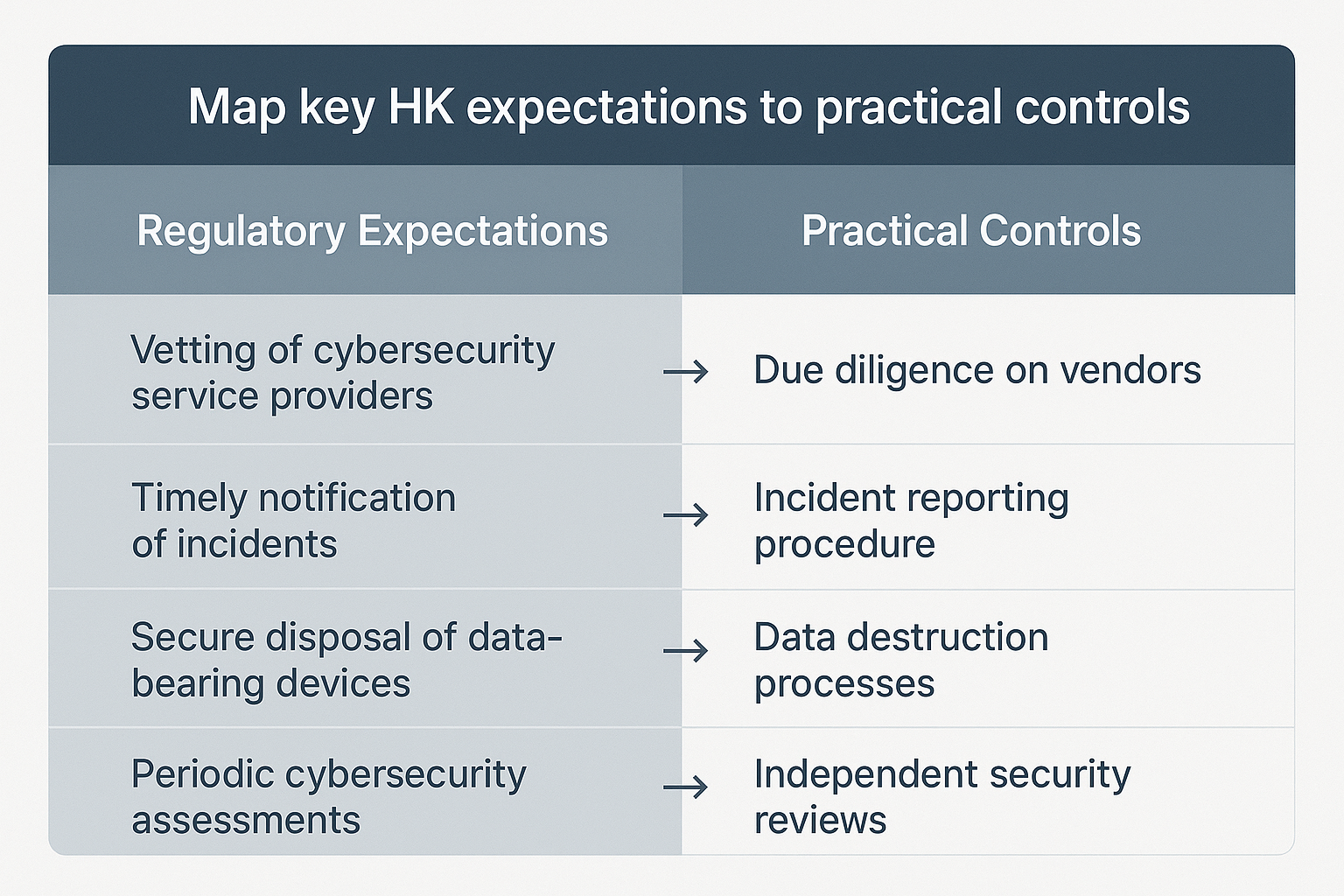
| Regulatory expectation (as per consultations) | What to implement now |
|---|---|
| Safekeeping + segregation of client assets | HK trust over client stablecoins/keys; per‑client sub‑ledger; daily reconciliations; audit trails |
| Adequate audit and record‑keeping | SOC 2 Type II roadmap, annual financial audit, key ceremony logs, 7‑year retention |
| AML/CFT for issuance/redemption | KYC, sanctions screening, wallet analytics, Travel Rule, continuous transaction monitoring |
| Controls for unhosted wallets | Address verification, allow‑listing, velocity limits, EDD triggers, documented refusal criteria |
| Licensee may or may not custody | Separate issuer and custodian entities; inter‑company SLAs; conflict‑of‑interest policy |
90‑day action plan
- Weeks 1–3: Regulatory gap assessment against HKMA consultations and SFC VASP custody standards; draft trust deed and wind‑down plan.
- Weeks 4–6: Select trustee/associated entity, finalize wallet architecture (MPC/HSM), define cold/warm/hot tiers and approvals.
- Weeks 7–9: Implement unhosted wallet controls, Travel Rule integration, and analytics; run tabletop incident and redemption drills.
- Weeks 10–12: Independent audit kickoff, insurance binding, and formal client disclosures on segregation and redemption rights.
One last point.
Even for “wholesale only,” assume supervisors and counterparties will test you like a retail platform. Build to that bar and your launch conversations get much easier.


