
HK Compliance Guide: Wholesale & Fiat Stablecoins, CRS
StanCompliance
January 22, 2026
Hong Kong stablecoin regulation
wholesale stablecoins
fiat-backed stablecoins
Common Reporting Standard
SEC cash equivalent guidance
custodial wallet AML
VASP compliance

If you’re building or using stablecoins in Hong Kong, three questions keep coming up: what counts as “wholesale,” can fiat-backed stablecoins be treated like cash, and how does CRS reporting bite? Here’s the short, practical read.
Where Hong Kong policy sits now
- The Government explicitly “welcomes proposals” to test licensed stablecoins for real payments, including enhancing Government payments, per the latest policy statement on digital assets. See the Government’s Policy Statement (often referred to as 2.0) for the signal and the tone.
- Expect a licensing regime for fiat-referenced stablecoin issuers and tighter oversight of custodial wallets, including extra controls for unhosted wallets (FIs and VASPs named as in-scope wallet providers in consultation conclusions).
- Retail trading of stablecoins on SFC-licensed exchanges remains restricted pending the issuer regime; institutional/wholesale pilots are the immediate path.
Wholesale vs fiat-backed (retail) stablecoins in HK
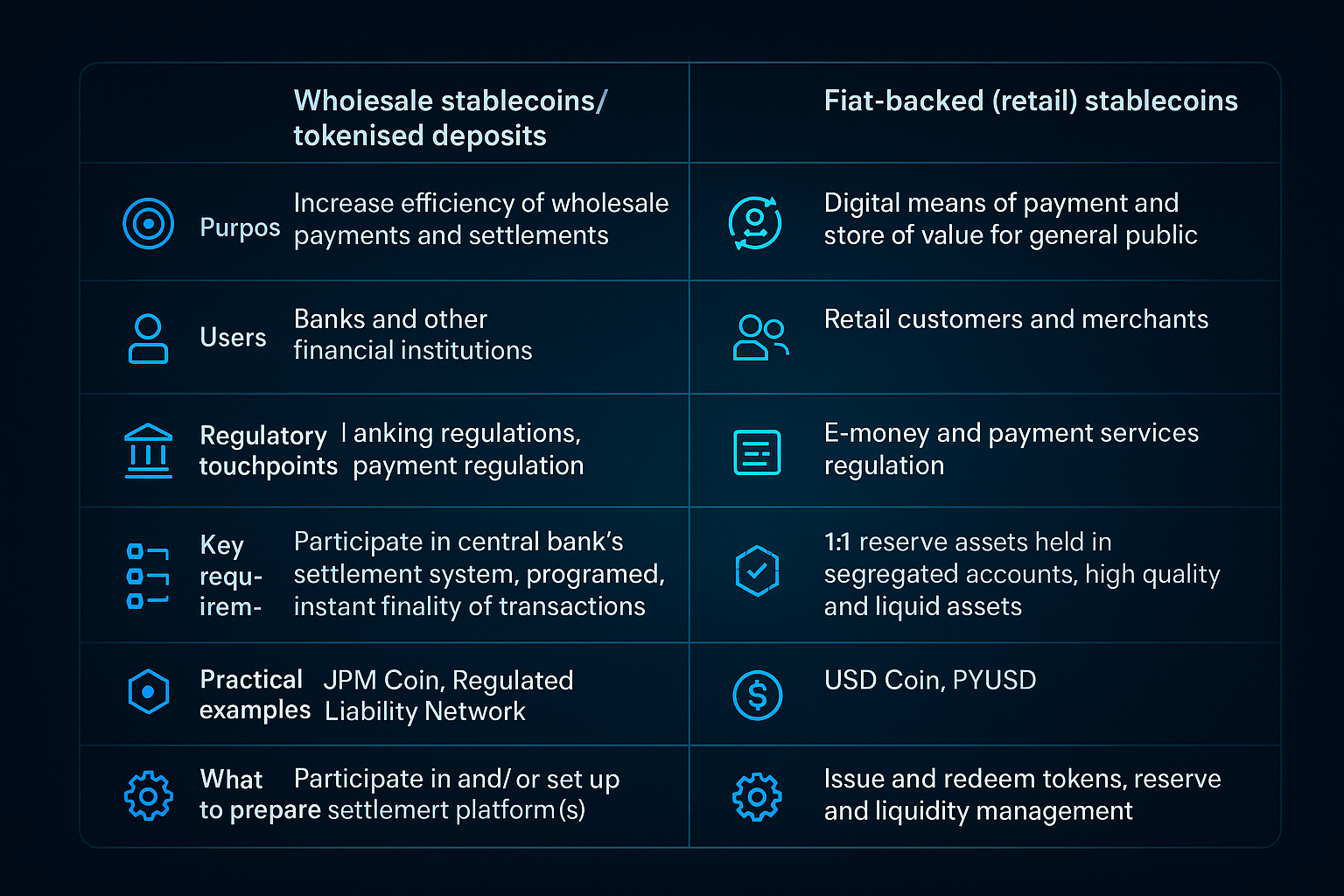
- Purpose
- Wholesale: Interbank/enterprise settlement, on-chain cash leg for tokenised assets, programmable payments.
- Fiat-backed (retail): Consumer and merchant payments, on/off-ramp into crypto, treasury holdings.
- Users
- Wholesale: Banks, licensed corporations, large corporates, public sector.
- Retail: Exchanges, fintechs, end-users.
- Regulatory touchpoints
- Wholesale: HKMA oversight if issued by banks/tokenised deposits; sandbox pilots; potential linkage with mBridge and tokenised market infrastructure.
- Retail: Forthcoming stablecoin issuer licence; SFC VASP rules for platforms; AMLO/AML controls on custodial wallets and unhosted wallet risk mitigation.
- Key requirements
- Wholesale: Permissioned networks, settlement finality, intraday liquidity controls, interoperable RTGS links.
- Retail: Full reserve in high‑quality liquid assets, segregation, daily reconciliation, robust redemption-at-par, governance and disclosures.
- Practical examples
- Wholesale: Bank-issued tokenised deposits for DvP settlement; supplier payments in a permissioned network.
- Retail: HKD/USD-pegged coins used by merchants once issuer regime goes live.
- What to prepare
- Wholesale: Legal opinions on settlement finality; node/operator onboarding; treasury policies for on-chain liquidity.
- Retail: Reserve policy and attestation playbook; wallet AML/KYC and Travel Rule; listing criteria with SFC-licensed venues (once permitted).
Accounting: can fiat stablecoins be cash equivalents?
- The U.S. SEC’s staff guidance (reported by Bloomberg/The Block) suggests USD-pegged stablecoins may be classified as cash equivalents if there is a guaranteed redemption mechanism and demonstrated value stability.
- Hong Kong reporters under HKFRS/IFRS don’t get a blanket pass. IAS 7 still applies case-by-case. A workable test we see auditors use:
- Is redemption legally enforceable at par (T+0/T+1) with minimal haircut?
- Are reserves bankruptcy-remote and in cash/cash-like instruments (e.g., bank deposits, T‑bills, MMFs)?
- Is counterparty risk (issuer/custodian) immaterial or mitigated?
- If you hold stablecoins materially (say >5% of cash, illustrative), pre-clear with your auditor, disclose redemption mechanics, custodians, concentration, and any gates.
CRS today, CARF tomorrow
- CRS in Hong Kong (AEOI via the IRD) covers “financial accounts” maintained by Reporting Financial Institutions. Tokens themselves aren’t financial accounts under CRS. However:
- If you’re a custodial wallet provider that also holds financial assets (e.g., client fiat, MMFs, securities) you may be a Custodial Institution and have CRS obligations on those accounts.
- Stablecoin issuers holding reserve assets report their own income, but customers holding the tokens are not “account holders” of the reserve portfolio for CRS.
- The OECD’s Crypto-Asset Reporting Framework (CARF) is coming. Hong Kong is expected to implement alongside the latest CRS updates (timelines globally cluster around 2026–2027). Build now:
- Classify entities (issuer, wallet provider, exchange) and map to CRS/CARF roles.
- Collect tax residency and TINs during onboarding for custodial customers.
- Implement Travel Rule and unhosted wallet risk controls to align AML data with tax reporting datasets.
- Keep transfer logs with beneficiary/originator fields that can support CARF reporting.
AML for custodial wallets (what regulators will check)
- KYC aligned to AMLO and SFC’s VASP Guidelines.
- Travel Rule data exchange with covered counterparties; enhanced scrutiny for unhosted wallets (verification of beneficiary ownership, small-value limits, sanctions/PEP screening, rationale for transfers).
- Ongoing monitoring tied to stablecoin-specific red flags (pegging stress, rapid mint/redeem patterns, cross-jurisdictional hops).
What to do this quarter
- Decide your lane: wholesale pilot vs retail issuance vs custodial services.
- For issuers: draft a reserve and redemption policy; line up banks/custodians; design daily attestation.
- For treasurers: pre-clear accounting classification; set limits and counterparties; test redemption flows.
- For VASPs/custodians: uplift Travel Rule, unhosted wallet controls, and data models for CRS/CARF.
- Engage early with HKMA/SFC sandboxes; reference the Government’s openness to testing licensed stablecoins for payments.
A final note: policy is pro-utility but strict on basics—reserves, redemption, AML. If you can evidence those three, Hong Kong will meet you halfway.
References
- HKSAR Policy Statement on the Development of Virtual/Digital Assets: https://www.info.gov.hk/gia/general/202210/31/P2022103000360.htm
- SEC staff guidance coverage on stablecoins and cash equivalents (Bloomberg via The Block): https://www.theblock.co/post/306891/sec-updates-accounting-guidance-stablecoins
- IRD CRS (AEOI) in Hong Kong: https://www.ird.gov.hk/eng/tax/dta_aeoi.htm
- OECD Crypto-Asset Reporting Framework (CARF): https://www.oecd.org/tax/exchange-of-tax-information/crypto-asset-reporting-framework-and-amendments-to-the-common-reporting-standard.htm
- SFC VASP AML Guideline (Travel Rule): https://www.sfc.hk/en/Rules-and-standards/Anti-Money-Laundering-and-Counter-Financing-of-Terrorism/Guidelines-for-Virtual-Asset-Service-Providers


