
HK Compliance Guide: RWA Tokenisation & eKYC Onboarding

HK Compliance Guide: RWA Tokenisation & eKYC Onboarding
If you’re building a tokenised real‑world asset (RWA) platform in Hong Kong, two questions decide your launch timeline: how your tokens are classified and how you onboard customers without face‑to‑face contact. The rest—custody, analytics, and stablecoin rails—flows from those choices.
Hong Kong’s direction is clear. The Government’s updated digital asset policy work emphasises tokenisation frameworks and the use of surveillance and AI‑driven financial tools, with academia–industry collaboration to build talent pipelines. See the policy statements and updates here: Policy Statement on the Development of Virtual Assets in Hong Kong and HKMA’s virtual assets hub.
What your RWA likely is under Hong Kong law
- Most RWAs that represent ownership, claims, or income rights will be treated as “securities” under the SFO. If you distribute to Hong Kong investors, expect SFC Type 1 (dealing) and, if you manage portfolios, Type 9 (asset management). See the SFC’s circular on tokenised securities.
- Custody is tightening. The Government’s consultation on virtual asset custodians proposes that licensees adopt appropriate technological solutions—specifically blockchain analytics—to track assets, associated wallet addresses, and flag suspicious activity. Expect similar expectations of distributors using third‑party custodians.
- If your tokens reference fiat reserves or operate like a stablecoin, follow the HKMA/FSTB stablecoin materials. Travel Rule‑level data exchange matters because “it provides institutions participating in a stablecoin transfer with essential information for transaction monitoring, sanctions screening and risk mitigation.” At the same time, the consultation acknowledges limits in “monitoring every single peer‑to‑peer transaction involving unhosted wallets.”
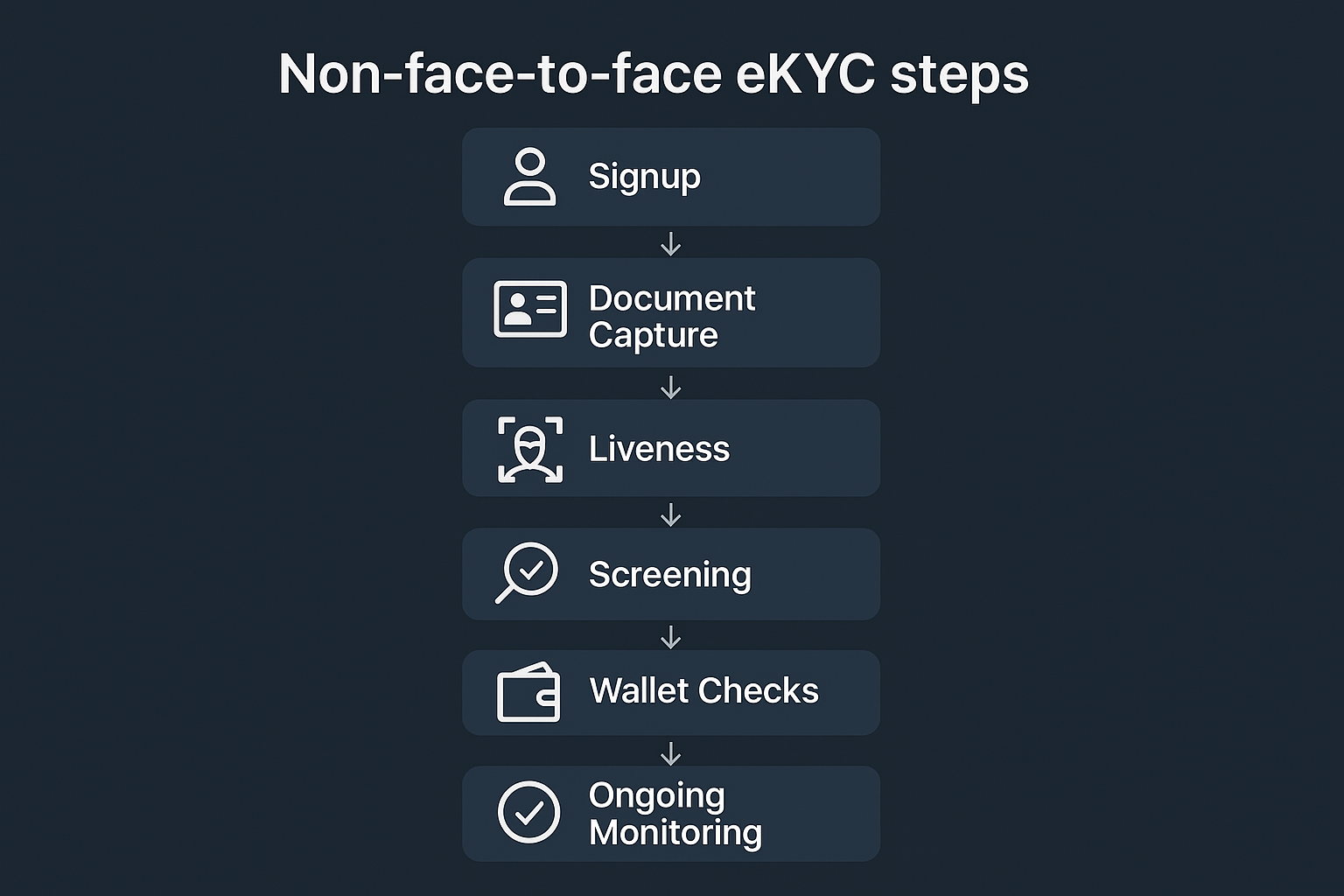
Non‑face‑to‑face onboarding (eKYC) that passes an SFC/HKMA file review Remote onboarding is fine in Hong Kong if you meet AML/CFT standards. Build your flow around the HKMA AML Guideline, remote onboarding circulars, and the SFC’s VASP AML Guideline.
Recommended production flow:
- Capture and verify identity
- Machine‑read ICAO NFC chip in ePassports where possible; fall back to high‑resolution OCR plus integrity checks for HKID/passports.
- Active liveness and face matching with pass thresholds tuned to reduce false accepts; document the operating point selection (illustrative: FAR 0.1%, FRR 2.0%).
- Address verification via e‑statements or utility bills; if unavailable, use micro‑deposits or postal code verification.
- Screen and risk‑rate
- Real‑time sanctions/PEP/adverse media screening with fuzzy matching; secondary review for close hits.
- Source‑of‑funds/source‑of‑wealth for higher‑risk profiles (e.g., large ticket RWAs, offshore entities).
- Wallet policy and Travel Rule
- Discourage unhosted wallet deposits for retail. If you permit them, apply “additional controls to mitigate the risks of unhosted wallets” (e.g., proof‑of‑ownership signing, enhanced due diligence for first‑time addresses).
- Implement a Travel Rule solution for VA transfers between regulated intermediaries to exchange originator/beneficiary info.
- Ongoing monitoring
- On‑chain analytics to risk‑score inbound/outbound flows; layer alerts with off‑chain behaviour. Record your typologies (mixing, sanctioned nexus, ransomware tags).
Stablecoin rails for settlement
- Use regulated intermediaries where possible. The data exchange supports sanctions screening and anomaly detection; it also makes audits simpler.
- Acknowledge the gap: you cannot surveil every P2P transaction that never touches a VASP. Compensate with heuristics—deposit address allow‑lists, velocity limits, and trigger‑based enhanced reviews.
Operating model in one page
90‑day implementation checklist
- Select two vendors each for: NFC/KYC SDK, sanctions/PEP, blockchain analytics, and Travel Rule. Run a 2‑week bake‑off with precision/recall metrics (illustrative target: sanctions precision >95%).
- Write a wallet acceptance standard: hosted first; unhosted only with proof‑of‑ownership and enhanced due diligence.
- Build rulebooks: RWA valuation updates, corporate actions on‑chain, redemption SLAs, and incident response for key loss or chain forks.
- Document your residual risk statement acknowledging unhosted wallet limitations and corresponding mitigants.
This isn’t red tape for its own sake. It’s how you keep your permissions, your banking, and your reputation. If you get these four planks right—classification, custody, eKYC, and monitoring—you’ll ship in Hong Kong with fewer surprises and a cleaner audit trail.
References:
- Policy Statement on the Development of Virtual Assets in Hong Kong: https://www.info.gov.hk/gia/general/202210/31/P2022103100307.htm
- HKMA virtual assets and stablecoins resources: https://www.hkma.gov.hk/eng/key-functions/international-financial-centre/fintech/virtual-assets-and-stablecoins/
- SFC circular on tokenised securities: https://www.sfc.hk/en/News-and-announcements/Policy-statements-and-announcements/Circular-on-Tokenised-Securities-Related-Activities
- SFC AML/CFT standards (including for VASPs): https://www.sfc.hk/en/Rules-and-standards/Anti-Money-Laundering-and-Counter-Terrorist-Financing
- HKMA remote on-boarding circular: https://www.hkma.gov.hk/eng/news-and-media/press-releases/2020/12/20201204-4/


