
HK Compliance Guide: RWA Tokenisation and CRS/CARF

RWA tokenisation meets CRS/CARF: what Hong Kong issuers need to do in 2025
If you’re planning to tokenise bonds, real estate interests, or commodities in Hong Kong, you now have two tax-transparency regimes to think about: the OECD Common Reporting Standard (CRS) and the newer Crypto-Asset Reporting Framework (CARF). Hong Kong’s Policy Statement 2.0 explicitly links its digital asset agenda with international tax transparency, and signals support for tokenised bonds and broader RWA tokenisation across sectors like precious metals. See the Government’s direction in Policy Statement 2.0 and framework review notes on tokenised bonds and RWA expansion (Government aims to set a benchmark; initial focus on bonds; broader assets next).
Why this matters now
- Policy Statement 2.0 commits to incentivising tokenisation of RWAs and financial assets and references the OECD CARF for supervision and tax transparency.
- CRS already covers many tokenised securities held in financial accounts.
- CARF fills the gaps for crypto-assets and service providers that fall outside CRS. OECD’s CARF details here.
In short: your structure determines whether CRS, CARF, or both will bite.
CRS vs CARF for tokenised RWAs
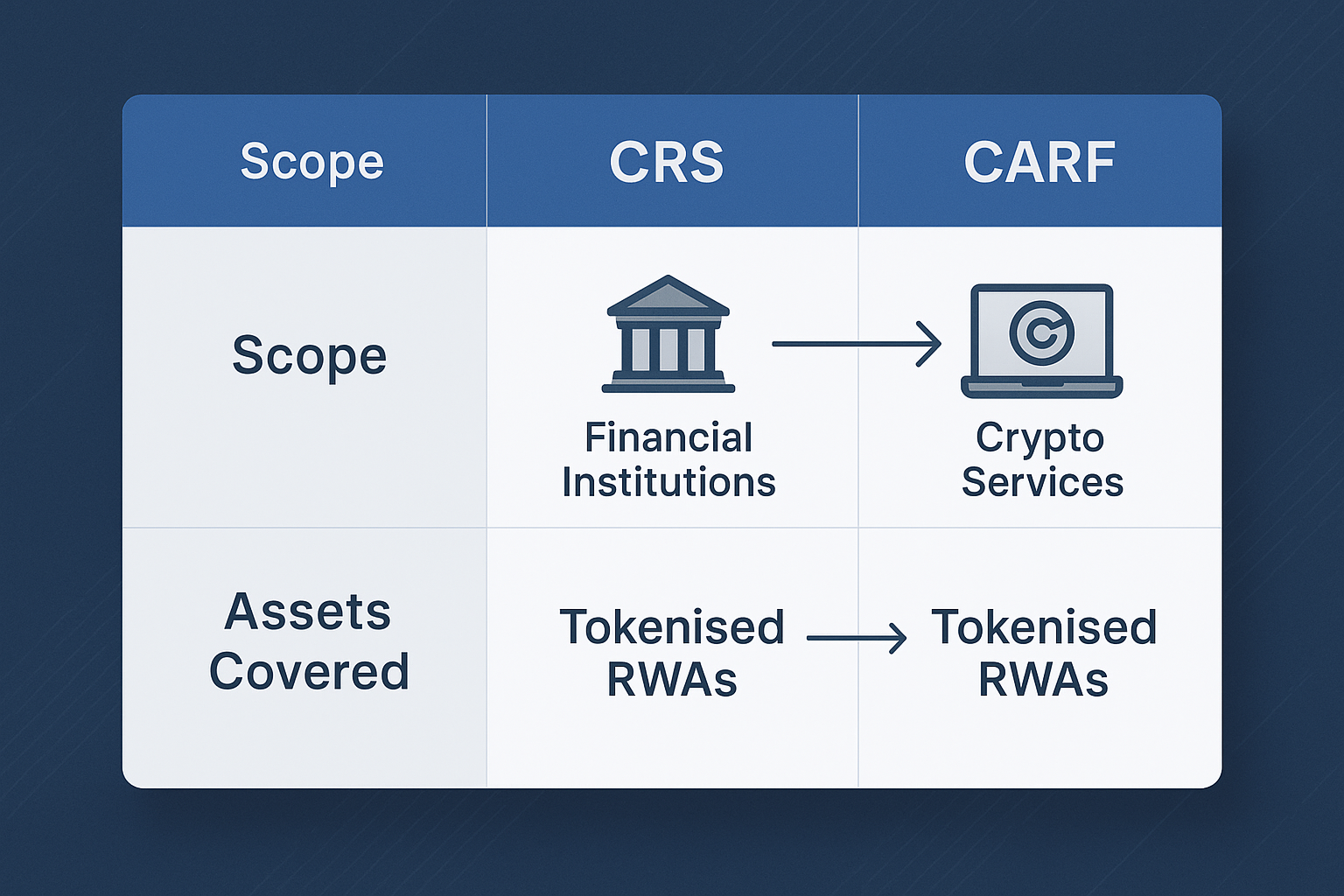
- Scope
- CRS: Financial accounts at Reporting Financial Institutions (banks, custodians, certain investment entities).
- CARF: Crypto-asset service providers (exchanges, brokers, DPTPs) reporting users’ relevant crypto-asset transactions.
- Assets covered
- CRS: “Financial assets” and “depository/custodial accounts.” A tokenised bond held at a custodian is typically in-scope.
- CARF: Crypto-assets that can be transferred or stored electronically using DLT or similar tech. Includes many tokenised RWAs if traded/transferred on-chain outside traditional custody.
- Who reports
- CRS: Your bank, custodian, or investment entity.
- CARF: Your exchange/broker or platform operating as a crypto-asset service provider.
- Data reported
- CRS: Account balances, income (interest/dividends), gross proceeds; tax residency details.
- CARF: Transaction-level details (acquisitions, disposals), wallet identifiers, valuations; tax residency details.
- Timelines
- CRS: Already operational in HK; annual reporting via IRD.
- CARF: Global adoption rolling out; HK has signalled support in Policy Statement 2.0. Track IRD/SFC/HKMA implementation dates.
A simple decision path
Practical structuring moves for 2025
- Map the instrument: Confirm whether your token is a security under the SFO. For bonds/equity interests, assume SFO applies. Align with SFC tokenised securities guidance for issuance and intermediaries.
- Choose custody deliberately:
- Bank/custodian account: expect CRS onboarding (self-certifications, TINs) and year-end reporting.
- VASP/on-chain flows: expect CARF-style user due diligence and transaction reporting once implemented.
- Build dual-track KYC/Tax procedures: Collect CRS self-certifications at investor onboarding and design CARF-compliant customer due diligence for platform users. Keep records for at least 7 years.
- Data standards early: Structure cap tables and on-chain registries to tag investors by tax residency and legal type. Avoid mixing omnibus wallets without look-through rights.
- Prospectus and exemptions: If offering tokenised bonds, confirm prospectus exemptions (e.g., professional investors) or prepare approved offering documents. The Government highlights tokenised bonds as a mature use case; use those templates.
- Cross-border exchanges: If secondary trading is in Singapore/EU, reconcile CARF-like reporting with local regimes. Assume multi-jurisdictional reporting even for HK issuers.
Two quick examples
- Tokenised bond, custodied at a Hong Kong bank, subscribed by PIs: CRS applies via the custodian; CARF usually not, unless tokens later move to non-custodial trading venues.
- Tokenised gold receipts issued by an SPV, traded on a licensed VASP: CARF due diligence/reporting likely at the VASP level; CRS could apply if a custodian holds tokens in a financial account.
Common traps we keep seeing
- Treating a tokenised bond like a “crypto” and skipping CRS onboarding.
- Using non-custodial wallets for secondary trading with no CARF-ready KYC.
- Inconsistent valuation sources for reporting; lock your pricing oracle/method.
What to do this quarter
- Run a CRS/CARF gap assessment against your issuance and trading flows.
- Update offering docs and platform T&Cs to disclose reporting obligations.
- Engage your custodian/VASP to align on data fields and timelines.
- Monitor IRD/SFC/HKMA circulars for CARF implementation specifics in HK.
Tokenisation is moving from pilots to production. Getting CRS/CARF right is the difference between clean scale-up and regulatory drag.


