
HK Compliance Guide: Real-Time Monitoring, SFC VATP & RWA

Introduction Real-time monitoring is no longer a “nice to have” for Hong Kong virtual asset players. Under the SFC’s VATP Guidelines and the Government’s push on tokenisation (Policy Statement 2.0), platform operators, fund managers, and custodians are expected to detect risks continuously—on-chain and off. With Project Ensemble bringing tokenised money market funds and other RWAs closer to production, blind spots will get costly.
What the SFC Actually Expects
- VATPs: The SFC’s Guidelines for Virtual Asset Trading Platform Operators (see Part X) set ongoing monitoring and market surveillance expectations, including detection of wash trading, layering/spoofing, price manipulation, and abnormal settlement behaviour. Link: SFC VATP Guidelines (PDF).
- Intermediaries: The SFC/HKMA joint circular on intermediaries’ virtual asset-related activities requires robust product due diligence, ongoing surveillance, and suitability/testing where relevant—especially when distributing VA funds or providing advisory/discretionary services.
- Funds: The SFC’s 7 April 2025 circular on SFC‑authorised funds with VA exposure tightened risk management, pricing/valuation governance, custody standards, and disclosures for retail‑facing products.
- Custody: The Government’s legislative proposal to regulate virtual asset custodian services signals dedicated standards around segregation, reconciliations, tech and key management, and incident reporting—implying continuous monitoring of wallet movements and access control.
- Tax transparency: Expect alignment with the OECD’s Crypto‑Asset Reporting Framework (CARF), making data integrity and traceability non‑negotiable. Link: OECD CARF.
- Tokenisation: Policy Statement 2.0 confirms legal/regulatory review on tokenisation, starting with bonds but informing other RWAs. HKMA’s Project Ensemble—co‑led with the SFC on asset management participation—encourages use cases like tokenised money market funds and revenue‑stream RWAs. Link: HKMA Project Ensemble.
The Monitoring You Need (not just AML)
- Market abuse surveillance: Cross‑market and cross‑token pattern detection; linkage of accounts with common control; alerts on spoofing/wash trading.
- On‑chain risk analytics: Counterparty wallet risk scoring, sanctions/OFAC checks, address clustering, mempool monitoring for withdrawals.
- Fiat/VA reconciliation: Intraday reconciliation across banks, stablecoin rails, and hot/cold wallets; variance thresholds with auto‑holds.
- Travel Rule compliance: Message delivery, counterparty VASP due diligence, and exception handling built into withdrawal flows.
- RWA‑specific controls: Asset‑token ledger sync, lifecycle events (coupon, amortisation, corporate actions) reconciled to the traditional registrar/CMU; valuation drift checks between token price and reference NAV/yield.
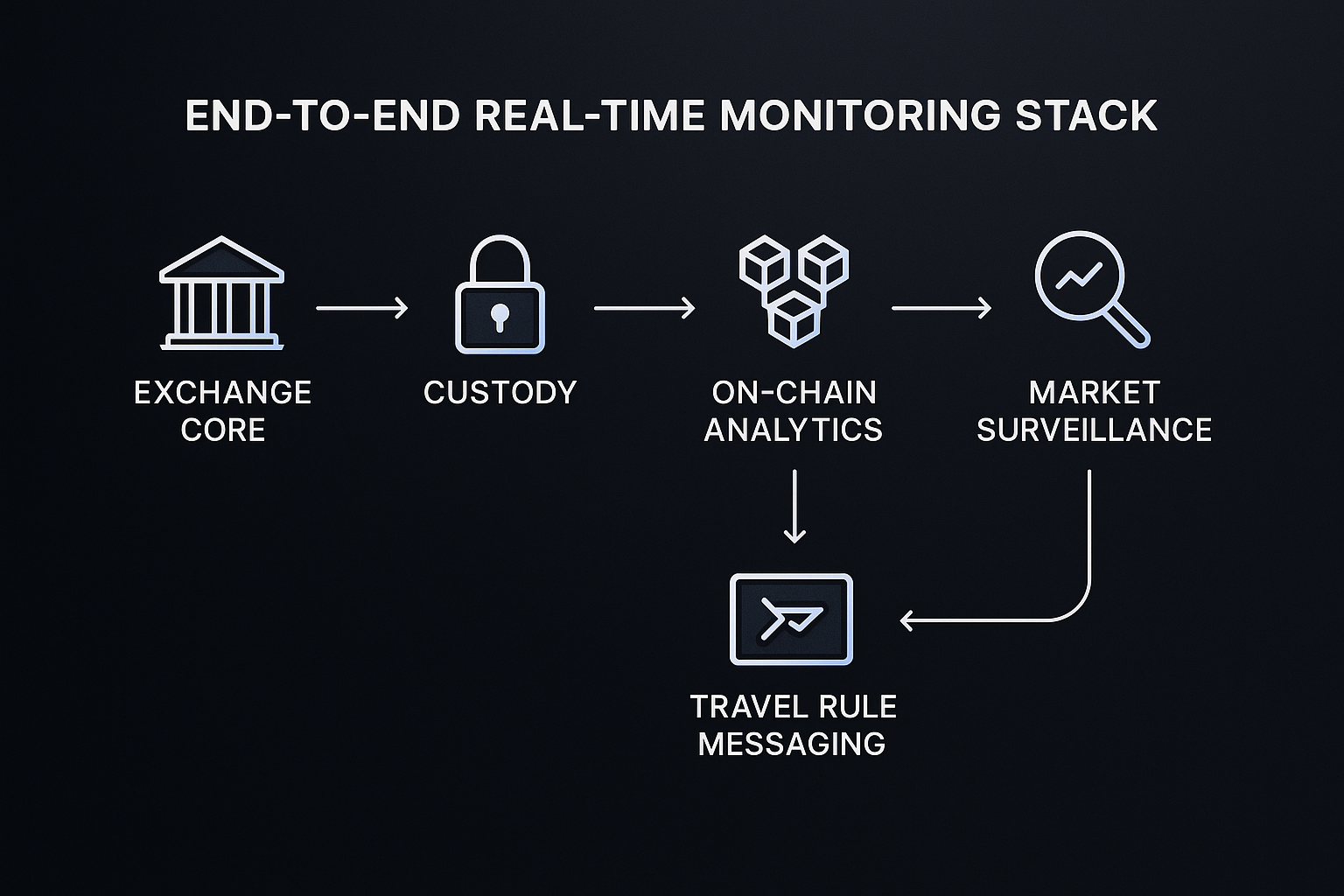
Who must monitor what (at a glance)
| Entity | Primary monitoring focus | Key reference |
|---|---|---|
| VATP | Market abuse, client asset segregation, token admission/ongoing review, on/off-chain anomalies | SFC VATP Guidelines (Part X) |
| Intermediary (broker/asset manager) | Product due diligence, suitability, ongoing distribution surveillance, custody oversight | SFC/HKMA joint circular |
| Custodian (VA) | Wallet access control, reconciliations, key events, incident reporting | Legislative proposal on VA custodians |
| Fund (VA/RWA) | Valuation, liquidity, counterparty risk, disclosures | SFC circular (7 Apr 2025) |
RWA: Practical Implications Tokenising bonds, funds, and cash flows sounds straightforward. The catch is lifecycle monitoring. You’ll need:
- Golden source alignment: On-chain positions must match registrar/CMU; any mismatch should trigger a T+0 exception queue.
- Cash flow controls: Coupon or revenue‑share distributions matched to on-chain receipts within defined SLAs (e.g., 2 hours; illustrative).
- Transfer restrictions: Rule‑based whitelists (jurisdiction, KYC tier) enforced at the token contract and monitored continuously.
What to Do Now
- Implement event‑driven monitoring: Stream wallet, order book, and banking events into a single alerting layer with a case system. Aim for sub‑minute alerting on withdrawals and large order cancellations.
- Bake the Travel Rule into UX: Block withdrawals until originator/beneficiary data is verified; automate VASP due diligence refreshes.
- Prepare for custodian licensing: Document key ceremonies, threshold schemes, HSM configs, and access logs. Run quarterly recovery drills.
- Align tokenisation controls: For Project Ensemble pilots, draft control mappings that show reconciliation, valuation, and transfer‑restriction checks end‑to‑end.
- Anticipate OTC coverage: The FSTB consultation (Feb–Apr 2024) flagged diverse OTC models; if you operate OTC, assume licensing/monitoring obligations will tighten.
Conclusion Real-time is the standard. Between the SFC’s VATP regime, the intermediaries’ joint circular, and the push under Policy Statement 2.0 and Project Ensemble, Hong Kong is wiring surveillance into every layer of VA and RWA activity. If you can explain your alerts, exceptions, and reconciliations in one page, you’re close. If not, start now.
Links
- SFC VATP Guidelines (Part X): https://www.sfc.hk/-/media/EN/assets/components/codes/files-current/web/guidelines/Guidelines-for-Virtual-Asset-Trading-Platform-Operators/Guidelines-for-Virtual-Asset-Trading-Platform-Operators.pdf
- HKMA Project Ensemble: https://www.hkma.gov.hk/eng/key-functions/international-financial-centre/fintech/project-ensemble/
- OECD CARF: https://www.oecd.org/tax/automatic-exchange/crs-implementation-and-assistance/crypto-asset-reporting-framework-and-amendments-to-the-common-reporting-standard.htm
If you want a quick gap assessment, StanCOMP can benchmark your monitoring stack against these requirements in under two weeks.


