
HK Compliance Guide: IRAs & Fiat Stablecoins in DeFi

Introduction: why IRAs matter for stablecoins in DeFi, in Hong Kong now Hong Kong is pro-innovation but not blind to risk. The Government’s Policy Statement 2.0 signalled continued support for tokenised bonds, RWAs and stablecoin use cases, while tightening the regulatory framework and cross-border cooperation. That optimism is paired with sharper AML/CFT expectations as the stablecoin regime lands. If you issue, hold, or integrate fiat-backed stablecoins in DeFi, your Institutional Risk Assessment (IRA) is your first line of defence—and the first thing a regulator will ask for.
The policy backdrop you should anchor to
- Policy direction: The Government is facilitating stablecoin use cases and tokenisation as part of a broader digital asset push, including regular tokenised government bonds and RWA expansion (see Policy Statement updates from 2023–2024).
- AML/CFT signals: BIS has highlighted stablecoin vulnerabilities for ML/TF and sanctions evasion. FATF guidance continues to flag the risks of unhosted wallets given anonymity and mobility.
- Hong Kong’s consultation outcomes: Authorities expect FIs and VASPs that provide custodial wallets for stablecoin users to implement robust AML/CFT, with additional controls for interactions with unhosted wallets. Some FATF members have even started with full identification and verification of any stablecoin holder—a useful calibration point as Hong Kong finalises its regime.
So, don’t treat DeFi touchpoints as “out of scope.” They’re squarely in scope.
What a “DeFi + fiat stablecoin” IRA should cover Focus your IRA on concrete, testable risk hypotheses—not generic narratives.
- Customers and counterparties
- Hosted vs unhosted wallet flows; origin of funds; exposure to sanctioned or high-risk locations.
- Whether counterparties are VASPs with Travel Rule capability and sanctions screening.
- Product and transaction features
- Mint/burn and redemption mechanics; convertibility; transparency of reserves and attestations.
- Stability mechanisms (fiat-referenced reserves vs algo components), fee structures, and redemption windows.
- Delivery channels and devices
- Mobile apps, web wallets, and hardware devices used to transact VAs; device compromise and mule risk.
- DeFi protocol exposure
- Whether pools are permissioned/KYC-gated; governance concentration; upgrade keys; oracle design; MEV/sandwich risks.
- Roles and responsibilities
- If you’re an issuer: lifecycle controls and financial integrity responsibilities.
- If you’re a VASP/custodian: Travel Rule, blockchain analytics, address screening, and customer notifications.
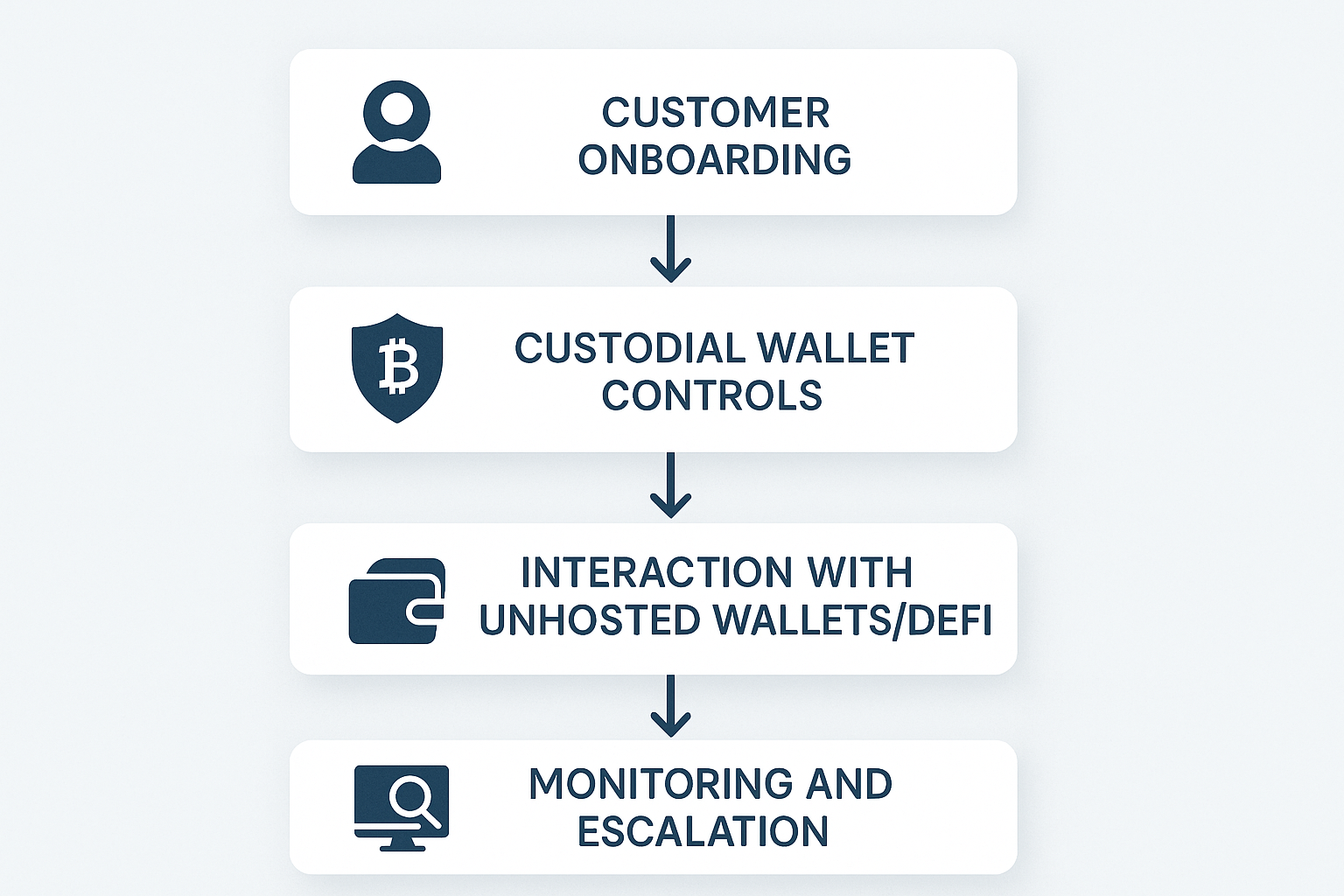
A control map that usually satisfies HK expectations
| Risk scenario | Primary control | Owner | Evidence regulators like to see |
|---|---|---|---|
| Deposits/withdrawals to unhosted wallets | Counterparty due diligence: address binding, proof-of-ownership attestations, risk-scoring via chain analytics; velocity/amount caps; enhanced review for new addresses | VASP/custodian | Policy/guidance, address allowlist logs, risk scores, review outcomes |
| Use of stablecoins in DeFi pools | Approved protocol allowlist; on-chain policy enforcement (transaction pre-checks); ring-fenced DeFi sub-accounts | VASP/custodian | Allowlist change control, transaction blocking proofs, exception registers |
| Sanctions/PEP exposure | Sanctions/PEP screening of users; on-chain screening of counterparties; geofencing | VASP/custodian | Screening hit logs, disposition notes, geo-IP controls |
| Issuer integrity (if applicable) | Segregated reserves, daily liquidity monitoring, monthly attestations by independent auditor; blacklisting/freeze capability with governance controls | Stablecoin issuer | Attestation reports, treasury holdings, mint/burn logs, key management reviews |
| Travel Rule gaps | Interoperable Travel Rule messaging; fallback procedures at or below FATF’s USD/EUR 1,000 benchmark | VASP/custodian | Sample message payloads, returns/rejections, counterparty due diligence |
Five controls that tend to make or break audits
- Identification and verification for all custodial wallet users; explicit residual risk treatment for unhosted wallets. If you can’t verify a counterparty, limit or block the flow.
- Real-time blockchain analytics tied to case management. Don’t just score—triage, escalate, and document.
- Protocol allowlists for DeFi. If it’s not on the list (or permissioned/KYC-gated), it’s off-limits for client assets.
- Clear redemption policies for fiat-backed stablecoins: timing (e.g., T+0/T+1), fees, bank counterparties, and stress liquidity playbooks.
- Travel Rule readiness with multiple providers, plus bilateral testing with your top 10 counterpart VASPs.
What to do this quarter
- Run a focused IRA refresh: add a dedicated “stablecoins in DeFi” section with scenario testing (e.g., sanctioned mixer exposure via LP positions; cross-chain bridge risks).
- Update onboarding and wallet policies: include address proof-of-ownership flows and a documented stance on unhosted wallets.
- Implement a DeFi allowlist and transaction pre-checks: start with permissioned pools; log and review all blocks/exceptions weekly.
- For issuers: finalise reserve governance, attestation cadence, and incident-response for freezes/blacklists; document lifecycle controls as part of your AML programme.
- Test your Travel Rule flows end-to-end with real counterparties; record defects and fixes.
One more point. If your policy sounds great but you can’t show evidence, it doesn’t exist.
References and further reading
- Hong Kong Policy Statement on Virtual Assets and subsequent updates (tokenised bonds, RWAs, stablecoins): https://www.info.gov.hk/gia/general/202310/30/P2023103000529.htm
- HKMA/FSTB consultation on regulating fiat-referenced stablecoin issuers (2024): https://www.hkma.gov.hk/eng/news-and-media/press-releases/2024/01/20240131-3/
- SFC Guideline on AML/CFT (for Licensed Corporations and VASPs): https://www.sfc.hk/-/media/EN/assets/components/codes/files-current/web/guideline-on-anti-money-laundering-and-counter-financing-of-terrorism/Guideline-on-Anti-Money-Laundering-and-Counter-Financing-of-Terrorism--For-Licensed-Corporations-and-Virtual-Asset-Service-Providers.pdf
- FATF guidance on virtual assets and VASPs, and Travel Rule updates: https://www.fatf-gafi.org/en/publications/Fatfrecommendations/Guidance-RBA-VA-VASPs.html and https://www.fatf-gafi.org/en/publications/fatf-recommendations/Targeted-Update-virtual-assets-vasps-travel-rule.html
- BIS on stablecoin vulnerabilities: https://www.bis.org/publ/arpdf/ar2023e3.htm
Conclusion Hong Kong is laying the rails for real-world tokenisation and compliant stablecoin adoption. The trade-off is clear: if you want to plug fiat-backed stablecoins into DeFi, your IRA must explicitly cover custodial wallet controls, unhosted wallet interactions, and protocol-level safeguards—backed by evidence. Get those right, and you’ll be on the right side of both innovation and supervision.


