
HK Compliance Guide: CBDC, OTC & Wholesale Stablecoins

HK Compliance Guide: CBDC, OTC & Wholesale Stablecoins
If you’re running treasury, product, or compliance in Hong Kong, 2025 is the year your playbook needs three pages: CBDC rails (mBridge/e-HKD), wholesale stablecoins, and OTC controls. Policy Statement 2.0 makes it clear: regulators want real-world use cases, not just talk, and they’re inviting proposals to test licensed stablecoins, even for Government payments. That’s a rare signal. Move.
What’s changing (fast)
- CBDC goes wholesale-first: mBridge is maturing into a cross‑border settlement rail. Start mapping your trade flows now.
- Stablecoin issuance becomes a licensed activity: fiat‑referenced issuers will face Hong Kong requirements on reserve quality, redemption, disclosures, and governance.
- OTC will no longer be a grey zone: AML/CFT, Travel Rule, and sanctions controls will be table stakes, with specific expectations for unhosted wallets.
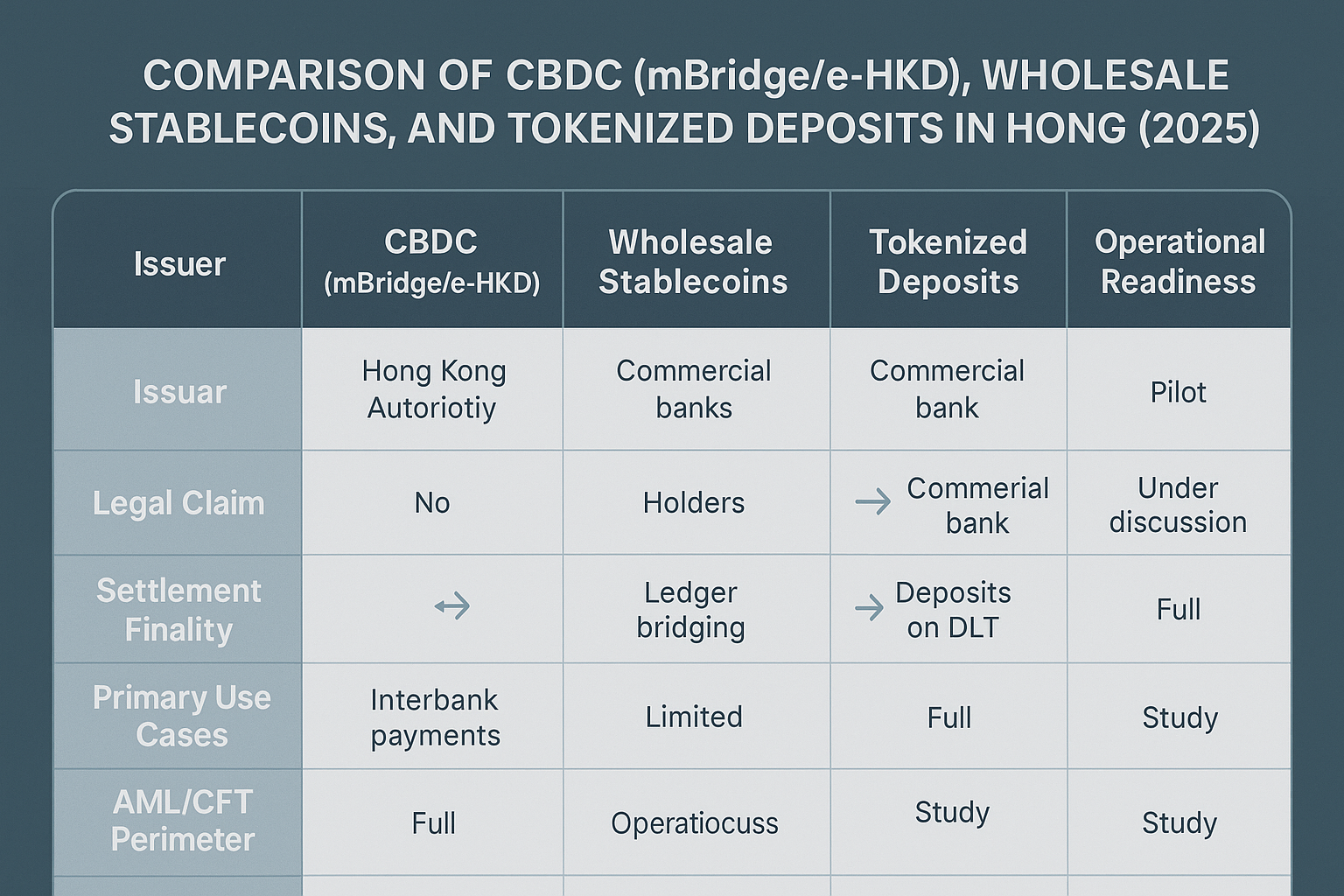
CBDC: mBridge and e-HKD pilots
- Why it matters: Wholesale CBDC can shorten cross‑border settlement from T+2 to near‑instant while slashing correspondent costs. See HKMA’s CBDC hub and BIS mBridge updates for technical and legal contours.
- Compliance angle: Treat mBridge as a regulated payment infrastructure. You still need full KYC, sanctions screening, and purpose-of-payment checks; the rail doesn’t replace AML/CFT duties.
- What to do now
- Identify two to three high-friction corridors (e.g., CNY/HKD supplier payments) where pre‑funding or FX spreads hurt you most.
- Build ISO 20022 mapping and a rules engine for Travel Rule equivalence where VA legs interact with VASPs.
- Update treasury policies for T+0 irrevocability: netting, cut‑offs, and intraday liquidity buffers.
- Join or partner into pilots via your relationship banks; document settlement assurance, dispute handling, and data retention.
Wholesale stablecoins: from experimentation to licensing
- Policy direction: Policy Statement 2.0 welcomes proposals to test licensed stablecoins in real government payments and other real‑economy use cases. The regulatory regime will emphasise 1:1 high‑quality reserves, timely redemption, clear disclosures, and robust governance.
- AML/CFT reality: The BIS has warned about stablecoins’ ML/TF and sanctions risks; FATF highlights unhosted wallet threats. Expect heightened controls when interacting with self‑custody.
- Practical guardrails
- Distribution: Prefer institutional whitelists and custodial wallets operated by FIs/VASPs, with extra checks for any unhosted wallet flows.
- Reserves and redemption: Demand independent attestations, concentration limits (e.g., T‑bills vs bank deposits), and T+1 (or faster) redemption SLAs.
- Data and reporting: Implement Travel Rule messaging for transfers involving VASPs; log on/off‑ramp counterparties, purpose, and source of funds.
- Use cases to pilot: supplier payments, collateral mobility between prime brokers, and proceeds management for tokenised securities.
OTC: getting ahead of the new perimeter
- Expectation setting: Authorities are moving to bring VA OTC under AMLO-style licensing. Even before it’s law, run as if it is.
- Controls that regulators will look for
- CDD/KYC: verify legal persons’ UBOs; enhanced due diligence for high‑risk geographies and PEPs.
- Travel Rule: exchange originator/beneficiary information for VA transfers with VASPs; reject transfers lacking required data. See SFC’s VASP page for implementation resources.
- Unhosted wallets: apply additional checks—attestation of ownership, test transfers, chain‑analytics on source of funds—and set stricter limits or manual approvals.
- Sanctions and screening: continuous screening on customers, wallets, and counterparties; monitor for red flags cited by BIS and FATF.
- Record‑keeping and STRs: maintain complete audit trails; file promptly to the JFIU when suspicion arises.
Design choices that keep you out of trouble
- Keep retail exposure minimal if your use case is institutional; build permissioned rails first.
- Make unhosted wallet access an exception with risk‑based caps and pre‑clearance.
- Separate the roles: issuance, custody, market making, and brokerage each carry different risks and should have independent controls.
- Don’t promise par liquidity unless you’ve tested redemptions under stress and hold the right assets.
Helpful links
- HKMA CBDC overview: https://www.hkma.gov.hk/eng/key-functions/international-financial-centre/central-bank-digital-currency-cbdc/
- BIS mBridge: https://www.bis.org/about/bisih/topics/cbdc/mbridge.htm
- FATF VA/VASP guidance: https://www.fatf-gafi.org/en/publications/Fatfrecommendations/Guidance-rba-virtual-assets-vasps.html
- BIS on stablecoin vulnerabilities: https://www.bis.org/publ/qtrpdf/r_qt2209b.htm
- SFC VASP resources: https://www.sfc.hk/en/Regulatory-functions/Intermediaries/Virtual-asset-service-providers
- JFIU suspicious transaction reporting: https://www.jfiu.gov.hk/en/str.html
Bottom line Hong Kong is inviting serious pilots that solve real payment and settlement pain points—especially with licensed stablecoins and CBDC rails. If you can evidence tight AML/CFT, controlled wallet perimeters, and reliable redemption, regulators will listen. If not, they won’t. Start with one corridor, one coin, one control set—prove it, then scale.


