HK Compliance Guide: CBDC, AI & VASP Registration 2025

HK Compliance Guide: CBDC, AI & VASP Registration 2025
If you’re building in Hong Kong’s digital asset space, 2025 is the year your compliance stack either future‑proofs your business or slows it to a crawl. Three threads matter most right now: CBDC pilots, practical AI in AML, and the expanding VASP perimeter (custody and OTC) on top of the existing VATP regime.
Let’s cut through it.
1) CBDC: What e-HKD and mBridge mean for compliance
- e-HKD: The Hong Kong Monetary Authority (HKMA) continues its multi‑year e‑HKD pilot work with banks and PSPs. No retail launch date yet, but settlement and programmable payment use cases are maturing. See HKMA’s e‑HKD hub: https://www.hkma.gov.hk/eng/key-functions/digital-economy/e-hkd/
- Cross‑border: The BIS‑led mBridge project, with HKMA as a participant, is at a Minimum Viable Product stage with limited participants across Hong Kong, Mainland China, UAE and Thailand. Expect more live corridor testing rather than headlines. Background: https://www.bis.org/about/bisih/topics/cbdc/mcbdc_bridge.htm
Compliance impact:
- CDD/record‑keeping do not change just because value moves in CBDC. Schedule 2 of the AMLO still governs KYC and retention: https://www.elegislation.gov.hk/hk/cap615
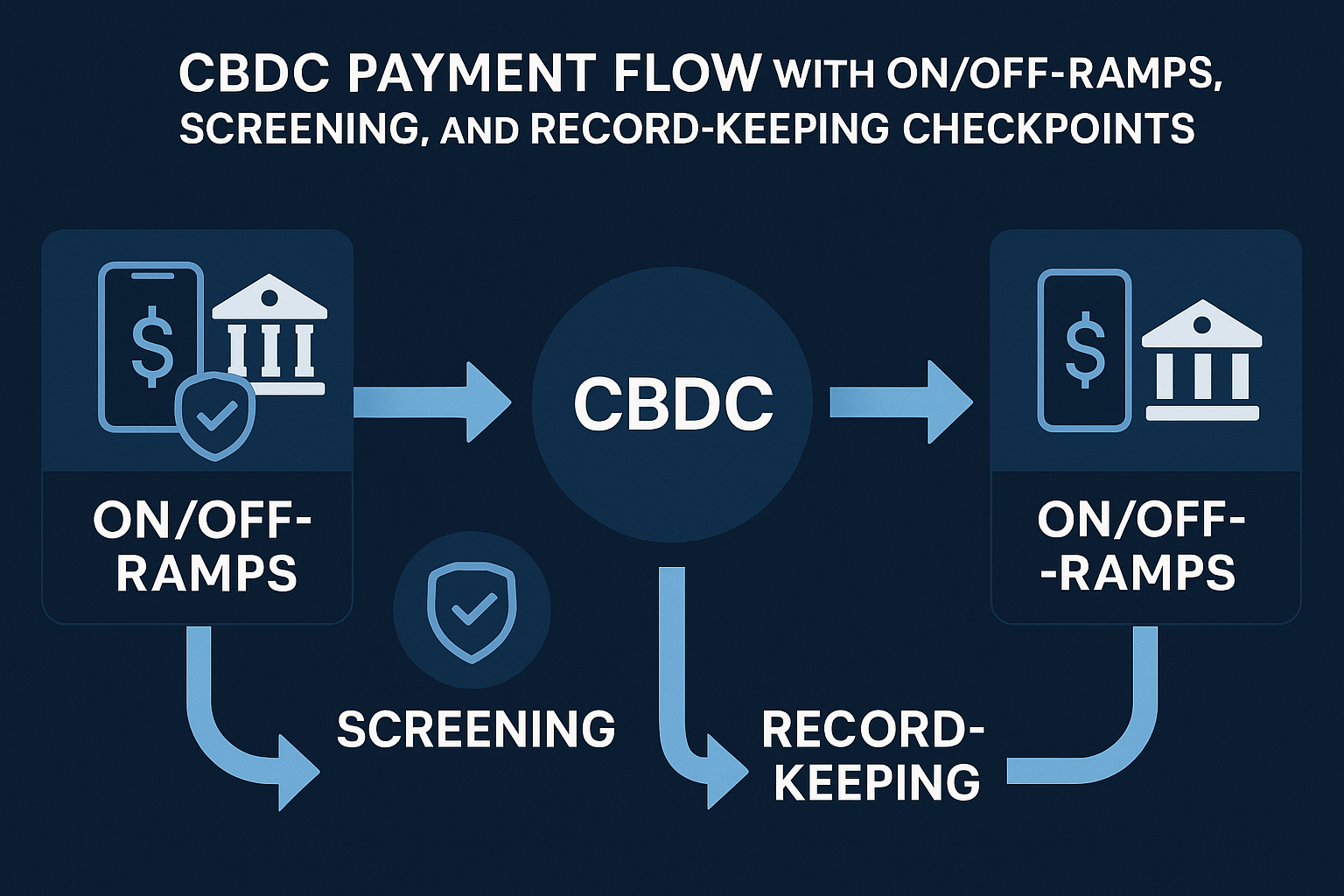
- Prepare for CBDC‑specific data fields (wallet identifiers, programmability flags, on/off‑ramp metadata). Update policies now so your audit trail can evidence origin, purpose, and controls over any smart conditions embedded in payments.
- For cross‑border CBDC (e.g., mBridge), map sanctions screening and Travel Rule interoperability early. CBDC rails won’t solve Travel Rule gaps for you.
2) AI in AML/CFT: Use it, but with guardrails
AI is moving from pilot to production in onboarding, screening, and transaction monitoring. In Hong Kong, the legal baseline remains the AMLO and SFC/HKMA expectations on model risk, explainability, and auditability.
Practical moves we’re implementing with clients:
- Human‑in‑the‑loop: Auto‑clear low‑risk alerts with deterministic rules; route medium/high‑risk to analysts. Track overrides with reason codes.
- Model governance: Maintain a written “model card” for each AI component—data sources, known biases, performance (e.g., 92% precision, 88% recall on 12 months of alerts—illustrative), retraining cadence, and backtesting results.
- Vendor diligence: For third‑party AI, contract for data lineage, prompt/response logs, and the right to audit.
- Records: Retain training data samples, feature lists, and decision logs to meet Schedule 2 record‑keeping. If you can’t explain why an alert cleared, assume it didn’t.
One line worth underlining: opaque models without an audit trail are a regulatory finding waiting to happen.
3) VASP registration: where we are in 2025
-
VATPs (exchanges): Since June 2023, any person operating a virtual asset trading platform must be licensed by the SFC, pass a fit‑and‑proper test, and meet AML/CTF and investor protection obligations. The SFC holds supervisory, investigative, and intervention powers. Details: https://www.sfc.hk/en/What-we-do/Fintech/Virtual-asset-trading-platforms
-
Custody: In late June 2025, the Government (FSTB) and SFC issued a public consultation to regulate virtual asset custodian services under the “same activity, same risks, same regulation” principle. Licensed/registered VA custodians would be subject to Schedule 2 AMLO CDD and record‑keeping, plus additional prudential and operational requirements. Consultation page: https://www.fstb.gov.hk/fsb/en/publication/consult/
-
OTC dealing: A separate consultation on regulating dealing in virtual assets (including OTC shops) was also issued around the same period. See reference paper: https://www.fstb.gov.hk/fsb/en/publication/consult/doc/VAOTC_consultation_paper_en.pdf
-
VATP licence (in force): SFC; fit‑and‑proper, AML/CTF, investor protection, ongoing supervision
-
VA custodians (consultation, 2025): SFC/FSTB; Schedule 2 AMLO CDD/records; proposed safeguarding, segregation, insurance/assurance
-
VA OTC dealers (consultation, 2025): SFC/FSTB; proposed licensing/registration and AML/CTF obligations
Note: The custodian and OTC regimes are proposals at the time of writing—plan as “likely,” not “done.”
What to do now
- Map your activities to future licences: trading, custody, OTC, advisory. Don’t wait for the Bill—design your entity structure and responsible officers now.
- Upgrade Schedule 2 hygiene: clean KYC files, clarify beneficial ownership, and standardize 7‑year retention with immutable logs.
- Build AI governance: approve a model risk policy, stand up a model inventory, and implement challenger testing on at least one high‑volume control (e.g., sanctions screening).
- CBDC‑ready records: add CBDC fields to your ledger and case management; test a small e‑HKD/mBridge pilot with your bank partner.
Bottom line
Hong Kong’s message is clear: same activity, same risks, same regulation. If you align early—on CBDC data, AI governance, and the widening VASP perimeter—you’ll spend far less time firefighting when the new rules land.
If you want a quick gap review against Schedule 2 and the upcoming custodian/OTC proposals, we can run a 2‑week diagnostic and give you a punch‑list that your board will actually read.