
HK Compliance Guide: Blockchain AML/CFT Risk Assessment

HK Compliance Guide: Blockchain AML/CFT Risk Assessment
If you run a VA exchange, OTC desk, wallet, stablecoin project, or custody business in Hong Kong, your AML/CFT risk assessment can’t be a generic PDF anymore. The HKMA’s stablecoin regime is crystallising, the FSTB is moving VA custodians into a licensing box, and regulators expect you to evidence real-time blockchain risk control, not just policy statements.
What regulators expect now
-
HKMA stablecoin AML/CFT guideline: The consultation conclusions confirm broad industry support and set out next steps for Licensed Stablecoin Issuers. The framework emphasises sharing essential transfer information to enable transaction monitoring, sanctions screening, and risk mitigation across participants. See HKMA’s stablecoin materials: https://www.hkma.gov.hk/eng/key-functions/international-financial-centre/virtual-assets-and-stablecoins/
-
Custody licensing proposal: The Government’s consultation on VA custodians requires licensees to adopt technological solutions (read: blockchain analytics) to track VAs, wallets, and flag suspicious activity. See FSTB overview: https://www.fstb.gov.hk
-
Global signals: BIS has highlighted stablecoin vulnerabilities for ML/TF and sanctions evasion; FATF flags unhosted-wallet risks and expects effective Travel Rule implementation. References: BIS https://www.bis.org, FATF VA/VASP guidance https://www.fatf-gafi.org/en/publications/Fatf-recommendations/Guidance-RBA-virtual-assets-vasps.html
How to build a practical, defensible risk assessment
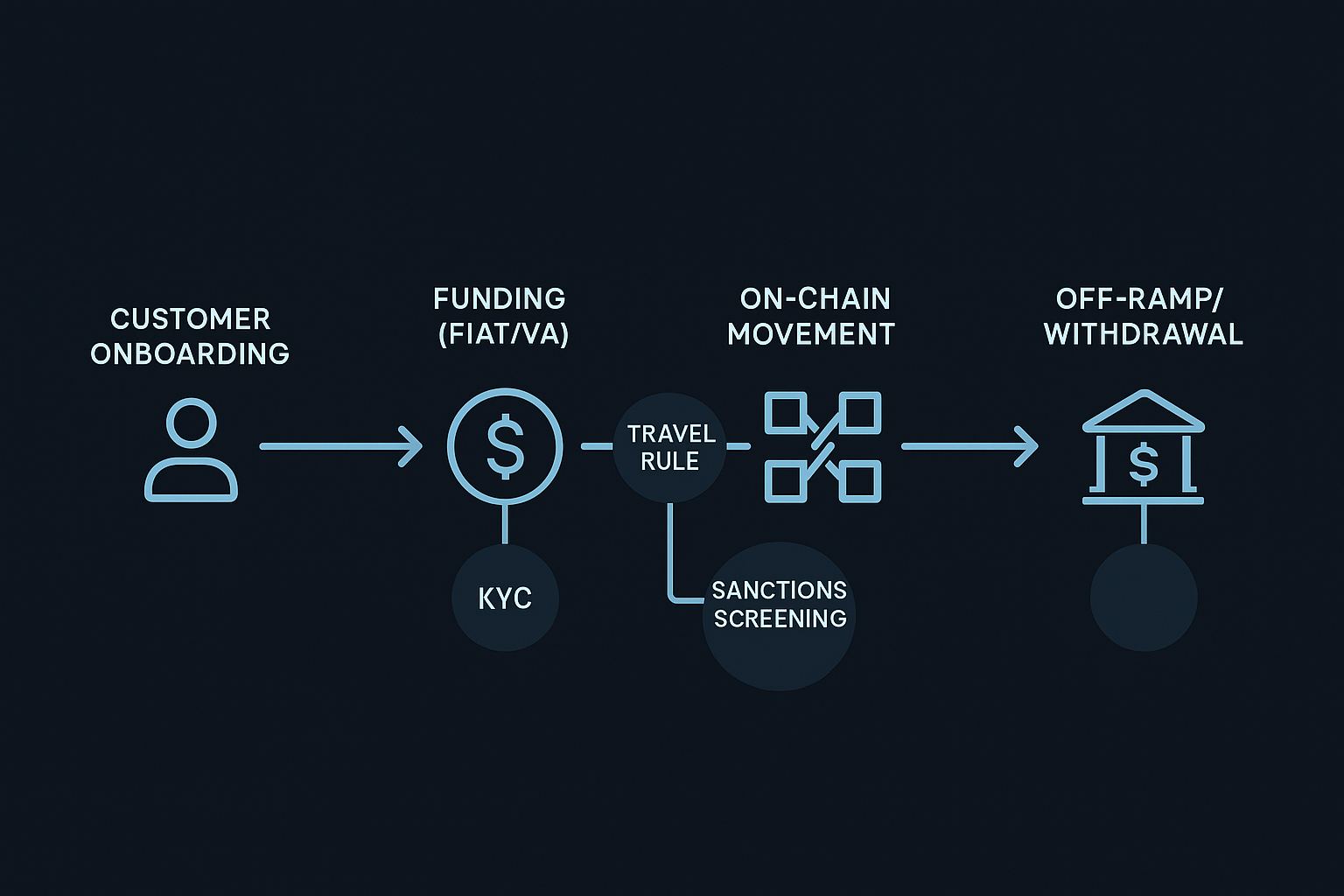
- Map your business and data flows
- Catalogue products (spot, staking-as-a-service, stablecoin issuance/redemption, OTC block trades, custody-only).
- Trace value flows, including cross-chain bridges, Layer-2s, and off-exchange settlement.
- Identify all counterparties (hosted vs unhosted wallets; VASP counterparties and their jurisdictions).
- Define inherent risk factors and signals
| Risk area | Red flags (illustrative) | Why HK regulators care |
|---|---|---|
| Customer & geography | Sanctions exposure; high-risk jurisdictions; nested OTCs | Screening effectiveness and information-sharing are core expectations |
| Asset/chain type | Privacy coins; mixers; cross-chain bridges | BIS/FATF concerns on obfuscation and mobility |
| Wallet type | Unhosted wallets; newly created/abandoned | FATF highlights anonymity risks |
| Stablecoin exposure | Non-transparent reserves; off-shore issuer | HKMA proposes issuer oversight and robust AML/CFT for transfers |
| Behavioural patterns | Peel chains; rapid in-and-out; dusting | Transaction monitoring and analytics are mandatory for custodians |
- Calibrate controls to risks
- Travel Rule operations: Implement interoperable messaging with counterparty VASPs; auto-block transfers missing required originator/beneficiary data; reconcile on-chain TXIDs with off-chain identity records. See SFC AML/CFT guideline for VASPs: https://www.sfc.hk/en/Rules-and-standards/Anti-money-laundering-and-counter-terrorist-financing
- Blockchain analytics: Deploy tools (e.g., Chainalysis, TRM, Elliptic) to:
- Score inbound/outbound wallets and transfers.
- Detect typologies (mixers, darknet, sanctioned nexus, ransomware).
- Produce case files with visual graphs for STRs to JFIU.
- Sanctions and screening: Sanctions at address, entity, and narrative-text levels; include cross-chain bridges and wrapped assets.
- Stablecoin-specific: Validate issuer licensing status (HK or relevant jurisdiction), reserve attestations, redemption pathways, and transfer information sufficiency per HKMA guideline expectations.
- Custody-specific: Segregate client assets on-chain, implement allow-/deny-lists, rate-limit withdrawals, and enforce multi-person approval with hardware-backed key management.
- Score and evidence residual risk
- Use a weighted model (illustrative): customer 30%, geography 20%, asset/chain 20%, wallet type 15%, behaviour 15%.
- Rate inherent risk (1–5), rate control effectiveness (1–5), compute residual risk with simple matrix logic.
- Document thresholds for EDD, manual review, and STR triggers. Keep a model change-log and quarterly back-testing summary.
- Governance and MI
- Dashboards that show: percentage of VA flows with complete Travel Rule data, share of volumes touching medium/high-risk labels, time-to-resolution for SAR-worthy alerts, and the top five typologies detected this quarter.
- Independent testing: annual control assurance, model validation, and forensic sampling of withdrawals to unhosted wallets.
Stablecoin and custody nuances to nail
- Stablecoins: Treat issuer risk like a correspondent bank—assess governance, reserves transparency, sanctions posture, and information-sharing capability for transfers.
- Custody: The consultation makes analytics non-negotiable. Add deposit address attribution, clustering logic for client sub-accounts, and continuous wallet health checks (dusting, reuse, poisoning).
90-day action plan
- Weeks 1–2: Map flows; gap-assess Travel Rule, sanctions, analytics; align with AMLO and SFC/HKMA guidance: https://www.elegislation.gov.hk/hk/cap615
- Weeks 3–6: Implement analytics with risk-based rules; integrate Travel Rule messaging; update screening lists; pilot EDD for unhosted-wallet withdrawals.
- Weeks 7–10: Roll out dashboards; train investigators on typologies; dry-run STRs; document the risk assessment and Board sign-off.
- Weeks 11–12: Independent review; remediate findings; lock KPIs and quarterly testing cadence.
Bottom line
Regulators in Hong Kong are clear: if value moves on-chain, your controls must move with it—data-rich, real-time, and auditable. Build the assessment like you expect it to be read by both your Board and the HKMA/SFC. Because it will be.


