
HK Compliance: FATF on Stablecoins & Tokenised Securities

Introduction FATF has sharpened its focus on stablecoins and unhosted wallets, while Hong Kong’s Policy Statement 2.0 pushes ahead with tokenisation of RWAs and regular issuance of tokenised government bonds. If you operate in Hong Kong’s digital asset market, this mix means opportunity—with tighter AML/CFT obligations at the core.
Treat algorithmic stablecoins as high-risk until proven otherwise.
FATF signals you shouldn’t ignore
- Stablecoins: The BIS has underscored stablecoin vulnerabilities for money laundering, terrorist financing, and sanctions evasion, calling for strong regulation. FATF echoes this, highlighting specific risks from anonymity and mobility—especially when stablecoins move through unhosted wallets. Some FATF members launched with strict baselines, requiring identification and verification of any stablecoin holder from day one. That’s the direction of travel.
- Unhosted wallets: FATF guidance flags higher ML/TF risk for transfers to/from unhosted wallets and VAs transacted via such devices. Expect scrutiny on originator/beneficiary information, sanctions screening, and the purpose of funds.
Where Hong Kong is headed (Policy Statement 2.0) Hong Kong wants to facilitate stablecoin use cases and expand tokenisation of RWAs and financial instruments, while aligning with international standards—IOSCO policy recommendations, the FSB’s global framework for crypto-asset activities, Basel’s prudential treatment of crypto exposures, and the OECD’s Crypto-Asset Reporting Framework. Regular tokenised government bond issuance is part of that roadmap. Innovation is welcome; AML/CFT guardrails are non-negotiable.
What this means for algorithmic stablecoins
- Expect heightened risk classification: Algorithmic models lack clear reserve assets and redemption mechanisms. For compliance, treat them as high-risk instruments; restrict retail access and avoid payment use cases unless you can evidence robust governance, audits, and price stability.
- Apply enhanced due diligence (EDD): KYC all counterparties interacting with algorithmic stablecoins; collect source of funds/wealth for material exposures; implement on-chain analytics and pattern-based monitoring for mixer/bridge interactions.
Tokenised securities and RWA tokenisation Tokenised doesn’t mean unregulated. Securities law still applies. If a token represents equity, debt, or a collective investment scheme, expect SFC oversight for issuance, distribution, custody, and secondary trading. For RWAs, verify title, enforceability, and the off-chain legal stack before you mint a single token.
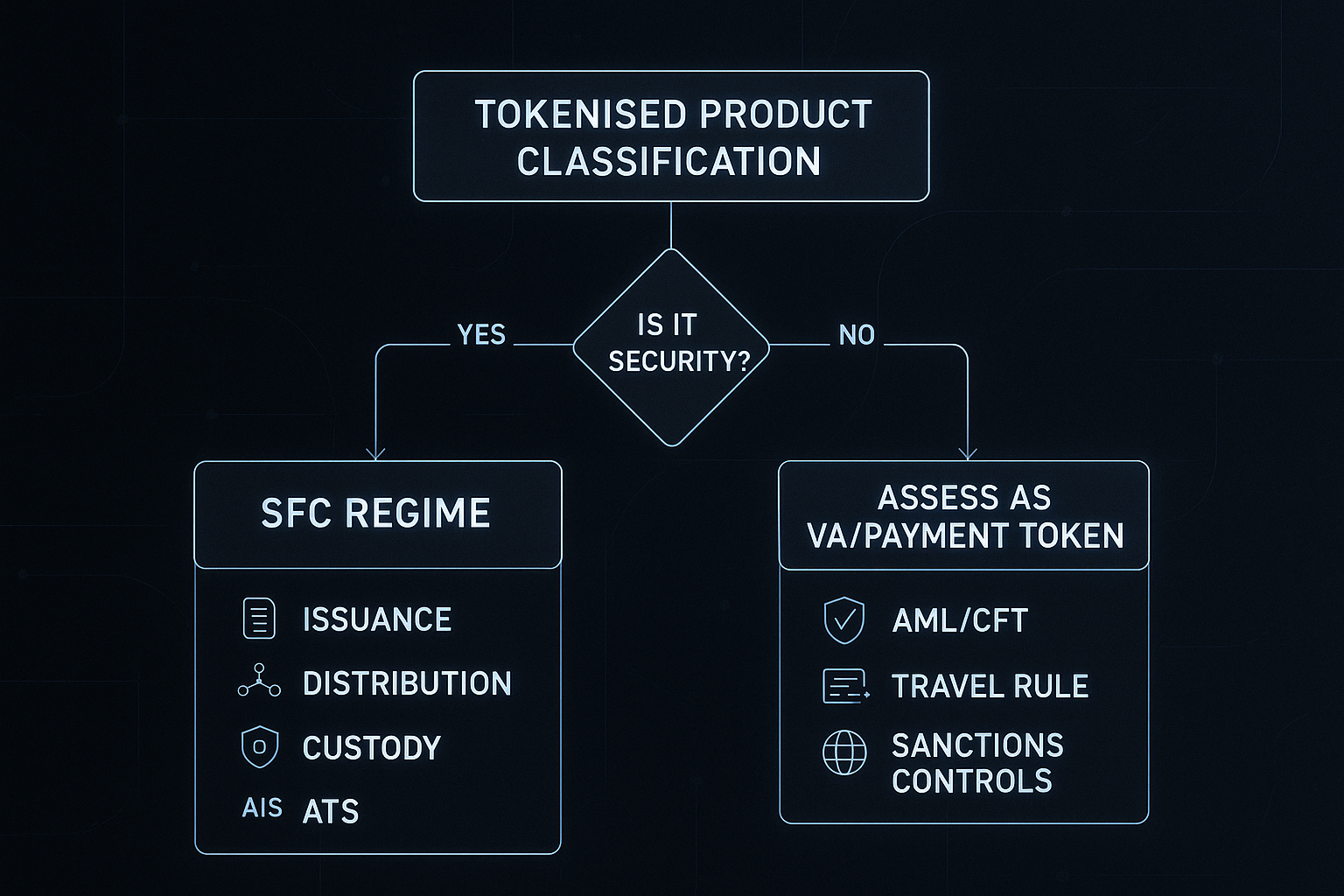
Quick control map for HK firms
| Topic | FATF/Policy 2.0 signal | Practical control (HK) |
|---|---|---|
| Stablecoin holders | Some members require identification and verification of any holder | Full KYC for all stablecoin users; capture purpose-of-use; refresh frequently for active wallets |
| Unhosted wallets | High-risk due to anonymity/mobility | Verify ownership of self-custody addresses before large withdrawals; Travel Rule when feasible; sanctions + on-chain screening |
| Algorithmic stablecoins | Elevated ML/TF and market integrity risk | High-risk rating; restrict to professional investors; real-time depeg alerts; EDD on issuers and major liquidity providers |
| Tokenised securities | Regulatory perimeter unchanged by token form | SFC licensing for distribution/ATS; investor suitability; prospectus/exemptions; segregated custody; resilience testing |
| RWA tokenisation | Legal enforceability is paramount | Map token to legal title/rights; third-party trustee/registrar; lifecycle event automation with manual override |
Execution checklist (what to do this quarter)
- Classify tokens: Maintain a written taxonomy covering payment stablecoins, algorithmic stablecoins, utility tokens, and tokenised securities, with controls per class.
- Build an unhosted wallet policy: Ownership verification (e.g., SOWA signatures or micro-transfers), allow/deny lists, thresholds, and Travel Rule data capture on VASP-to-VASP transfers.
- Strengthen monitoring: On-chain analytics rules for stablecoin flows (bridges, mixers, high-risk jurisdictions) and automated depeg/abnormal velocity alerts.
- Tokenisation legal stack: Term sheets, trust/agency arrangements, registrar controls, and redemption playbooks tied to corporate actions and insolvency scenarios.
- Align with global standards: Map your controls to IOSCO, FSB, Basel, and OECD CARF expectations referenced in Policy Statement 2.0.
Closing thought Hong Kong is laying the pipes for institutional-grade tokenisation while keeping AML/CFT tight. If you lean into those guardrails—especially around algorithmic stablecoins and unhosted wallets—you’ll be ready for both the regulator and the market.
References
- BIS on stablecoins risks and regulation: https://www.bis.org/publ/bisbull58.htm
- FATF on virtual assets and VASPs: https://www.fatf-gafi.org/en/topics/virtual-assets.html
- Hong Kong Policy Statement (virtual assets/digital assets): https://www.fstb.gov.hk/en/financial-services/policy-initiatives/fintech/virtual-assets.html
- FSB global regulatory framework for crypto-asset activities: https://www.fsb.org/2023/07/fsb-finalises-global-regulatory-framework-for-crypto-asset-activities/
- OECD Crypto-Asset Reporting Framework (CARF): https://www.oecd.org/tax/automatic-exchange-of-information/crypto-asset-reporting-framework.htm


