
HK Compliance: FATF, CRS & Retail Stablecoin Rules 2025

Introduction
If you operate a crypto exchange, wallet, treasury desk, or fintech in Hong Kong, 2025 is the year three rulebooks finally converge on your operating model: FATF AML standards, CRS tax reporting, and retail stablecoin rules. They don’t always speak the same language, but they point in one direction—bank‑grade controls for virtual assets, consistent accounting, and clear consumer protections.
What FATF now means in practice for Hong Kong VASPs
Hong Kong’s policy stance is to align with international standards from IOSCO, the FSB, and the Basel Committee (see the government’s “Policy Statement 2.0” direction referencing IOSCO’s crypto recommendations, the FSB’s global framework, and Basel’s prudential treatment). This translates to:
- Travel rule and counterparty due diligence: Licensed VASPs must exchange originator/beneficiary information with counterpart VASPs and apply enhanced checks to unhosted wallets. FATF has flagged unhosted wallets as higher risk due to anonymity and portability; expect auditors to ask for evidence of screening and risk scoring on these flows. Links: FATF guidance; FSB framework; IOSCO recommendations; Basel standard.
- Stablecoin AML posture: The BIS has underscored stablecoin vulnerabilities for ML/TF and sanctions evasion. Consultation conclusions noted some FATF members began with a cautious model that requires KYC for any stablecoin holder. Don’t assume “small-value stablecoin” equals simplified due diligence in Hong Kong.
- Governance uplift: Map board accountability, risk, and compliance testing to IOSCO’s market integrity recommendations and FSB cross‑border principles. For banks and SFO-licensed groups, Basel crypto exposure limits and risk aggregation rules still apply at the consolidated level.
CRS isn’t just for banks anymore
The Common Reporting Standard (CRS) applies in Hong Kong to “Financial Institutions” (FIs), which can include custodial entities and certain investment entities—some crypto businesses fall in by function, not by label. Two realities:
- If you safeguard client fiat or digital assets as a business and earn fees, you may be a “Custodial Institution” for CRS. That triggers collection of tax residency self‑certifications, TINs, and annual reporting to the IRD.
- Crypto‑specific reporting (the OECD’s Crypto‑Asset Reporting Framework, CARF) is coming, but CRS obligations already bite. Our reviews often find 20–40% of active client files missing TINs or residence data (illustrative). Clean this now—CRS reporting typically runs by end-May for the prior year in Hong Kong.
Retail stablecoin rules in 2025: what’s allowed and what’s next
- Trading access: Licensed VATPs in Hong Kong have generally restricted retail access to fiat‑referenced stablecoins pending an issuer regime. Expect a phased opening only once the stablecoin issuer licensing framework is in force and AML/consumer safeguards are operationalized.
- Issuer regime trajectory: Government consultations have emphasized full-scope AML/KYC (including for device-based transactions), redemption guarantees, reserve segregation, and disclosures. Build for guaranteed redemption, daily reserve attestation, and wallet‑level KYC as the baseline.
- Accounting ripple effects: Per recent U.S. SEC staff guidance reported by Bloomberg and The Block, USD‑pegged stablecoins could be treated as cash equivalents—but only where there’s a guaranteed redemption mechanism. For Hong Kong groups with U.S. listings or U.S. GAAP reporting, treasury teams should re‑assess classification, liquidity risk, and disclosures. Under IFRS, apply IAS 7’s “short-term, highly liquid, insignificant risk” test—don’t assume equivalence. Obtain auditor pre‑clearance and document counterparty, legal, and redemption risks.
What to do this quarter
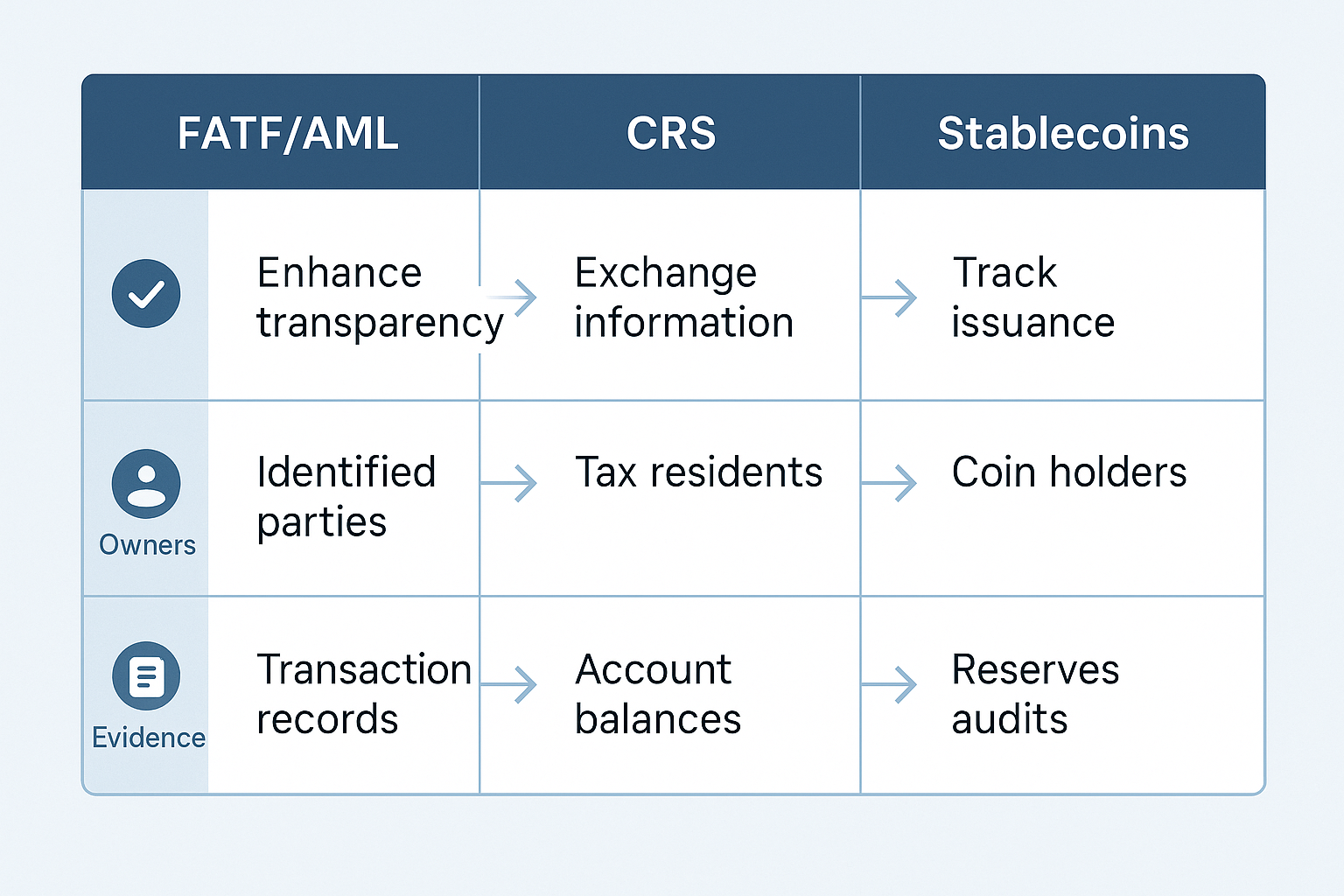
-
FATF/AML
- Actions: Implement travel rule interoperability, risk‐score unhosted wallets, record sanctions screening on stablecoin flows, test name matching.
- Owner: Compliance + Engineering.
- Evidence: Transfer payload logs, sanctions hits workflow, quarterly QA test pack.
-
CRS
- Actions: Classify entities for CRS, refresh client self‑certs/TINs, reconcile reportable accounts, prepare IRD XML by end‑May.
- Owner: Finance + Ops.
- Evidence: FI status memo, gap list for missing TINs, filing confirmation.
-
Stablecoins
- Actions: If an issuer/custodian, design guaranteed redemption with T+0/T+1 SLAs, segregate reserves at regulated banks, daily reconcile; if a VATP, maintain retail restrictions until the issuer regime is effective.
- Owner: Treasury + Legal.
- Evidence: Legal terms, reserve attestations, redemption logs, product gating controls.
Closing thought
The direction of travel is clear: global standards first, local nuance second. Build your controls to satisfy FATF, align your reporting with CRS today (and CARF tomorrow), and treat retail stablecoins like bank products—with redemption, reserves, and real KYC. It’s more work upfront. But it’s much cheaper than a remediation program under a spotlight.
References and further reading
- IOSCO Policy Recommendations for Crypto and Digital Asset Markets: https://www.iosco.org/library/pubdocs/pdf/IOSCOPD751.pdf
- FSB Global Regulatory Framework for Crypto-asset Activities: https://www.fsb.org/2023/07/global-regulatory-framework-for-crypto-asset-activities/
- Basel Committee Prudential Treatment of Cryptoasset Exposures: https://www.bis.org/bcbs/publ/d545.htm
- FATF virtual assets guidance and travel rule updates: https://www.fatf-gafi.org/en/publications/Fatfrecommendations/Guidance-rba-virtual-assets-vasps.html
- BIS commentary on stablecoin vulnerabilities: https://www.bis.org/publ/bisbull69.htm
- SEC staff guidance on stablecoin accounting (coverage): https://www.theblock.co/post/316655/sec-staff-guidance-stablecoin-accounting-cash-equivalent-reporting-bloomberg
- SFC VATP licensing overview: https://www.sfc.hk/en/Rules-and-standards/Virtual-asset-trading-platforms-licensing-and-supervision


