HK Compliance: Cross-Border Crypto EDD & Fit-Proper

HK Compliance: Cross-Border Crypto EDD & Fit-Proper
Getting cross-border crypto payments right in Hong Kong isn’t just about Travel Rule files and address screening. It’s whether your governance, counterpart onboarding, and wallet controls line up with what the regulators have now signalled—especially around OTC channels, stablecoin flows, and unhosted wallets.
If you move value into or out of Hong Kong, this is where scrutiny lands first.
What’s Changed (and Why It Matters)
- VA OTCs are coming under a formal regulatory perimeter. The government’s consultation on VA OTCs made the rationale plain: these businesses funnel retail funds and therefore need AML/CFT-grade controls and investor protection within remit (see the consultation context here: Securities and Futures Commission – Virtual Assets).
- Stablecoin flows face a higher bar. The authorities clarified in AML/CFT guidance that due diligence on third-party entities should be equivalent to custodial wallet providers. For redemptions, you must perform diligence on the institution providing the custodial wallet and apply extra controls when interacting with unhosted wallets.
- Wallet screening is not optional. Where you cannot conduct satisfactory DD (e.g., the custodial wallet provider is unsupervised), you must screen wallet addresses with appropriate technological solutions and mitigate any elevated ML/TF risks.
These moves align with international standards noted in Hong Kong’s policy stance referencing IOSCO, the FSB, and Basel workstreams (see: Hong Kong’s virtual asset policy statements via the Financial Services and the Treasury Bureau and the SFC).
Where Cross-Border EDD Often Fails
- Treating a foreign VASP as “trusted” without verifying supervision or Travel Rule readiness.
- Accepting stablecoin redemption flows from a third-party custodian without checking its regulatory status and AML programme.
- Not differentiating unhosted wallets from supervised custodial wallets in risk scoring and monitoring.
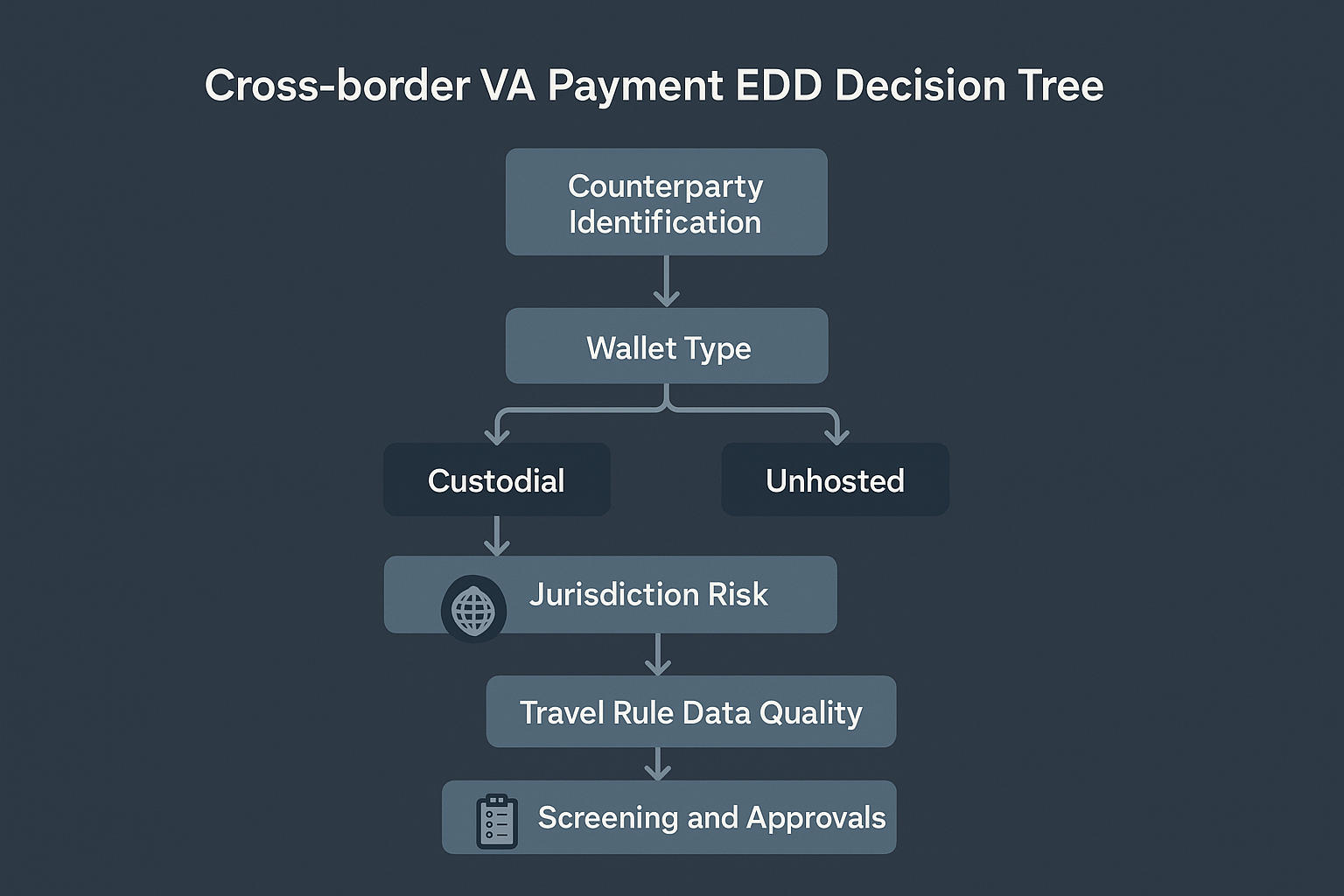
A Practical EDD Playbook for Cross-Border Crypto
-
Counterparty classification
- Licensed/supervised VASP: Verify licence, scope, and sanctions policy. Obtain a current AML attestation and Travel Rule capability statement.
- Financial institution/custodian: Confirm supervision, prudential standing, and wallet segregation controls.
- Unhosted wallet owner: Collect proof-of-control (signed message, micro-tx roundtrip) and enhanced sanctions/illicit nexus screening.
-
Stablecoin-specific checks
- Redemption pathways: If funds pass through a third-party custodian, apply the same DD you would for a custodial wallet provider. Document the chain of control and who holds KYC on end-users.
- Issuer monitoring: Record issuer blacklist events, smart contract changes, and freeze/blacklist actions that could affect your customer—then reflect this in ongoing monitoring rules.
-
Data and Travel Rule
- Require complete originator/beneficiary data for cross-border transfers. Reject or hold if counterparty VASP cannot transmit in a Travel Rule-compatible format.
- Keep a 2-hour triage SLA for incomplete Travel Rule data in business hours (illustrative), escalating to MLRO if unresolved.
-
Unhosted wallet risk controls
- Address screening: Use at least two analytics providers for high-risk corridors (illustrative: TRM + Chainalysis) to reduce model bias.
- Behavioral heuristics: Flag interaction with sanctioned mixers, darknet markets, or high-risk bridges. Impose cooling-off periods (e.g., T+1) for first-time external withdrawals above HKD 100,000 (illustrative).
-
Jurisdictional overlays
- Apply Enhanced Due Diligence for FATF high-risk or under-increased monitoring jurisdictions. Require source-of-funds/source-of-wealth evidence and senior management approval for initial transactions.
-
Supervised VASP ↔ VASP: Licence verification, Travel Rule exchange, dual analytics screening, periodic counterparty review (quarterly).
-
VASP ↔ Bank/Custodian: Regulatory status check, wallet segregation attestation, sanctions alignment, settlement account verification.
-
VASP ↔ Unhosted Wallet: Proof-of-control, heightened screening, first-transaction cap, manual approval for red flags.
Fit and Proper: Don’t Treat It as a Checkbox For Hong Kong licensing (current and proposed regimes), “fit and proper” anchors everything. Expect focus on:
- Integrity and disciplinary history of controllers, senior managers, and MLRO.
- Competence: demonstrable VA product knowledge, Travel Rule operations, blockchain analytics literacy.
- Financial soundness: sufficient capital runway and audited financials.
- Governance independence: clear three lines of defense, with the MLRO empowered to veto high-risk flows.
What To Do This Quarter
- Map counterparties by type and jurisdiction; upgrade any “trusted but unsupervised” relationships.
- Document your stablecoin redemption flows and custodial touchpoints, including issuer monitoring triggers.
- Separate SOPs for unhosted wallets vs. custodial wallets; embed proof-of-control steps.
- Run a fit-and-proper gap assessment for controllers and ROs against SFC standards.
Cross-border crypto is fine—if you can defend every hop.
References and further reading:
- SFC – Virtual Asset regulatory development: https://www.sfc.hk/en/Policies-and-regulations/Policy-and-regulatory-development/Virtual-asset-trading-platforms
- FSTB – Policy and consultation materials: https://www.fstb.gov.hk/en/
- FATF – Virtual Assets and VASPs guidance: https://www.fatf-gafi.org/en/publications/Fatfrecommendations/Guidance-rba-virtual-assets-and-vasps.html
If you want a rapid EDD template pack tailored for VA OTCs and stablecoin flows, reach out—we’ve implemented these controls across Hong Kong, Singapore, and the UAE with regulator-facing documentation that actually holds up.