
HK Compliance Brief: IRA & OECD CARF Crypto Reporting

HK Compliance Brief: IRA & OECD CARF Crypto Reporting
The short version: 2025 is the year crypto tax transparency goes from “coming soon” to implementation planning. If you operate in or from Hong Kong—exchanges, OTCs, brokers, custodians, tokenisation platforms—two regimes drive your roadmap: the OECD’s Crypto-Asset Reporting Framework (CARF) and the US “IRA-era” broker reporting rules. They’re different in scope but converge on one thing: granular, standardised, cross-border data.
What this means for Hong Kong Hong Kong’s Policy Statement 2.0 puts tax transparency alongside global prudential and market standards—IOSCO recommendations, the FSB’s global framework, and the Basel Committee’s crypto exposure rules—while advancing RWA tokenisation and stablecoin use cases. In parallel, the Government has moved to regulate VA OTC activity with FATF-aligned AML/CFT controls (CDD, record keeping, investor protection). The direction of travel is clear: build once for global standards, then localise.
Two pillars you can’t ignore
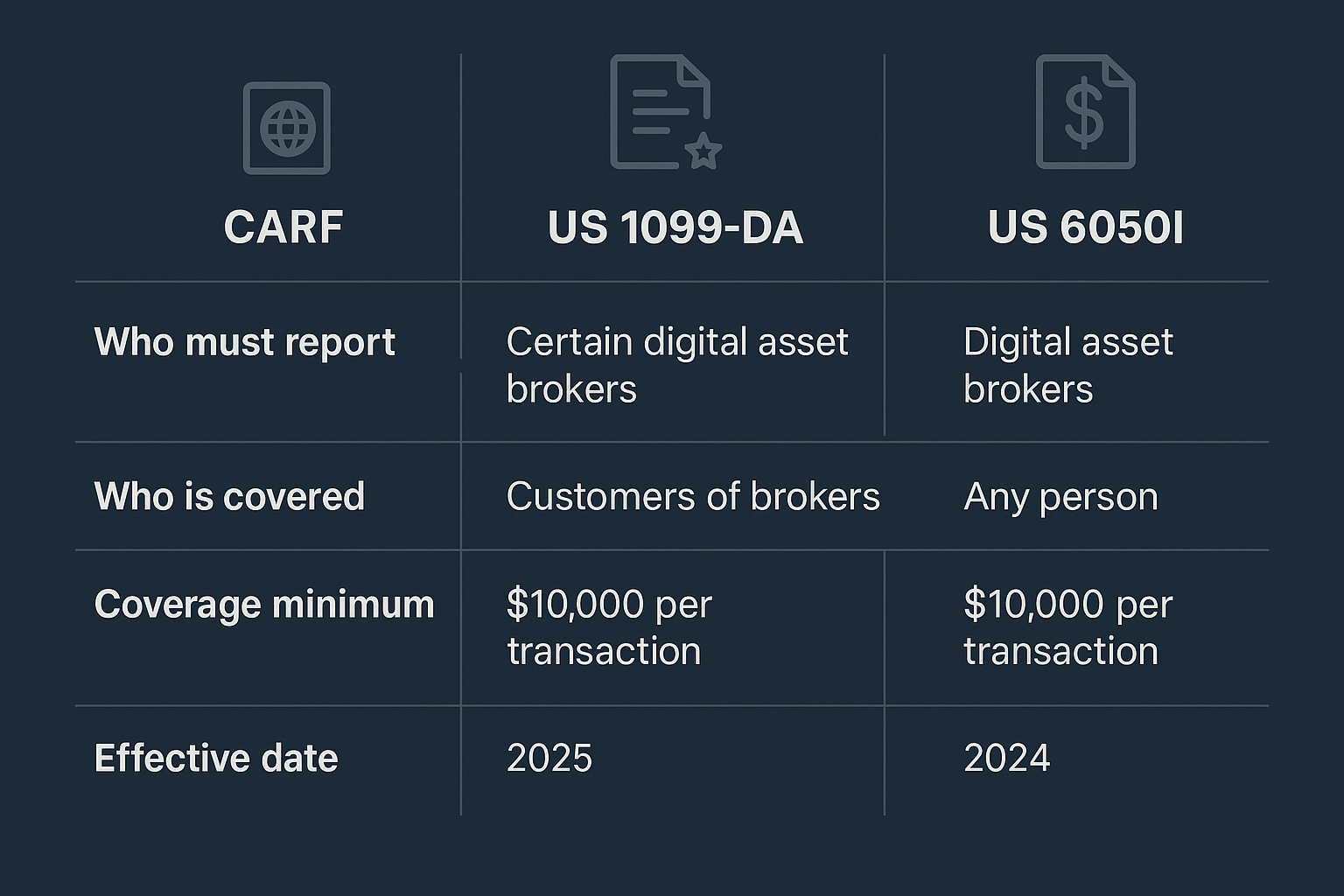
- OECD CARF (global): A new automatic exchange of information regime for crypto-assets, designed to sit alongside CRS. Expect reporting of customer identity, tax residence, wallet/account identifiers, gross proceeds, and—where relevant—cost basis across exchanges, brokers, and certain DeFi intermediaries. See OECD CARF overview: https://www.oecd.org/tax/automatic-exchange-of-financial-account-information/crypto-asset-reporting-framework.htm
- US “IRA-era” reporting (domestic, extra-territorial touch): Although often conflated, two rule streams matter:
- Broker reporting (Form 1099-DA) for sales/dispositions of digital assets by US persons and, in many cases, via US-facing platforms. Effective dates phase in from 2025 with first filings expected in 2026. See IRS Digital Assets hub: https://www.irs.gov/digital-assets and proposed regs: https://www.irs.gov/pub/irs-drop/reg-122793-19.pdf
- Section 6050I expansion (from the 2021 Infrastructure Act): Treats certain digital-asset receipts >US$10,000 like cash for reporting. Edge cases hit OTC desks and P2P brokers.
They overlap—but not perfectly.
Why this sits inside HK’s broader rulebook
- IOSCO, FSB, Basel: Expect governance, conflicts management, and prudential capital to be tested when you redesign data pipelines. Links: IOSCO policy recommendations https://www.iosco.org/; FSB global framework https://www.fsb.org/2023/07/global-regulatory-framework-for-crypto-asset-activities/; Basel crypto exposures https://www.bis.org/bcbs/publ/d545.htm
- FATF AML/CFT: OTC and platform KYC/KYV (Know-Your-VASP) now need consistent TIN/tax residency capture to avoid duplicate outreach and audit gaps. FATF VA guidance: https://www.fatf-gafi.org/en/publications/Fatfrecommendations/Guidance-VA-VASPs.html
- Investor protection: Misreporting taxes is a conduct risk. Expect SFC/HKMA to ask how your disclosures, statements, and suitability processes reflect tax-sensitive instruments (e.g., tokenised bonds with coupons vs. staking rewards).
What to do now (practical, 90-day plan)
- Map business lines and counterparties:
- Centralised exchange, OTC desk, brokerage, custody, tokenisation SPV, DeFi interface.
- Flag US touchpoints (US customers, marketing, servers, banking) and CARF jurisdictions.
- Build the minimum viable data schema:
- Identity: legal name, DOB, address, tax residence(s), TINs, KYC refs.
- Asset/transaction: token symbol/contract, chain/addresses, timestamp, quantity, fiat FMV at execution, cost basis, fees, counterparty VASP.
- Wallet/account identifiers consistent with CARF definitions.
- Calibrate valuation and cost basis:
- Lock pricing sources and FX rate hierarchies; document fallbacks.
- For cost basis, define FIFO/Specific ID policies where permitted; ensure consistency with US 1099-DA expectations for US persons.
- Tighten onboarding and disclosures:
- Collect self-certifications for tax residence and TINs at onboarding; refresh upon indicia changes.
- Add customer notices on potential reporting under CARF/1099-DA/6050I.
- Test reporting pipelines:
- Generate a sample 1099-DA file and a CARF-style XML for a limited customer set.
- Reconcile against ledger and bank/custody statements; target ≤0.5% variance (illustrative) before scale-up.
- Governance and record retention:
- Assign a CARF/IRS reporting owner; set issue logs and remediation SLAs.
- Retain evidence (KYC, valuations, consents) per HK AML/CTF and tax norms.
Caveats to watch
- DeFi interfaces: CARF contemplates certain intermediaries even if non-custodial. Document your role and data reach honestly.
- Stablecoins and RWAs: Tokenised coupons/redemptions blur income vs. proceeds. Align tax characterisation with legal terms and offering docs.
- Extra-territorial risk: You don’t need a US entity to trigger US reporting; “US person” and business nexus analyses matter.
Bottom line CARF and the US IRA-era rules are forcing crypto firms to behave like mature financial institutions on data, documentation, and disclosures. If you build a single, well-governed dataset that satisfies CARF, 1099-DA, and FATF AML records, you’ll avoid rework later—and you’ll be ready for Hong Kong’s push on tokenisation and stablecoin use cases grounded in global standards.


