
HK Compliance: Audits, Fund Tokenisation & HKMA Stablecoins

Introduction
Three threads are converging in Hong Kong’s digital asset market in 2025: audits, fund tokenisation, and the HKMA’s stablecoin regime. They’re not separate conversations anymore. If you issue a stablecoin, tokenise a fund, or custody client assets, your controls, code, and records will be judged as one cohesive system.
Let’s unpack what has actually changed — and what to do this quarter.
HKMA’s Stablecoin AML/CFT Regime: What It Really Demands
On 26 May 2025, the HKMA launched a consultation on AML/CFT requirements for stablecoin licensees. The aim is explicit: ensure licensees implement effective systems to prevent ML/TF in connection with licensed stablecoin activities. If an HKMA-licensed issuer also holds custody of its own coins, it will be under ongoing HKMA supervision — with clear expectations around investor protection: segregation of client VAs, adequate audit, record-keeping, and other safeguards.
Useful links:
- HKMA consultation on AML/CFT for stablecoin issuers (May 2025): https://www.hkma.gov.hk/eng
- Policy Statement 2.0 on the Development of Digital Assets in Hong Kong (stablecoin use cases): https://www.gov.hk/en/theme/psi/digital-asset-policy
What to do now (practical, not theoretical):
- Governance and RACI: Document who can mint/burn, pause contracts, change reserves policy, and approve redemptions. Map these to named individuals and backups.
- End-to-end AML: Customer due diligence, sanctions and PEP screening, source-of-funds checks, on-chain analytics for address risk, and rule-based monitoring for mint/burn/redemption patterns.
- Record-keeping: Maintain immutable logs linking wallet addresses to KYC profiles, mint/burn events, and reserve movements; retain for at least 6 years (typical HK AML standard).
- Reserve assurance: Daily reconciliation and independent attestations (e.g., monthly) that tie circulating supply to reserves. This will be checked.
- Custody design: Segregated on-chain addresses per client or per product; strict key management and access reviews. If you self-custody as an issuer, expect deeper HKMA scrutiny.
Smart Contract Auditing: Go Beyond “No Bugs Found”
For both stablecoins and tokenised funds, regulators will look past a PDF audit and into how the contract fits the business process. The audit scope needs to cover mechanics, governance, and failure modes.
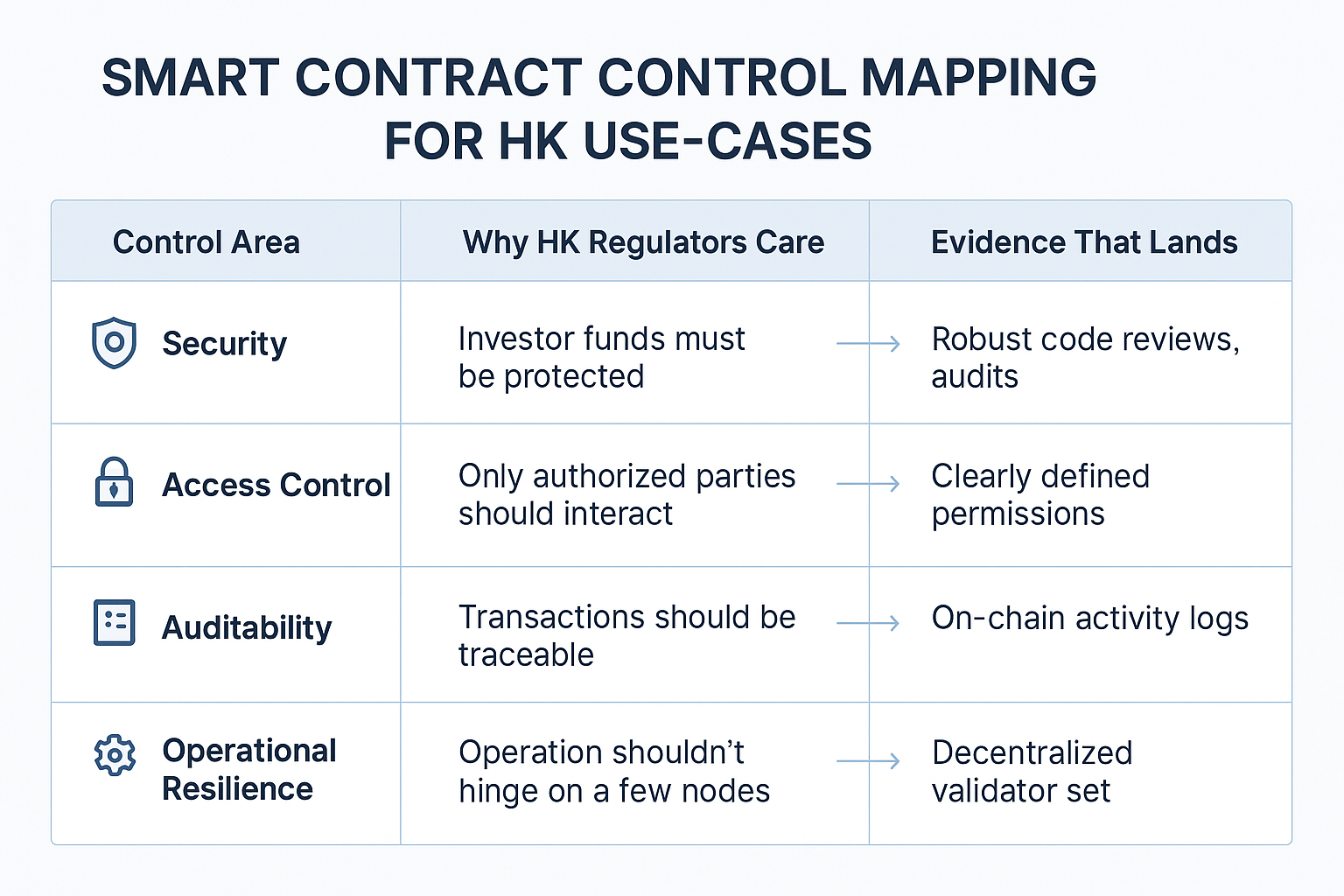
| Control area | Why HK regulators care | Evidence that lands |
|---|---|---|
| Mint/burn invariants | Prevents supply drift and ML/TF leakage | Property-based tests; invariants proving 1:1 backing |
| Admin controls | Concentrated keys = single-point failure | Multi-sig policies; HSM custody; change logs |
| Upgradeability | Silent upgrades can harm investors | Timelocks; on-chain announcements; rollback plans |
| Pausable/emergency | Abuse vs real incident | Clear runbooks; threshold criteria; board sign-off |
| Oracles/price feeds | Manipulation risk | Data redundancy; circuit breakers; oracle SLA |
| Reconciliation | Off-chain register vs on-chain ledger | Daily automated checks; exception handling tickets |
Add external validation: independent code audits, pre-deployment formal verification for critical functions, and a red-team simulation of operational abuse (e.g., compromised admin key + oracle spike).
Fund Tokenisation: SFC Expectations in Practice
Hong Kong supports tokenisation projects, including funds, and the SFC has indicated that tokenised products remain subject to existing product rules (e.g., Code on Unit Trusts and Mutual Funds) with extra tech risk controls. In plain terms, tokenising does not lower the bar; it raises it.
- Disclosure: Explain DLT risks, smart contract governance, resilience, and investor exit mechanics if the chain or tokenisation platform fails.
- Registries: The legal register of holders must reconcile with the on-chain view. Your TA function can’t rely solely on a node.
- Operations: Clear processes for subscriptions/redemptions, cut-off times, failed token deliveries, and settlement finality.
- Service providers: Due diligence on the tokenisation platform, node operators, and custodians — security posture, SLAs, and audit reports.
- Audits: Smart contract audit plus operational audit of issuance/redemption workflows and data integrity between systems.
Custody and Segregation: The Common Denominator
Custody is the point of failure that regulators assume will fail. The Government’s consultation on regulating virtual asset custodian services frames the baseline: segregate client assets, maintain robust records, and be audit-ready. Whether you’re an HKMA-licensed stablecoin issuer or a manager of tokenised funds, implement:
- Segregated wallets (per client or per product) with provable ownership.
- Key management with hardware-backed controls, dual control, and access reviews.
- Reconciliation across bank, chain, and books daily with exception handling.
- Third-party assurance: SOC 2-type controls and proof-of-reserves style attestations where relevant.
One more point.
Assume a regulator will replay a single investor’s lifecycle from KYC to redemption and expect every step — code, logs, approvals — to line up.
Closing Thoughts
Hong Kong isn’t slowing down. The HKMA’s AML/CFT framework for stablecoins, combined with SFC expectations on tokenised funds and the push to regulate custodians, sets a clear direction: real controls, not slogans. If you prioritise only three actions this quarter, make them these: formalise contract governance, industrialise AML plus on-chain monitoring, and harden custody with segregation and reconciliations. That’s how you stay fast — and stay authorised.


