HK Compliance: AML/CFT for Stablecoin Issuers under PSO

HK Compliance: AML/CFT for Stablecoin Issuers under PSO
Hong Kong is moving from statements to specifics. On 26 May 2025, the HKMA tabled its draft AML/CFT Guideline for Licensed Stablecoin Issuers and reported broad industry support in its consultation conclusions. In plain terms: if you issue a fiat-referenced stablecoin accessible by Hong Kong users, expect to be licensed under the Payment Systems and Stored Value Facilities Ordinance (Cap. 584) (PSO) and held to bank-grade AML/CFT standards.
Why this matters now
- Hong Kong’s virtual asset build-out is entering its “infrastructure” phase. After the 2022 AMLO amendment set the AML baseline for VATPs, regulators are extending FATF-aligned controls to custodians and now stablecoin issuers.
- The PSO gives the HKMA a familiar supervisory chassis to regulate issuance, redemption, and circulation—where AML/CFT risks are most acute.
Links for context:
- HKMA homepage (consultations and guidelines): https://www.hkma.gov.hk
- PSO (Cap. 584): https://www.elegislation.gov.hk/hk/cap584
- AMLO (Cap. 615): https://www.elegislation.gov.hk/hk/cap615
- 2022 Policy Statement on Virtual Assets: https://www.info.gov.hk/gia/general/202210/31/P2022103100315.htm
- SFC VATP regime (for reference): https://www.sfc.hk/en/Regulatory-functions/Intermediaries/Virtual-asset-trading-platforms
- FATF Virtual Assets guidance: https://www.fatf-gafi.org/en/topics/virtual-assets.html
- JFIU (suspicious transaction reporting): https://www.jfiu.gov.hk
What the HKMA’s draft AML/CFT Guideline signals Expect the stablecoin AML playbook to mirror AMLO/FATF requirements, calibrated to token flows and reserve operations.
-
Governance and accountability
- Board-approved AML/CFT policies; clear three lines of defence.
- Named Compliance Officer and MLRO with direct board access.
- Independent audit of AML at least annually.
-
Risk assessment and onboarding
- Enterprise-wide ML/TF risk assessment covering issuance, redemption, peer-to-peer transfers, cross-border corridors, distributors/agents, and reserve-related counterparties.
- CDD/KYC on holders and merchants; beneficial ownership verification for corporates; EDD for PEPs and high-risk geographies.
- Sanctions screening (UN and local lists) at onboarding and continuously.
-
Monitoring and investigations
- Blockchain analytics to detect mixing, chain-hopping, and darknet exposure.
- Rules- and model-based monitoring aligned to token mechanics (e.g., rapid mint-redeem loops, velocity spikes).
- STRs to JFIU; case management with audit trails.
-
Transfers and information sharing
- Alignment with FATF Recommendation 16: capture and transmit originator/beneficiary information for relevant VA transfers where feasible; interoperability with Travel Rule service providers when interacting with VATPs/VASPs.
-
Outsourcing and distribution
- Robust due diligence and ongoing oversight of distributors, market makers, OTC partners, and wallet providers; written agreements with right to audit.
- Reliance on intermediaries only where AMLO conditions are met (equivalence, timely data access).
-
Record-keeping and training
- Keep CDD and transaction records for at least 5 years.
- Role-based training for front line, compliance, and tech teams.
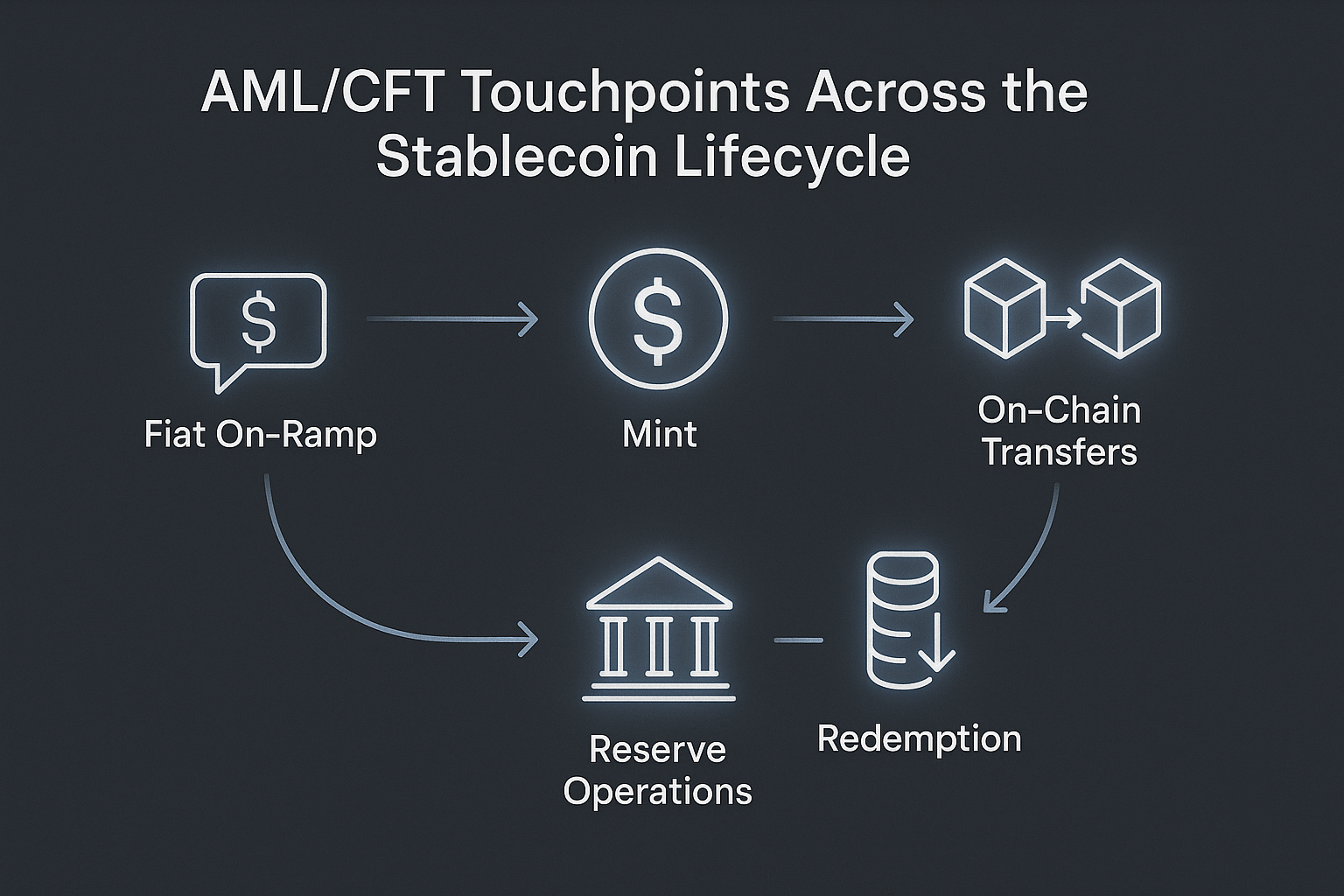
A quick comparison: what regulators expect and what you should do
| Area | HKMA/PSO expectation | Issuer action (illustrative) |
|---|---|---|
| Governance | Board ownership; MLRO/CO in place | Appoint MLRO; AML KPIs in board pack |
| Risk assessment | EWRA covering token flows | Update EWRA before licensing; refresh annually |
| Onboarding | BO identification; EDD for PEPs | Centralise KYC; add KYB for distributors |
| Monitoring | On- and off-chain surveillance | Deploy blockchain analytics; tune rules monthly |
| Transfers | Originator/beneficiary data where applicable | Integrate Travel Rule provider; test with VATPs |
| Outsourcing | Contractual controls; audit rights | Standardise DDQ; conduct onsite reviews |
| Reporting | Timely STRs to JFIU | Playbooks and 24/7 escalation |
| Records | ≥5 years retention | Immutable logs; tamper-evident storage |
What to do in the next 90 days
- Map flows and risk-rate them: who can mint/redeem, which wallets, which corridors, which partners.
- Build a minimum viable AML stack:
- KYC/KYB system with sanctions/PEP screening.
- Blockchain analytics with clear risk scoring thresholds.
- Case management and STR workflow integrated with JFIU submissions.
- Close the gaps on transfers: select a Travel Rule solution and run bilateral tests with at least two Hong Kong VATPs. Target sub-24 hour information response times.
- Tighten partner oversight: refresh due diligence for OTCs, market makers, and wallet partners; embed data-sharing SLAs and audit clauses.
- Resource realistically: as a rule of thumb (illustrative), 1–2 AML analysts per 10,000 active wallets, plus an investigations lead for every 500 alerts/month.
Common pitfalls we see
- Treating blockchain analytics as optional. It’s expected where material on-chain exposure exists.
- Over-reliance on distributors without timely access to underlying CDD.
- Ignoring redemption risk. Large, rapid redemptions to third-party accounts are classic laundering patterns.
Bottom line The HKMA’s direction is clear: stablecoin issuance under the PSO will carry full AMLO-grade obligations, tuned to token rails. If you design AML into issuance, redemption, and partner touchpoints now, licensing later becomes a process—not a scramble.