
HK CBDC, PSO & VASP Compliance: StanCOMP Insights

Introduction: Why CBDC, PSO and VASP now Hong Kong’s digital asset rulebook is crystallising. The HKMA is pushing ahead on e-HKD and cross-border wholesale CBDC experiments; the SFC’s VATP regime under the AMLO is live; and FSTB/HKMA are moving to regulate VA custody and OTC dealers. If you run payments, exchange, custody or tokenisation in Hong Kong, the overlap between CBDC, the Payment Systems and Stored Value Facilities Ordinance (Cap. 584) and VASP requirements is no longer theoretical — it’s your implementation roadmap.
CBDC in HK: e-HKD and mBridge, with compliance implications
- Retail e-HKD: The HKMA’s e-HKD pilots are testing programmability, tokenised deposits and offline payments. See HKMA’s e-HKD page for scope and timelines: https://www.hkma.gov.hk/eng/key-functions/digital-currency/ehkd/
- Wholesale CBDC: Project mBridge with the BIS Innovation Hub is advancing cross-border settlement using a common platform: https://www.bis.org/about/bisih/topics/cbdc/mcbdc_bridge.htm
What this means:
- Wallet providers and programmability “rules engines” for e-HKD will likely be regulated entities (authorized institutions, SVF licensees, or similar) under Cap. 584. Expect HKMA standards on wallet governance, resilience, and AML screening for programmable transfers.
- CBDC does not remove your AML/CFT duties. KYC, sanctions screening, travel rule interoperability and offline wallet risk controls will be assessed end-to-end.
PSO (Cap. 584): When it bites The Payment Systems and Stored Value Facilities Ordinance (often still called “PSO”) governs retail payment systems and SVFs: https://www.hkma.gov.hk/eng/key-functions/international-financial-centre/regulatory-regime-for-stored-value-facilities-and-retail-payment-systems/
Triggers to watch:
- You issue or manage stored value (including tokenised balances) for retail users.
- Your system is “designated” as a retail payment system due to scale or systemic risk.
- You provide wallets that hold central bank money (e-HKD) or stablecoins for consumer payments.
If your CBDC product uses prefunding, pooled float or merchant acquiring, assume Cap. 584 impact and structure for licensing or bank partnerships early.
VASP, custody and OTC: The AMLO spine
- VATP regime: The Anti-Money Laundering and Counter-Terrorist Financing (Amendment) Ordinance 2022 created the SFC licensing regime for VA trading platforms, aligned with FATF standards: https://www.sfc.hk/en/Rules-and-standards/Virtual-asset-trading-platforms
- Definition anchor: Section 53ZRA of the AMLO (Cap. 615) defines “virtual asset” as a cryptographically secured digital representation of value with features such as a unit of account or store of value: https://www.elegislation.gov.hk/hk/cap615
- Custody proposal: The Government’s consultation on regulating virtual asset custodian services adopts the AMLO definition and contemplates arrangements similar to banks registered with the SFC for securities — expect entity-level licensing, segregation, insurance/compensation arrangements, and technology risk standards.
- Stablecoin AML/CFT: Consultation conclusions indicate custodial wallet providers (FIs or VASPs) for stablecoin holders will face explicit controls and obligations to mitigate unhosted wallet risks.
- OTC proposal: Recognising OTC dealers straddle VA and money service sectors, proposed rules mirror VATP and MSO elements — including appointment of a competent Compliance Officer, system controls, incident response, and enhanced due diligence for cash-heavy flows.
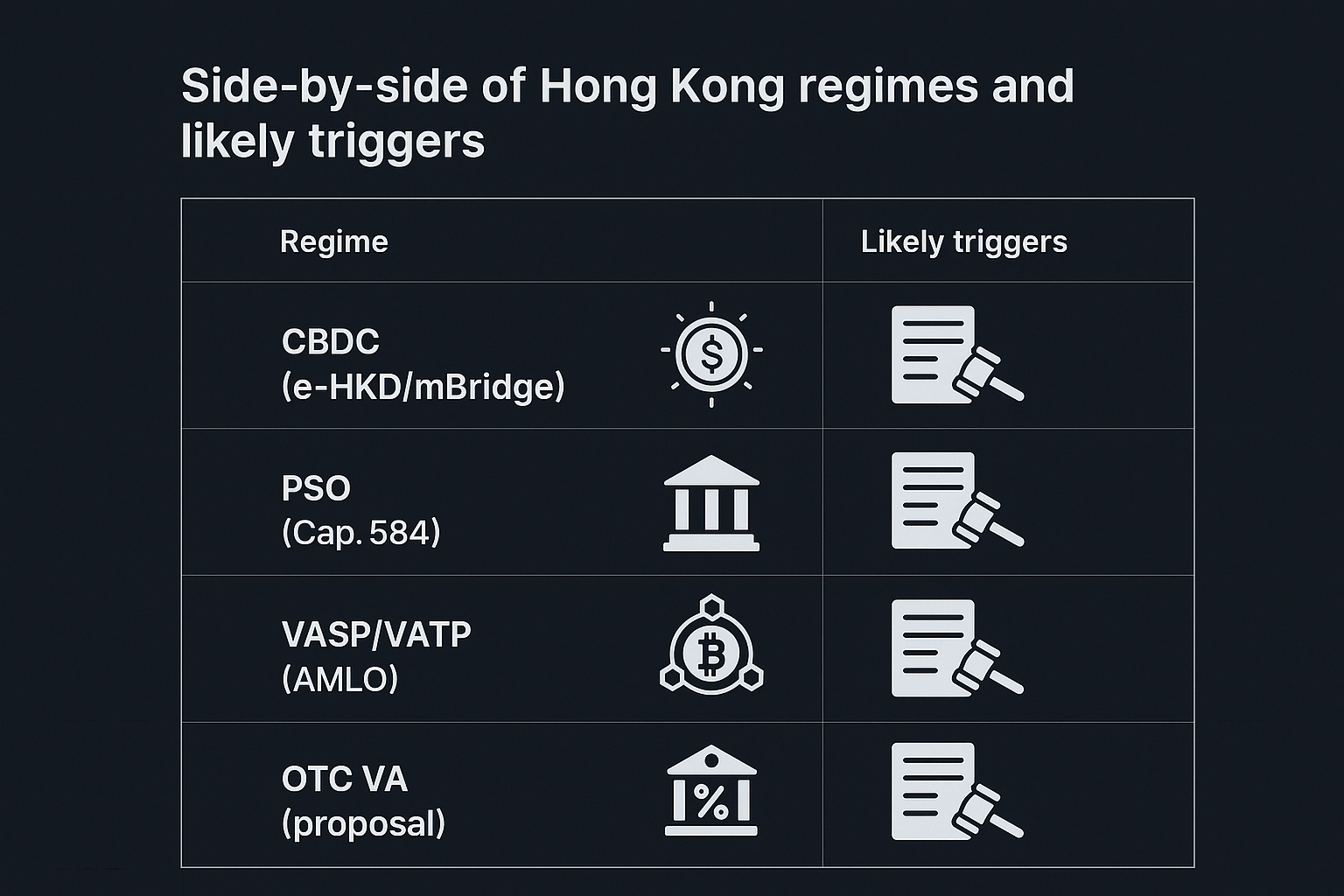
- CBDC (e-HKD/mBridge): Wallet operators, programmability modules, settlement nodes → HKMA oversight; Cap. 584 if retail
- PSO (Cap. 584): SVF issuance, retail payment systems, merchant acquiring → Licensing/designation by HKMA
- VASP/VATP (AMLO): Operating a VA trading platform, custody-as-a-service, stablecoin custodial wallets → SFC/FSTB licensing; AML/CFT per AMLO
- OTC VA (proposal): Dealing/brokering outside exchanges, cash handling → New licence; Compliance Officer required
What to do now
- Map flows precisely: Token type (e-HKD, fiat, VA, stablecoin), who holds private keys, and where settlement occurs. This determines whether Cap. 584, AMLO Part 5B, or both apply.
- Pick a regulatory chassis early:
- Bank partnership for e-HKD/stablecoin wallets, or
- SVF licence for retail balances, or
- SFC VASP for exchange/custody businesses.
- Custody hardening:
- Segregated on-chain addresses; dual/triple-approval; HSM-backed key management with recoverability.
- Insurance or compensation arrangement sized to realistic hot-wallet exposure (e.g., 1–2% of AUC, illustrative).
- Stablecoin controls:
- Identify custodial vs unhosted wallets; apply transfer limits, behavioural analytics and enhanced KYC for unhosted interactions, consistent with consultation conclusions.
- Governance and people:
- Appoint a competent Compliance Officer (explicitly called out in the OTC proposals).
- Establish incident playbooks covering system failure/security breach reporting across SFC/HKMA touchpoints.
One last point CBDC and VASP regimes are converging on custody, resilience and AML. Structure your product so you can evidence those three pillars on day one.
If you need a quick scoping call, StanCOMP can help you map your architecture to Cap. 584 and AMLO requirements and avoid costly rework before launch.


