
HK CBDC Compliance: Source of Wealth Essentials

Introduction: CBDC rails don’t dilute AML. They magnify it. Hong Kong’s e-HKD work is moving from lab pilots toward real-world integration with banks, wallets, and possibly tokenized asset rails. The Hong Kong Monetary Authority (HKMA) will remain the frontline supervisor for banks’ digital asset dealing, while the Securities and Futures Commission (SFC) sets standards for virtual asset (VA) providers and licensing. That split—spelled out in the government’s Policy Statement 2.0 on Digital Assets—means one thing for compliance teams: source of wealth (SoW) controls must be CBDC-ready from day one.
Documentation beats narrative.
Why SoW matters for CBDC
- CBDC is cash-like in speed but not in anonymity. Institutions will face sharper expectations on customer due diligence (CDD), ongoing monitoring, and record-keeping under Schedule 2 of the Anti-Money Laundering and Counter-Terrorist Financing Ordinance (AMLO).
- Hong Kong is tightening the wider VA perimeter: proposed regimes for VA OTC shops and VA custodians explicitly push AML/CTF and investor protection into these channels. If your CBDC rails touch VA flows (e.g., on/off-ramps, tokenized instruments, OTC desk settlement), your SoW standards must match the highest applicable bar.
References:
- HKMA e-HKD programme (central bank digital currency): https://www.hkma.gov.hk
- SFC virtual asset regime: https://www.sfc.hk/en/Rules-and-standards/Virtual-asset-trading-platforms
- AMLO Cap. 615 (Schedule 2): https://www.elegislation.gov.hk/hk/cap615?xlang=en
Source of Wealth vs. Source of Funds
- Source of Funds (SoF): Where this specific transaction’s money comes from (e.g., a salary payment last Friday).
- Source of Wealth (SoW): How the customer accumulated their overall wealth over time (e.g., 12 years of employment, equity proceeds, VA gains).
For CBDC onboarding and high-velocity payments, regulators will expect SoW to be clear, evidenced, and proportionate to risk.
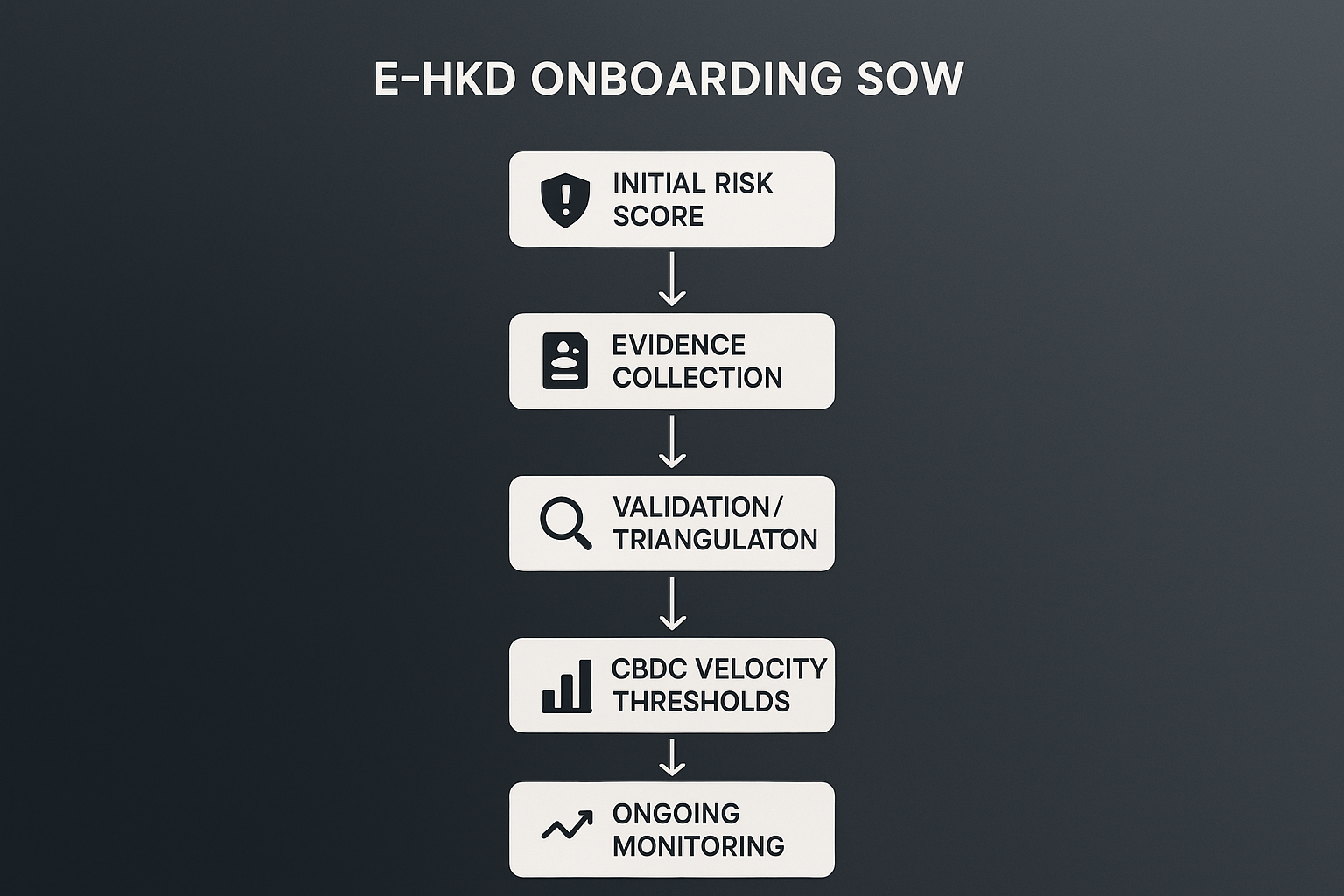
The core SoW playbook (for e-HKD-era onboarding)
- Segment the customer
- Retail, high-net-worth, SME, VA-native, cross-border.
- Assign an initial risk score (illustrative: low 1–3, medium 4–6, high 7–9).
- Collect targeted SoW evidence (risk-based)
- Employment income: tax returns/Employer’s Return, bank statements (6–12 months), employment letter.
- Business owners: audited financials, BR/CR, major contracts, shareholder registry, dividend vouchers.
- VA-derived wealth: exchange statements, on-chain proof with attribution tools, realized gains evidence, OTC receipts. Tie wallets to beneficial owner.
- Investments: broker statements, IPO allotments, private placement agreements, sale-and-purchase records for property.
- Validate, then triangulate
- Consistency across documents, bank inflows mapping, counterparty checks.
- For VA wealth, corroborate on-chain history and off-ramp trails. Use independent analytics. Where proceeds move into CBDC wallets, map timing and quantum.
- Set CBDC-specific guardrails
- Thresholds: set lower triggers for enhanced review on rapid CBDC inflows/outflows (illustrative: HKD 500k daily or HKD 2m rolling 30 days).
- Velocity alerts: detect “smurfing” across multiple CBDC-linked wallets/accounts.
- Purpose flags: programmable or escrow-like CBDC features should be documented in customer profiles and contracts.
- Keep records that tell a story
- AMLO Schedule 2 requires robust CDD and record-keeping. For CBDC, store: SoW evidence, wallet identifiers, risk rationale, adverse media outcomes, and ongoing review notes (6 years minimum retention).
Table: Practical SoW expectations in a CBDC context
| Segment | Typical SoW Evidence | Triggers for EDD | CBDC-Specific Checks |
|---|---|---|---|
| Retail salary earners | Tax slips, 12m bank statements | ≥HKD 500k/month CBDC throughput; cash-heavy top-ups | Salary trail matches CBDC inflows; device/wallet consistency |
| SME owners | Audited accounts, BR/CR, contracts | Large supplier payments to unrelated parties | Counterparty KYC; invoice-to-payment reconciliation |
| VA-native wealth | Exchange/wallet statements, OTC receipts | Rapid on/off-ramp, mixers, high-risk exchanges | On-chain analytics, travel rule data, OTC licensing status |
| Overseas PEPs/HRCs | Asset statements, declarations | Complex structures; sudden large CBDC inflow | Beneficial owner mapping; enhanced media/sanctions sweep |
Regulatory direction you can bank on
- Policy Statement 2.0 emphasises a balanced regime, investor protection, and minimising regulatory arbitrage—HKMA leads banks; SFC leads VA providers.
- The VA OTC consultation argues for bringing OTC channels into the AML/CTF perimeter to protect investors.
- The VA custodian proposal ties custodians to AMLO Schedule 2 CDD and record-keeping—expect compatibility with CBDC settlement and stronger segregation controls.
What to do now
- Refresh your SoW policy to explicitly cover CBDC wallets, velocity thresholds, and on-chain corroboration.
- Calibrate monitoring to CBDC behavioural patterns (time-of-day spikes, merchant category anomalies).
- Map counterparties: ensure VA OTCs and custodians you touch are (or will be) within Hong Kong’s regulatory perimeter.
- Train front-line teams on SoW vs SoF. Then test with real files.
Final thought CBDC won’t lower the AML bar in Hong Kong. It raises it—and the firms that operationalise SoW well will move faster, safer, and with regulator-ready files.


