
HK CBDC Compliance: Real-Time Monitoring & Risk-Based AML

Introduction: CBDC rails change AML expectations Hong Kong’s e-HKD pilots are moving from concept to live trials under the HKMA’s two-tier model. If you plan to integrate CBDC rails in 2025—whether as a bank, PSP, or wallet front end—your AML/CFT posture must shift from batch checks to continuous, real-time controls. This isn’t optional. BIS work has highlighted stablecoin and tokenised payment vulnerabilities for ML/TF and sanctions evasion, and Hong Kong’s Policy Statement 2.0 commits to aligning with IOSCO, FSB and Basel standards while facilitating CBDC and tokenisation use cases.
Real-time means decisions before value settles.
Why real-time monitoring for CBDC?
- Settlement finality and programmability compress your decision window.
- The FATF continues to flag risks around pseudonymity and unhosted wallets, urging risk-based mitigations and effective Travel Rule implementation.
- Hong Kong’s stablecoin AML consultations emphasise that every participant in a transfer should receive essential information to run transaction monitoring, sanctions screening and risk mitigation. The same design logic applies to CBDC intermediaries.
Designing the control stack
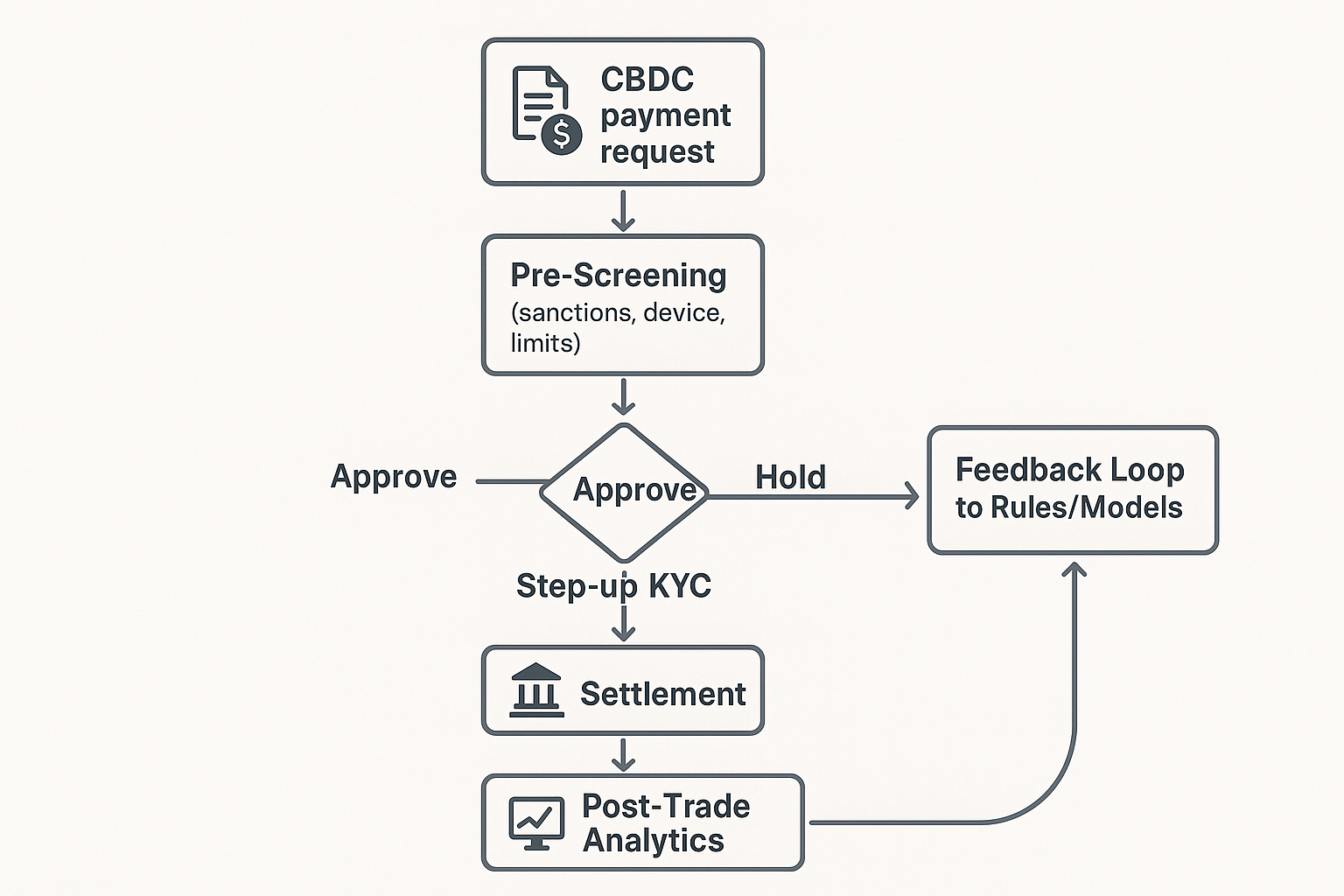
- Pre-transaction checks (milliseconds): Sanctions/PEP screening, geofencing, device fingerprint, wallet risk score, velocity limits.
- In-transaction scoring (sub-second): Counterparty reputation, pattern anomalies (structuring, smurfing), smart-contract flags if programmability is used, merchant category risk.
- Post-transaction surveillance (seconds to minutes): Graph/network detection (mule rings, layering), case escalation and SAR drafting.
Minimum data to make real-time AML work The following fields should be available at or before authorisation. Map them to IVMS 101/Travel Rule where applicable.
- Payer/payee legal name and identifier (Why: sanctions/KYC continuity; Source: intermediary KYC)
- Wallet unique ID + type (custodial/retail) (Why: wallet risk profiling; Source: wallet provider)
- Jurisdiction and IP/device metadata (Why: geofencing, mule-device detection; Source: SDK/device)
- Transaction purpose/merchant category (Why: rule selection; Source: merchant acquirer/PSP)
- Amount, frequency, rolling velocity windows (Why: structuring/threshold rules; Source: core ledger)
- Counterparty screening result + timestamp (Why: audit trail; Source: screening engine)
- Programmability tags (escrow, conditional release) (Why: release-risk control; Source: smart instruction)
Risk-based approach for CBDC flows Use differentiated controls instead of blanket friction:
- Low-risk domestic retail: auto-approve up to dynamic limits; continuous monitoring post-settlement.
- Medium-risk (e.g., first-time counterparties, new devices): pre-screen + step-up verification (SMS OTP, in-app liveness).
- High-risk (e.g., sanctioned nexus, risky merchant MCC, mixing patterns): hold-and-review, enhanced due diligence, on-ledger tracing.
- Prohibit: sanctioned parties, embargoed jurisdictions, wallets linked to confirmed fraud rings.
What to implement in the next 90 days
- Connect to the HKMA sandbox/pilot APIs for e-HKD where available and simulate latency budgets. See HKMA’s e-HKD Pilot Programme overview.
- Deploy dual-layer screening: UN/HKSAR lists for baseline; plus OFAC/EU for cross-border risk where policy permits.
- Adopt IVMS 101 messaging for Travel Rule-equivalent data portability between CBDC intermediaries.
- Build a rules library aligned with FATF red flags; add machine-learning anomaly detection inspired by BIS Project Aurora for mule and layering patterns.
- Instrument auditability: store screening inputs/outputs, model versions, analyst decisions with immutable timestamps.
- Run tabletop exercises for fraud/cyber incidents, reflecting the custody risks highlighted in Hong Kong’s consultation on virtual asset custodians.
Regulatory alignment to cite in policies
- FSTB’s Policy Statement 2.0 on digital assets: international coordination (IOSCO/FSB/Basel) and support for tokenised/RWA use cases.
- FATF guidance and 2024 targeted update on Travel Rule and unhosted wallets: risk-based controls over blanket de-risking.
- BIS analyses on AML/CFT for digital money and Project Aurora’s real-time network analytics approach.
Useful references
- HKMA e-HKD Pilot Programme: https://www.hkma.gov.hk/eng/key-functions/digital-economy/e-hkd-pilot-programme/
- FSTB Policy Statement on Virtual Assets (context for 2.0): https://www.fstb.gov.hk/en/financial-services/policy-statement-virtual-assets.html
- FATF targeted update (2024): https://www.fatf-gafi.org/en/publications/Fatfrecommendations/Targeted-update-virtual-assets-2024.html
- BIS Project Aurora (AML for payments): https://www.bis.org/innovation_hub/projects/aurora.htm
- FSB global framework for crypto-asset activities: https://www.fsb.org/2023/07/global-regulatory-framework-for-crypto-asset-activities/
Bottom line CBDC compliance in Hong Kong will be judged on speed, auditability, and proportionality. Build for real-time decisions, transport essential counterparty data across participants, and let risk drive friction. If you get these three right, supervisors will see a robust program—and customers will feel the difference only when it matters.


