
HK AML: Real-Time Monitoring & Risk-Based Compliance

HK AML: Real-Time Monitoring Meets the Risk-Based Test
Hong Kong is tightening the screws on AML/CFT for virtual assets, and “real-time” is no longer a nice-to-have. FATF’s June 2025 message is blunt: start your gap analyses now and update AML/KYC systems with the 2030 compliance horizon in mind. If you run a VA exchange, OTC desk, wallet, or payment rail in HK, the clock is ticking.
Here’s the practical read: build a risk-based monitoring program that actually runs in real time, not just in post-trade batches.
What changed in 2025 (and why it matters)
- FATF 2025 direction: National regulators and institutions should begin gap analyses with a 2030 compliance deadline in view. Translation: multi-year remediation is expected. Don’t wait for final rulebooks to start. See FATF’s recommendations and updates.
- VA OTC coming into the net: Hong Kong consulted on bringing VA OTC services into the regulatory remit to apply FATF-aligned AML/CTF controls, including CDD and record-keeping, with an explicit investor protection lens. This is about closing a major channel for retail flows. Reference: FSTB’s consultation on OTC VA trading.
- Stablecoin AML expectations: Consultation conclusions emphasise that participants in a stablecoin transfer must exchange essential information to support transaction monitoring, sanctions screening, and risk mitigation—consistent with international standards. See HKMA/SFC virtual assets updates and stablecoin materials.
The blueprint: risk-based, event-driven, and measurable
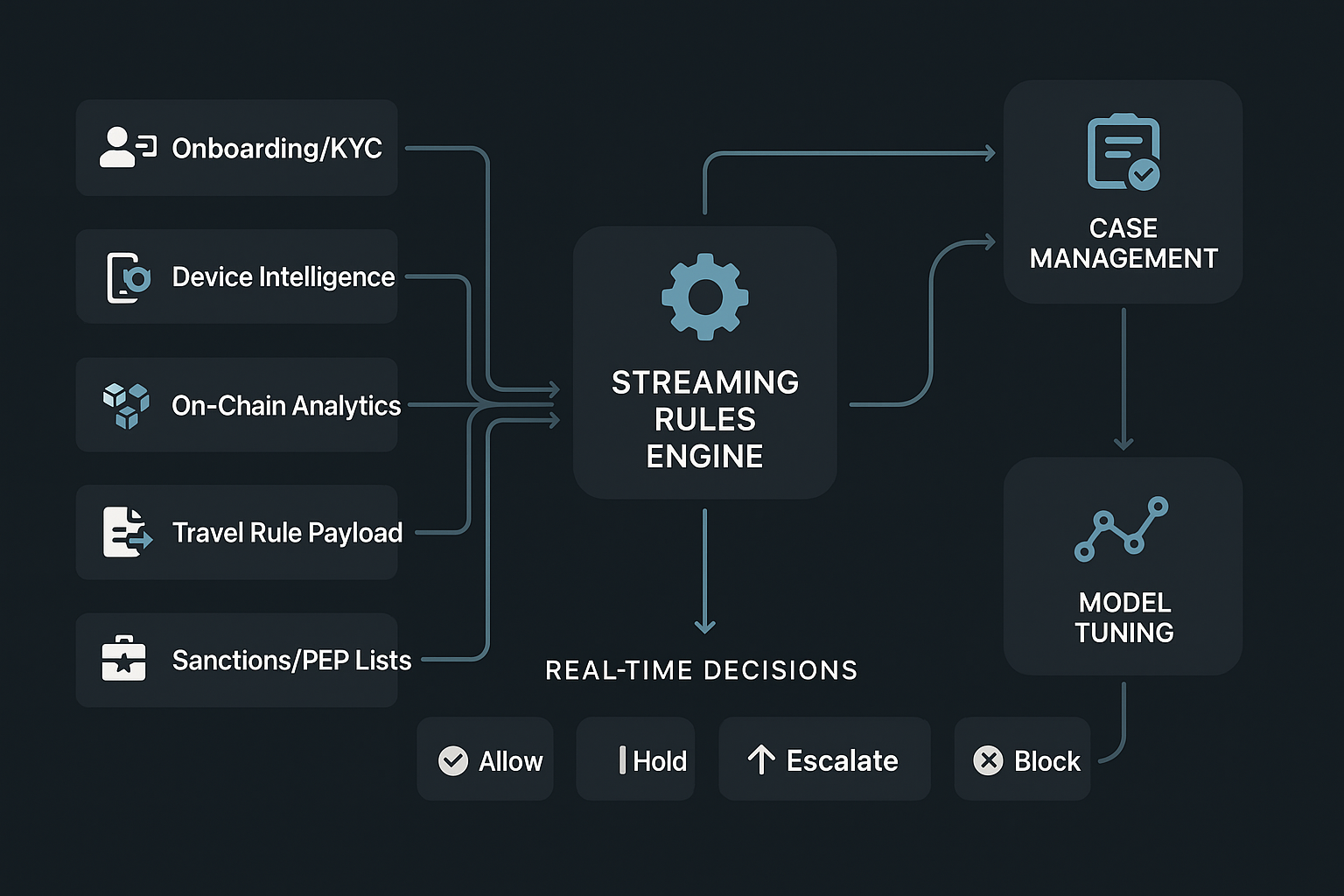
Key components:
- Segmentation first: customer risk (profession, geography, source of funds), asset risk (stablecoins, privacy coins), channel risk (cash OTC vs banked), and behavioral risk (velocity, structuring).
- Real-time triggers: pre-broadcast sanctions and wallet screening, mempool monitoring, Travel Rule data match (sender/beneficiary), anomaly detection on velocity and counterparties.
- Case management in seconds: alerts route to investigators with enriched context (on-chain labels, KYC snippet, prior SARs).
- Feedback loops: tune thresholds weekly; hard-block only where you have strong signals.
A simple, defensible control table
-
Low risk (e.g., known retail, routine size)
- Controls: sanctions + wallet screening, velocity checks, TR data validation
- Latency target: <3 seconds
- Escalation: auto-release unless dual-flag
-
Medium risk (e.g., new counterparty, unusual size/pattern)
- Controls: enhanced counterparty analytics, device/IP geofencing, liveness check on first transfer
- Latency target: <30 seconds
- Escalation: Tier-1 analyst review
-
High risk (e.g., nexus to sanctioned/high-risk addresses, OTC cash, privacy tools)
- Controls: hard hold, EDD refresh, source-of-funds evidence, senior sign-off
- Latency target: decision within 15 minutes
- Escalation: MLRO; SAR if not satisfactorily resolved
OTC-specific points you can’t ignore
- CDD and record-keeping are table stakes; expect explicit obligations mirroring FATF. See the HK consultation language on scope and rationale.
- High-friction scenarios: cash-funded buys, third-party pay-ins, frequent small-lot trades just under internal thresholds (structuring). Build structuring detectors that aggregate by device, phone, and biometric hash—not just name.
- Shopfront hygiene: video KYC with liveness, receipt digitisation, Travel Rule handshakes when sending to hosted wallets.
Stablecoins: treat them as payment rails
- Enforce Travel Rule data exchange before transfer settlement; reject incomplete payloads.
- Screen issuer and smart contract addresses; monitor depeg events as risk multipliers.
- Maintain sanction list freshness to sub-hour; stablecoin flows move fast.
Metrics that regulators actually respect
- Median alert latency (target: <3s low risk; <30s medium)
- Alert-to-case conversion rate (illustrative goal: improve from 25% to 50% in 2 quarters)
- Share of transfers with complete Travel Rule data (target: >98%)
- Time-to-SAR from first alert (target: same business day)
- False positive rate trend by scenario (drive down by 20–30% with weekly tuning)
What to do this quarter
- Run a 6-week FATF 2025 gap analysis mapped to AMLO/SFC/HKMA guidance; build a 2030 back-cast plan with annual milestones.
- Choose a streaming monitoring stack that ingests on-chain analytics, device intel, and Travel Rule payloads; avoid batch-only tools.
- Write scenario playbooks for OTC cash, stablecoin bursts, and sanctioned nexus; rehearse them.
- Tighten data quality: names/IDs normalisation, wallet tagging governance, and sanctions list refresh automation.
- Engage early: discuss your latency targets, Travel Rule coverage, and model governance with your supervisor.
One last point.
If it isn’t fast, it isn’t effective AML for virtual assets.
References and further reading
- FATF Recommendations and updates: https://www.fatf-gafi.org
- FSTB consultation on regulating VA OTC trading (Hong Kong): https://www.fstb.gov.hk
- SFC AML/CTF guideline for VASPs and LCs: https://www.sfc.hk
- HKMA virtual assets and stablecoin updates: https://www.hkma.gov.hk
If you want a sanity check on your monitoring latency and scenario coverage, we’ve benchmarked several HK setups this year. Happy to compare notes.


