HK AML/CFT for Wholesale Stablecoins: EDD Guide by StanCOMP

HK AML/CFT for Wholesale Stablecoins: EDD that actually works
Hong Kong is moving fast to harden AML/CFT expectations for licensed stablecoin issuers (LSIs). The HKMA’s consultation conclusions on the AML/CFT Guideline for LSIs signal two clear themes: enhanced due diligence (EDD) is non‑negotiable for wholesale models, and monitoring cannot stop at your direct customers. It must extend to third parties and secondary-market circulation too.
Why this matters now
- The HKMA has confirmed broad industry support for its AML/CFT approach and set out next steps toward finalising the Guideline. See the consultation conclusions summary here (HKMA).
- Supervisors are leaning on global signals: the BIS recently highlighted stablecoin vulnerabilities to ML/TF and sanctions evasion, and the FATF has warned about risks from unhosted wallets due to anonymity and mobility (BIS; FATF).
- The Guideline will clarify due diligence expectations for third‑party entities, aligning them with custodial wallet provider requirements. There’s also an explicit expectation to monitor stablecoins circulating in secondary markets, including holdings by non‑customers.
What this means for wholesale stablecoins Institutional use cases don’t simplify AML. They add layers: omnibus wallets, programmatic treasury flows, cross‑border settlement, and third‑party operators. EDD must be risk‑based, testable, and auditable.
The EDD playbook we recommend
- Customer onboarding (institutions and market operators)
- Identify UBOs and controllers down to natural persons. Verify with independent registries and filings.
- Map the wallet architecture: hosted vs unhosted, omnibus vs segregated, signing schemes, and smart‑contract controls.
- Assess source of funds/source of stablecoin. Validate fiat on‑ramp provenance and redemption pathways.
- Sanctions/PEP screening with documented false‑positive handling. Apply targeted financial sanctions screening to wallet clusters.
- KYT baseline: on‑chain risk scoring of declared wallets; require attestation of undisclosed wallets.
- Governance: for high‑risk clients, require senior management sign‑off and a written risk acceptance.
- Third‑party entities (aligned with custodial wallet provider standards)
- Verify licence/registration status where applicable, AML governance, Travel Rule readiness, and chain‑monitoring coverage.
- Demand control mappings and SOC/ISAE attestations where available. Conduct site or virtual walkthroughs for critical providers.
- Contract for audit rights and data portability. Pre‑agree incident reporting SLAs.
- Transfers and the Travel Rule
- Capture originator/beneficiary information and transmit using IVMS 101 or equivalent secure schema. Apply counterparty due diligence tiers.
- For unhosted wallets, apply risk‑mitigation: micro‑transfer verification, signed message proofs, and heightened sanctions screening.
- Set a conservative trigger for additional verification. Illustrative: enhanced verification for transfers ≥ HKD 50,000 and cumulative daily flow ≥ HKD 200,000. These figures are illustrative only; follow the final HKMA thresholding and AMLO requirements as issued.
- Ongoing monitoring (including non‑customers and secondary markets)
- Track circulation beyond your customer base. Maintain exposure registers to high‑risk services, darknet markets, and sanctioned clusters.
- Behavioural analytics: alert on velocity spikes, rapid mint–redeem cycling, or chain‑hopping through mixers/bridges.
- Case management with documented rationales and timely STR filings to the JFIU when suspicion arises.
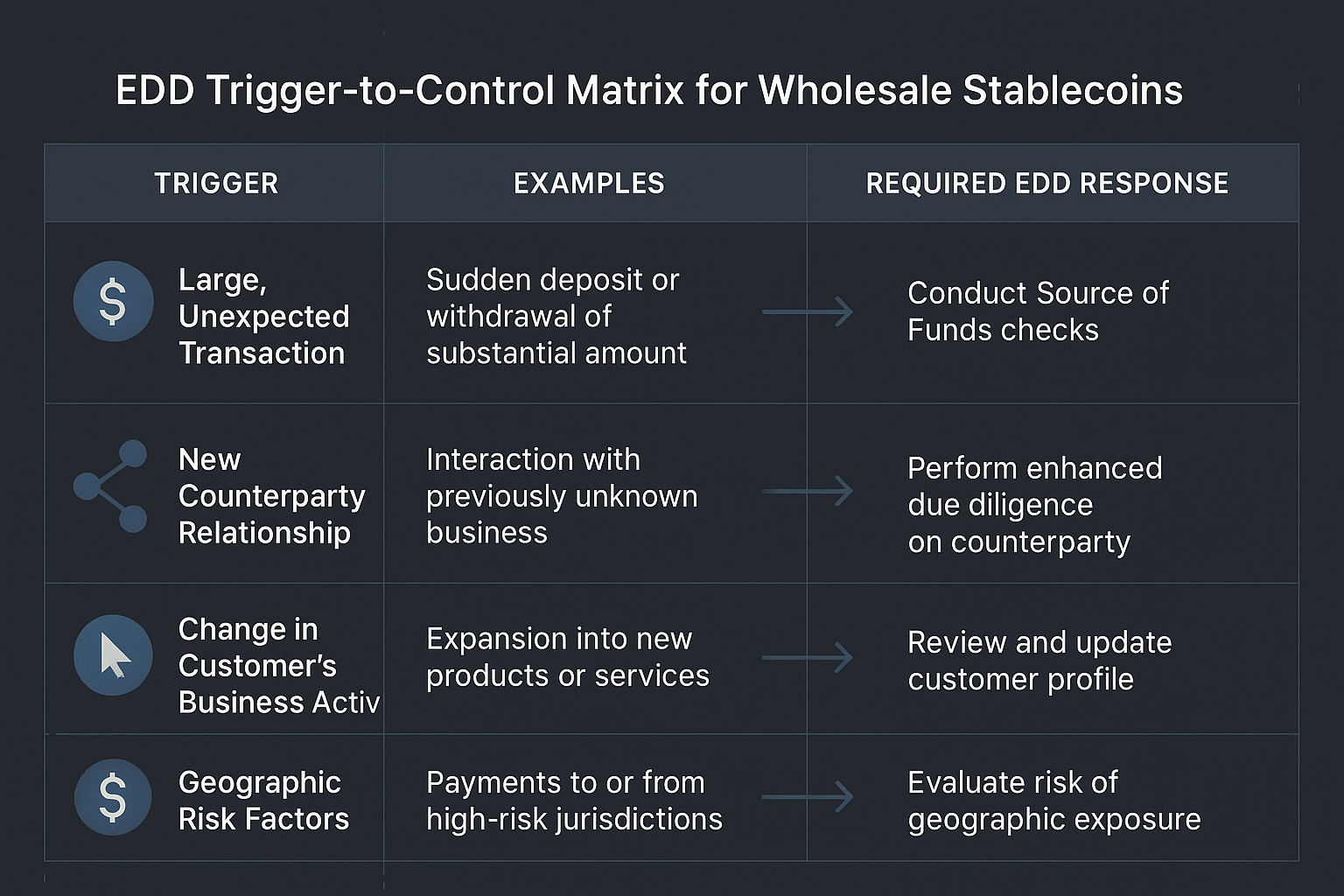
A compact trigger-to-control matrix
| Trigger | Examples | Required EDD Response |
|---|---|---|
| High‑risk geography | Sanctioned/grey‑listed route | Senior approval; enhanced KYT; provenance proof of funds |
| Unhosted beneficiary | New address; no ownership proof | Signed message or micro‑transfer verification; tighter limits |
| Rapid mint–redeem loop | Short‑interval cycles | Source-of-funds refresh; trading rationale; temporary hold |
| Third‑party operator change | New custodian/processor | Refresh due diligence; contract addenda; data migration plan |
| Adverse media hit | Fraud/sanctions link | Immediate freeze assessment; STR consideration; board notification |
Governance and record‑keeping
- Keep decision logs tied to risk assessments. If it’s not documented, it didn’t happen.
- Test controls quarterly. Include sample walkthroughs of Travel Rule messaging and secondary‑market monitoring.
- Train front-office and ops. EDD fails when the business misclassifies counterparties or wallets.
What to do this quarter
- Run a gap analysis against the consultation conclusions: third‑party due diligence alignment, secondary‑market monitoring, and transfer data capture.
- Pilot a Travel Rule solution with IVMS 101 and encryption interoperable with regional VASPs in Hong Kong and Singapore.
- Build a “non‑customer exposure” dashboard that surfaces material circulation of your stablecoin in high‑risk clusters.
The headline: wholesale doesn’t exempt you from retail‑grade risk. It compresses it.
If you need a pragmatic walkthrough tailored to your issuance and settlement model, the StanCOMP team can help you operationalise these controls before the final HKMA Guideline lands. References: HKMA consultation conclusions (AML/CFT for LSIs); BIS on stablecoin vulnerabilities; FATF guidance on virtual assets and unhosted wallets.