
StanCOMP: HK Virtual Assets Risk‑Based AML/CFT Guide

HK Virtual Assets Risk‑Based AML/CFT Guide
Introduction Hong Kong is tightening the screws on AML/CFT for virtual assets — and doing it the right way: risk-based, aligned with FATF Recommendation 15, and anchored in Schedule 2 of the AMLO. If you operate a VATP, provide OTC dealing, or run custody, you will be held to the same core standards as financial institutions: CDD, ongoing monitoring, record-keeping, and effective reporting. The only question is how you operationalise this without slowing the business.
This is where most firms stumble.
What Hong Kong requires (and proposes)
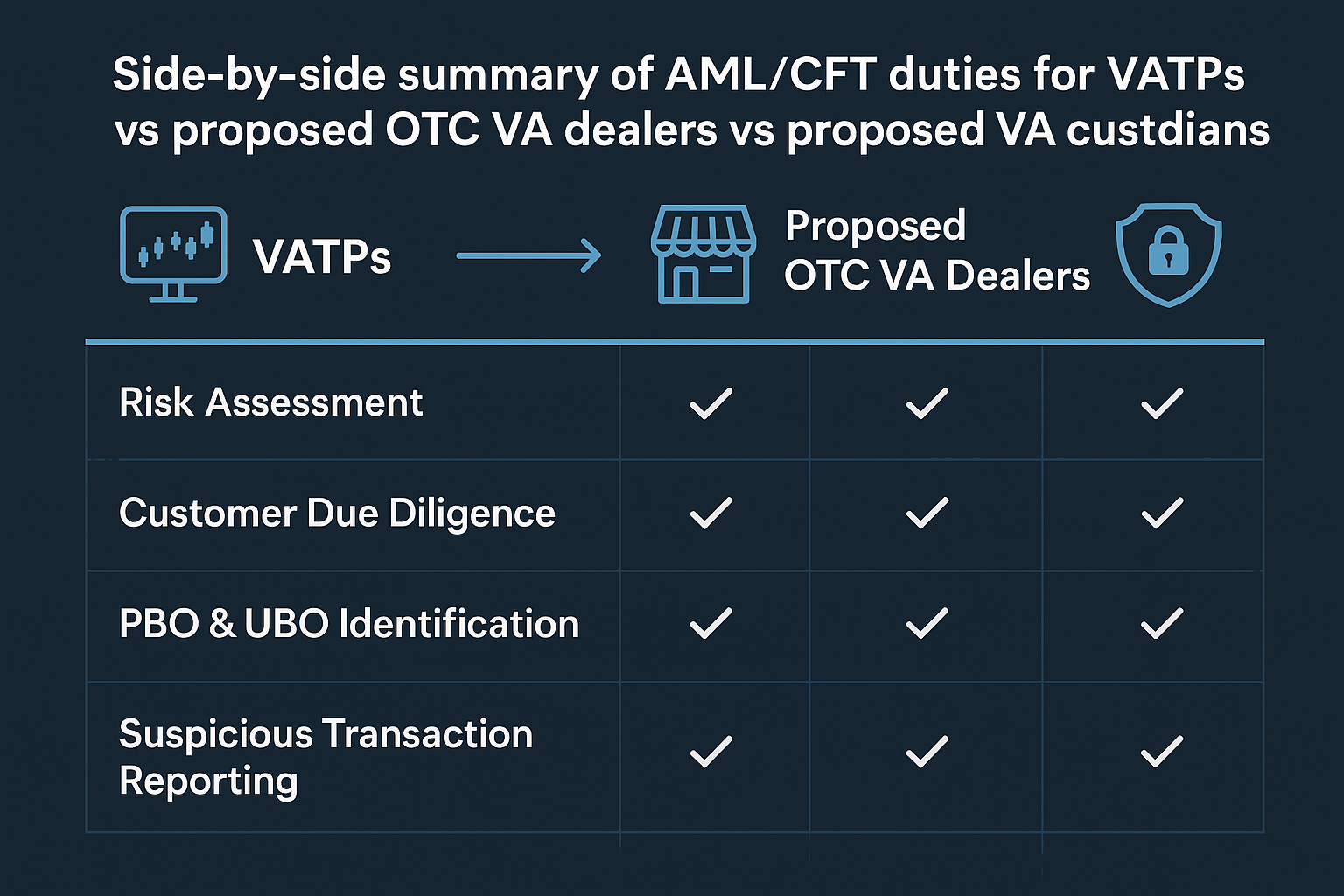
- In force (VATPs): The Anti-Money Laundering and Counter‑Terrorist Financing (Amendment) Ordinance 2022 introduced a regime for VATPs that mirrors FATF standards, including CDD and record-keeping under AMLO Schedule 2. See the SFC’s VATP page for current expectations.
- Proposed (OTC): The Government has consulted on regulating over‑the‑counter VA trading, bringing OTC dealers under an AML/CFT regime consistent with FATF requirements (including CDD and record-keeping).
- Proposed (Custody): The Government has consulted on regulating VA custodians, who would be required to observe Schedule 2 AML/CFT obligations, including CDD and corresponding record-keeping.
References:
- AMLO (Cap. 615) and Schedule 2 obligations: eLegislation (Cap. 615)
- FATF Recommendation 15 (Virtual Assets and VASPs): FATF
- SFC VATP regime overview: SFC Virtual Asset Trading Platforms
A practical risk-based playbook Don’t copy-paste a bank’s policy. Build controls tailored to how VA risks actually emerge in your channels.
- Do a heat‑map by risk pillar (illustrative)
- Customer: Pooled OTC cash buyers, mixers, privacy coins, DeFi bridge operators, complex structures, and hosted vs unhosted wallet users.
- Product/Service: Spot trading, P2P, derivatives exposure, cross‑chain swaps, staking/earn, insured vs uninsured custody, cold vs warm wallet.
- Geography: Exposure to sanctioned or high‑risk jurisdictions; nexus via counterparties, IPs, or on‑chain flow.
- Delivery channel: Walk‑in OTC, remote onboarding, third‑party referrals, omnibus accounts.
- Tune CDD depth to risk
- Standard: Verify identity, beneficial ownership, purpose/nature, source of funds at onboarding; ongoing monitoring.
- Enhanced (triggered by red flags): Evidence of source of wealth; senior management sign‑off; tighter limits; more frequent reviews. For high‑risk flows, require blockchain‑traced provenance (e.g., last 3–5 hops) and counterpart VASP validation.
- Get the Travel Rule right
- For transfers to/from other VASPs, collect and transmit originator/beneficiary information consistent with FATF’s Recommendation 15. Validate counterparty VASPs (licence/registration status, sanctions, Travel Rule readiness). For unhosted wallets, apply risk‑based checks: ownership attestation, test transactions, and on‑chain screening.
- Use blockchain analytics intelligently
- Screen addresses pre‑trade and pre‑transfer; score for sanctions exposure, darknet, ransomware, mixers, gambling, and scams.
- Investigate anomalies: sudden hops through mixers or high‑risk services; cross‑chain bridges shortly before fiat off‑ramp.
- Document decisions. If you override a risk score, explain why.
- Monitoring, STRs, and record‑keeping
- Build scenarios that reflect VA typologies: rapid in‑and‑out through stablecoins; dusting before liquidation; OTC cash aggregation then exchange exit.
- File STRs promptly with the JFIU where suspicion arises (relevant laws include OSCO, DTROP, and UNATMO). Maintain post‑reporting confidentiality internally.
- Keep records for at least 5 years per Schedule 2: CDD files, transaction data, Travel Rule data, investigation notes, and analytics reports.
OTC and custody: what to prepare now
- OTC dealers: Expect licensing and Schedule 2 compliance. Start by mapping all touchpoints where VA is exchanged for cash/fiat and lock down CDD, Travel Rule interoperability, and face‑to‑face onboarding standards.
- Custodians: Prepare for client asset segregation evidence, wallet management governance, dual‑control key ceremonies, and AML/CFT coverage for deposit/withdrawal flows. Even “pure safekeeping” needs transfer‑risk controls because deposits and withdrawals can be abused for layering.
Quick wins this quarter
- Policy: Refresh AML/CFT to explicitly reference AMLO Schedule 2, FATF Rec 15, Travel Rule handling, VA typologies, and STR governance.
- Vendor stack: Select a Travel Rule solution and a blockchain analytics provider; pre‑test data mapping and hit-handling playbooks.
- Data: Ensure you can retrieve complete records within 2 business days. Regulators will ask.
- Training: Role‑based, at least annually; test with real VA case studies (e.g., mixer exposure with false‑positive remediation).
Conclusion Hong Kong’s message is clear: same AML/CFT spine as finance, adapted to VA realities. If you calibrate your controls to actual risk — not just to templates — you’ll be audit‑ready when OTC and custody rules land, and you won’t have to slam the brakes on growth to get there.


