
StanCOMP: HK Travel Rule & DPMS Licence—Risk-Based Guide

Introduction: Why this matters now If you accept stablecoins, run an OTC desk, or deal in precious metals and stones (DPMS) in Hong Kong, your AML/CFT obligations are moving targets. The Travel Rule now bites beyond crypto-native firms, and DPMS registrants are increasingly intersecting with virtual assets as payment. The regulators are clear: apply a risk-based approach, document your rationale, and expect scrutiny.
Two anchors to keep in view:
- The HKMA reiterates that the Travel Rule is a key FATF requirement, with role-specific duties for ordering, intermediary, and beneficiary institutions, and practical guidance in paragraphs 6.25–6.42 of the AML/CFT Guideline.
- The Government’s VA OTC proposal contemplates investigative and enforcement powers and a six-month transitional period (no deeming arrangement under one option), referencing the VATP and DPMS regimes.
Who the Travel Rule actually bites The Travel Rule imposes different obligations based on role:
- Ordering institution: Collect and transmit originator and beneficiary information; screen and withhold if data is incomplete or suspicious.
- Intermediary institution: Ensure received originator/beneficiary data accompanies the transfer when passing it along; risk-based monitoring where data is missing.
- Beneficiary institution: Receive, screen, and make the information available to authorities; reconcile discrepancies.
If you are neither the ordering nor beneficiary (e.g., a technical service provider or a merchant like a DPMS receiving stablecoin via a VASP), you still need a documented risk assessment and controls aligned to your role. The HKMA points licensees to AML/CFT Guideline paras 6.25–6.42 for handling practical challenges, and is engaging via the FATF Virtual Asset Contact Group and FATF’s Best Practices on Travel Rule Supervision.
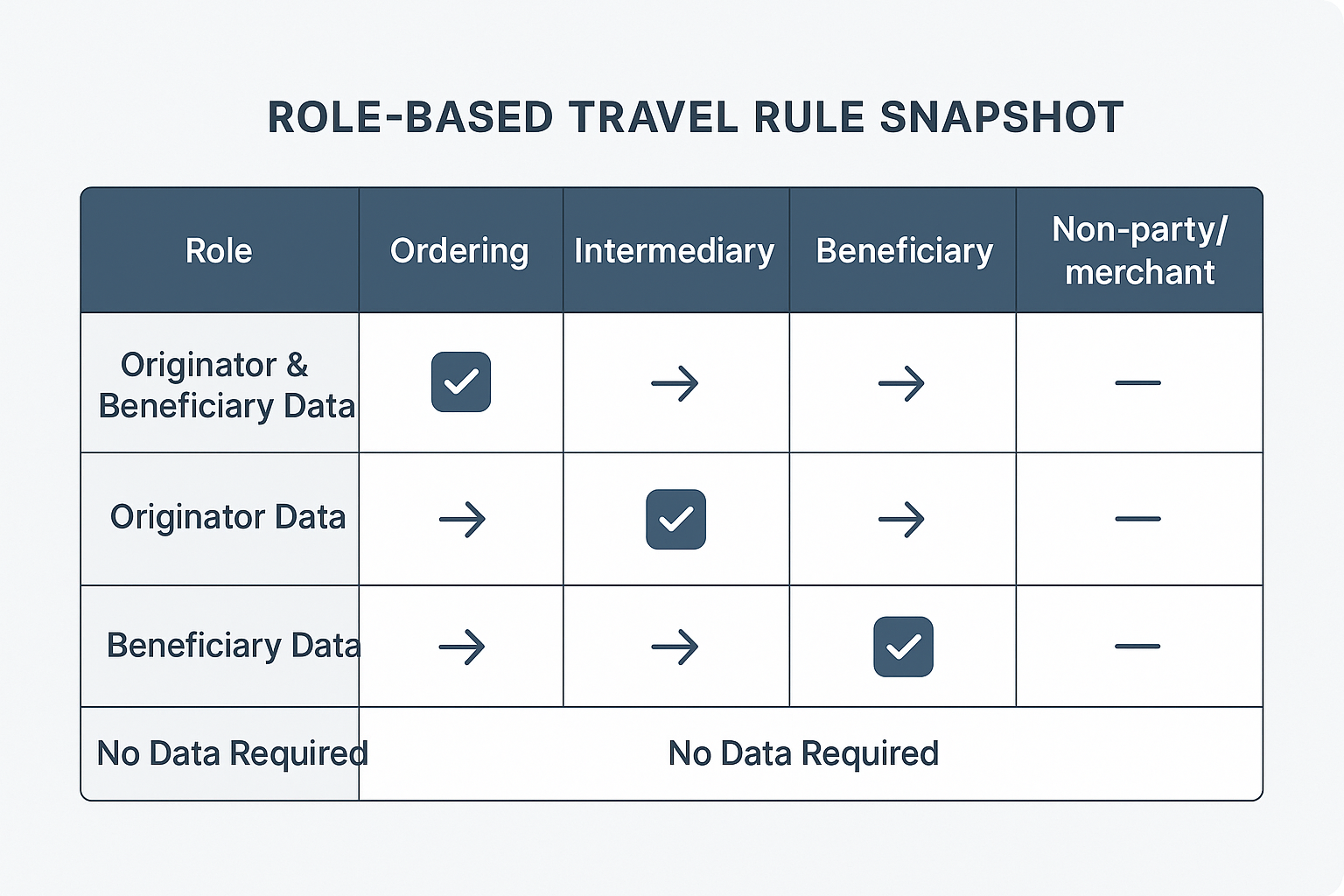
- Ordering: Collect KYC-level sender/receiver identifiers; transmit before/with the transfer; return/hold if materially incomplete.
- Intermediary: Pass through required data; flag missing info; risk-monitor chains with repeated defects.
- Beneficiary: Verify received data; screen parties; resolve mismatches before crediting.
- Non-party/merchant (e.g., DPMS paid in stablecoin): Not a Travel Rule “institution”, but must ensure counterpart VASP complies and that payment channel risk is acceptable.
Stablecoin transfers: a risk-based playbook (what works in practice)
- Only receive via VASPs that are Travel Rule-capable. Build an allowlist and sample-test messages monthly (illustrative: test 5 transfers/month).
- Data checks within 2 minutes of receipt (illustrative metric): originator name, account/wallet reference, beneficiary details, and sanctions screening before goods release.
- Handle non-compatible VASPs: auto-reject or route to fiat; document exceptions with senior sign-off.
- Keep audit trails for 5+ years: message payloads, screening results, decision logs, and staff approvals.
DPMS registration: quick refresher with crypto in mind
- Who regulates: Customs and Excise Department (C&ED) under AMLO Part 5A.
- Category A vs B:
- Category A: Dealers not engaging in cash transactions ≥ HKD 120,000.
- Category B: Dealers engaging in such cash transactions; full AML/CFT program, MLRO/Compliance Officer, CDD and record-keeping apply.
- If you accept stablecoins: treat them like high-risk “non-cash” unless policy says otherwise. Build a trigger that if VA-to-fiat on-ramp ends in a cash payout ≥ HKD 120,000, Category B controls kick in. Upgrade from A to B before changing your business model.
What to do now (checklist you can run this week)
- Map your role: For each payment rail (bank wire, VA, stablecoin), identify if you are ordering, intermediary, beneficiary, or merchant.
- Update policies: Cite AML/CFT Guideline paras 6.25–6.42 for Travel Rule exceptions handling; add clear reject/hold criteria.
- Contract with VASPs: Add clauses requiring Travel Rule compliance and data delivery SLAs; include right to audit message samples.
- DPMS hygiene: Confirm your current Category (A/B), appoint MLRO/CO if B, and align record-keeping to AMLO.
- OTC exposure: If you run or rely on OTC channels, plan for a six-month transitional window post-legislation and assume active enforcement.
One more thing: document everything.
References and useful links
- HKMA AML/CFT Guideline (see paras 6.25–6.42): https://www.hkma.gov.hk/eng/key-functions/banking-stability/aml-cft/
- FATF Virtual Assets and Travel Rule resources: https://www.fatf-gafi.org/en/topics/virtual-assets.html
- HKMA stablecoin policy updates and consultations: https://www.hkma.gov.hk/eng/news-and-media/press-releases/
- DPMS registration (C&ED): https://www.customs.gov.hk/en/service-enforcement-information/aml/dpms/index.html
- Government consultation on regulating VA OTC services (transitional arrangements, enforcement): https://www.info.gov.hk/gia/general/202402/08/P2024020800521.htm
- SFC VATP regime overview: https://www.sfc.hk/en/Rules-and-standards/Virtual-asset-service-providers
Conclusion Travel Rule compliance is no longer just a crypto-exchange problem. If you’re a DPMS receiving stablecoins or a business touching OTC flows, you’re in the frame. Build role-specific controls, tie them to HKMA and FATF guidance, and be ready for a tight transitional window on OTC rules. If you want a concise gap assessment tailored to your payment flows and DPMS category, StanCOMP can run one in two weeks with a prioritized remediation plan.


