EDD & Compliance for Algorithmic Stablecoins in Hong Kong

EDD & Compliance for Algorithmic Stablecoins in Hong Kong
Hong Kong is moving from discussion to deployment. From 1 August 2025, a licensing regime for stablecoin issuers will go live with requirements around reserve assets, stabilisation, redemption, and prudential risk management. That is the direction set in the Government’s Policy Statement 2.0 on digital assets and its push to pilot licensed stablecoins in government payments. For algorithmic models, this is a reality check.
The short version: if your “stability” depends primarily on code and market incentives rather than high‑quality reserves and guaranteed redemption, expect a very high bar—or a hard no—for issuance and retail distribution in Hong Kong.
What the rules mean in practice
- Licensing lens: The regime will prioritise fiat‑referenced stablecoins with robust reserves and at‑par, timely redemption. Purely algorithmic designs with no credible reserve backstop are unlikely to satisfy the stabilisation and redemption expectations embedded in Policy Statement 2.0.
- AML/CFT risk posture: The BIS has flagged stablecoins’ ML/TF and sanctions vulnerabilities, and the FATF continues to warn about unhosted wallets’ anonymity and mobility. Hong Kong intermediaries should treat algorithmic tokens as higher risk assets requiring EDD, even if not outright prohibited.
- Accounting and treasury: Fresh U.S. SEC staff guidance suggests certain USD‑pegged stablecoins could be treated as cash equivalents if there is guaranteed redemption and value stability tied to another asset class. That logic does not extend to algorithmic coins. Under HKFRS/IFRS, cash equivalents must carry insignificant risk of value change—an algorithmic stablecoin typically fails that test.
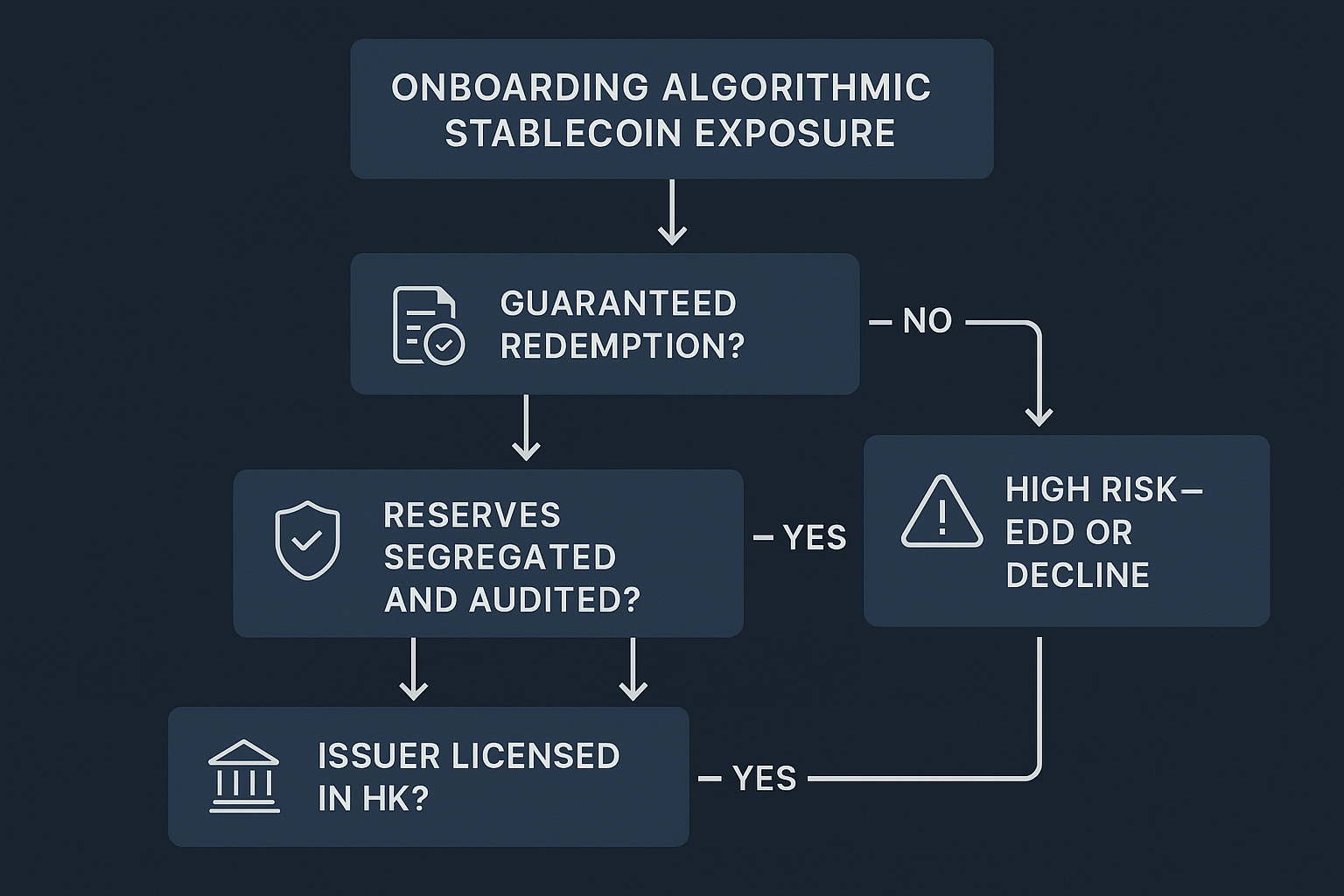
EDD playbook for VASPs and banks
-
Issuer assessment
- Legal structure, location, governance, and fitness/propriety of controllers.
- Stabilisation mechanism: presence of reserve assets, independent attestation frequency, redemption SLAs.
- Transparency: whitepaper disclosures vs on‑chain/attestation evidence.
-
Counterparty and wallet risk
- Unhosted wallet treatment aligned to FATF (R.15): verify source of funds/source of wealth; enhanced sanctions screening of addresses; Travel Rule compliance for transfers over set thresholds.
- Chain analytics: monitor peg stress events (e.g., deviation >1%) and exposure to sanctioned entities/mixers.
-
Transaction‑level controls
- Set conservative exposure limits during peg volatility spikes.
- Require pre‑funded redemptions for large off‑ramps.
- Document triggers for exit or freeze (e.g., sustained depeg >3% for 24h).
Illustrative EDD matrix
| Risk signal | Why it matters | Control to apply |
|---|---|---|
| No guaranteed redemption at par | Cash-out uncertainty; run risk | Decline or treat as speculative token |
| Dynamic mint/burn via governance token | Reflexivity and death-spiral risk | Heightened limits; daily liquidity checks |
| No independent reserve attestation | Opaque solvency | Require third‑party attestations or avoid |
| Heavy unhosted wallet flows | Higher ML/TF exposure | Source of funds/wealth, Travel Rule, screening |
| Recent >2% depeg events | Stability failure | Increase monitoring; restrict client exposure |
Accounting and disclosure
- Treasury classification: Do not book algorithmic stablecoins as cash or cash equivalents. Treat as financial or intangible assets subject to fair value measurement or impairment, per auditor guidance under HKFRS.
- Disclosures: Explain valuation methodology, liquidity risks, redemption limitations, and concentration exposure. Reference the SEC’s staff guidance only to highlight the contrast—your token lacks guaranteed redemption, therefore no cash‑equivalent treatment.
What to do now (next 90 days)
-
If you are an issuer:
- Map your design to Policy Statement 2.0 requirements. If you cannot evidence reserves and guaranteed redemption, reconsider your model or pivot to a hybrid with credible collateral and audited reserves.
- Prepare a licensing roadmap with governance, risk, and compliance functions (AML officer, compliance officer, risk head) and custody/separation of reserves with a regulated custodian.
-
If you are a VASP or bank:
- Update the product risk taxonomy to classify algorithmic stablecoins as high risk; pre‑clear with your board risk committee.
- Implement enhanced screening, Travel Rule controls, and on‑chain monitoring for any residual exposure.
- Align accounting policy memos with auditors: no cash‑equivalent presentation for algorithmic coins.
One final point.
Regulation is converging on a simple principle: stability must be earned, not asserted. In Hong Kong, that means reserves, redemption, and rigorous AML/CFT—exactly what algorithmic designs struggle to prove.
References: Hong Kong’s Policy Statement 2.0 on digital assets; BIS commentary on stablecoin vulnerabilities at bis.org; FATF VA/VASP guidance at fatf-gafi.org; and U.S. SEC staff guidance coverage indicating cash‑equivalent treatment only where redemption is guaranteed and value is tied to another asset class.