
AI-Powered Real-Time CBDC Monitoring: HK Compliance Guide

AI-powered real-time CBDC monitoring is no longer a thought experiment in Hong Kong. With the HKMA running the e-HKD pilot and co-leading the mBridge cross‑border CBDC initiative, institutions touching digital cash need controls that work at ledger speed. The Government’s Policy Statement 2.0 explicitly encourages RegTech, surveillance, and AI-driven tools with local presence and regional depth to uphold market integrity. That’s your signal to operationalise, not wait.
Where Hong Kong is today
- e-HKD: The HKMA’s e-HKD Pilot Programme is ongoing, focusing on programmability, tokenised deposits, and settlement use cases. See HKMA’s e-HKD page: https://www.hkma.gov.hk/eng/key-functions/digital-economy/e-hkd/
- mBridge: The BIS Innovation Hub and central banks including the HKMA have built an MVP for cross-border wholesale CBDC settlement. See BIS mBridge project: https://www.bis.org/innovation_hub/projects/mbridge.htm
Policy direction is clear: Hong Kong wants to be a digital assets hub and will back RegTech and cybersecurity tooling to get there (Policy Statement 2.0). At the same time, recent stablecoin AML consultation conclusions highlight two realities: (1) standardised transfer information gives institutions the essentials for transaction monitoring, sanctions screening, and risk mitigation; and (2) it’s technically challenging to monitor every peer‑to‑peer transaction involving unhosted wallets that never touches a regulated intermediary. CBDC monitoring should assume those constraints.
What “AI-powered real-time” actually means
- Event-driven detection: Ingest CBDC ledger events (authorisations, settlements, cancellations) and refresh risk in milliseconds, not overnight.
- Multi-list sanctions screening: Names, addresses, wallet IDs, and counterparty identifiers screened against HKSAR UN sanctions (Cap. 537), OFAC, EU, and domestic watchlists on each hop.
- Behavioural and graph analytics: Baselines per wallet and customer segment; graph risk from counterparties, geography, and velocity (e.g., 8 transfers to unrelated new wallets within 15 minutes).
- Explainable models + human-in-the-loop: Gradient-boosted models with SHAP summaries so investigators see why an alert fired; analysts can close, escalate, or retrain thresholds quickly.
- Continuous learning: Label outcomes and retrain weekly with drift checks; freeze models used for regulatory reporting and keep an audit trail.
Controls you should implement on day one
| Control | Why it’s CBDC-specific | HK reference | Practical target |
|---|---|---|---|
| Per-hop sanctions screening | CBDC legs can be atomic and rapid; each leg must be screened | Cap. 537 (UN Sanctions), HKMA AML Guideline | <300 ms screening latency; <0.5% false positive rate (illustrative) |
| Standardised transfer data | Travel-rule-like fields enable automated monitoring | Stablecoin AML consultation conclusions | 100% population of payer/payee legal name, ID type, issuer, jurisdiction |
| Velocity and structuring rules | Programmability increases burst risks | Policy Statement 2.0 (surveillance tools) | Trigger if >5 new counterparties or >HKD 100k sliced within 10 minutes (illustrative) |
| Graph risk scoring | Counterparty contamination spreads fast on-ledger | RegTech encouragement in Policy Statement 2.0 | Update graph risk within 1 second of event |
| PDPO-compliant data minimisation | CBDC telemetry can be sensitive | PDPO (Cap. 486) | Retain features, not raw PII, for 7 years with role-based access |
| Model governance | Supervisors will ask “Why did this alert fire?” | HKMA Model Risk Management expectations | SHAP explanation on 100% of model alerts; quarterly validation |
A pragmatic architecture
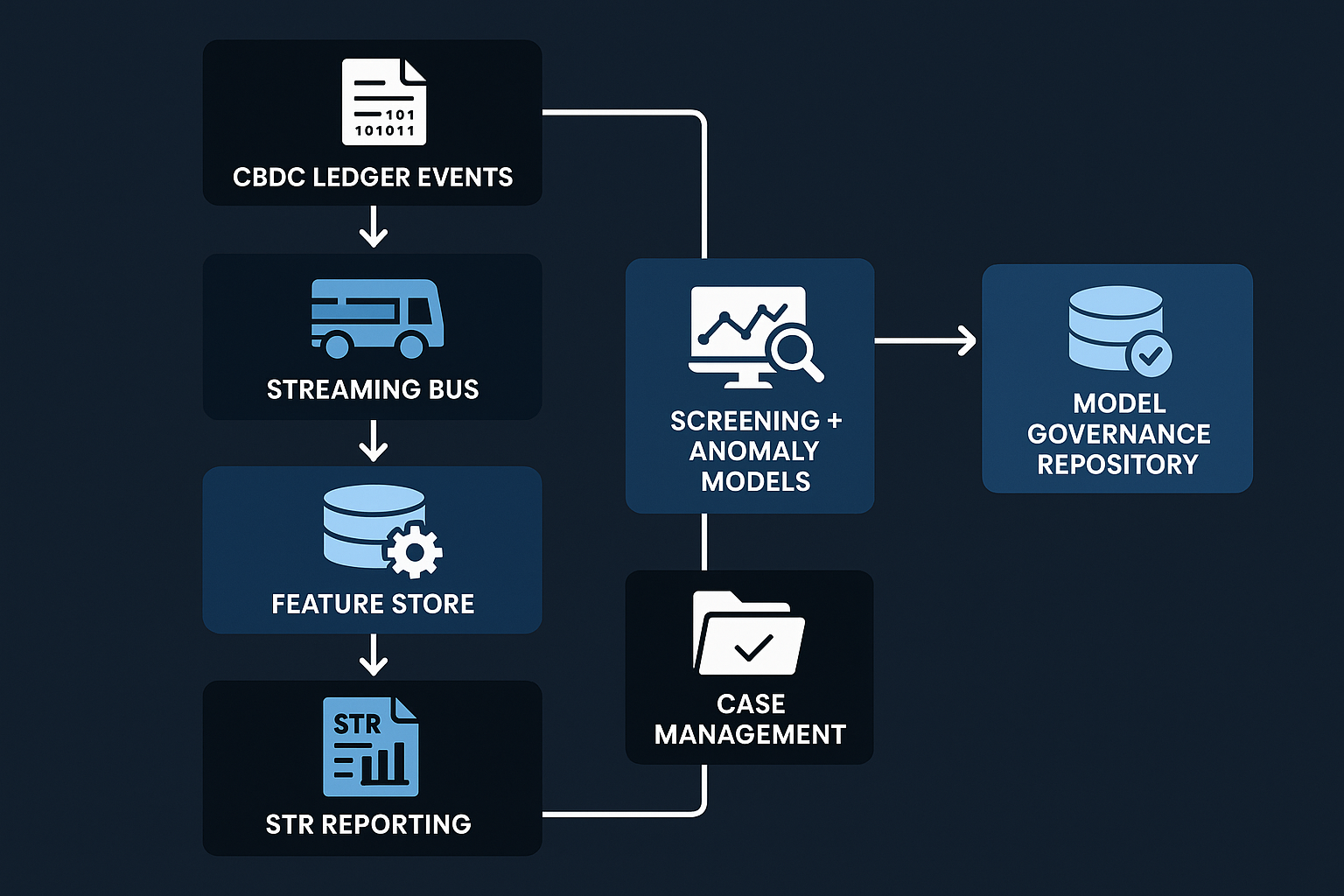
- Integrate via CBDC node or API gateway emitting settlement events to a streaming backbone (e.g., Kafka).
- Feature store computes rolling windows (1m/5m/1h) for velocity, counterparty diversity, and anomaly scores.
- Dual-track detection: deterministic rules for sanctions/travel-rule gaps; ML models for behaviour anomalies.
- Case management ties to STR filing workflows for the JFIU, with immutable audit logs.
- Separate PII and analytical features to meet PDPO requirements; apply data encryption and strict entitlements.
Policy and legal anchors you can cite
- AMLO (Cap. 615): Core AML/CFT obligations for banks, SVFs, and relevant intermediaries: https://www.elegislation.gov.hk/hk/cap615
- UN Sanctions Ordinance (Cap. 537): Targeted financial sanctions screening: https://www.elegislation.gov.hk/hk/cap537
- PDPO (Cap. 486): Personal data handling and retention: https://www.elegislation.gov.hk/hk/cap486
- Policy Statement 2.0 on Digital Assets: Government support for RegTech and AI surveillance; Cyberport funding for high‑impact blockchain/DA applications.
- Stablecoin AML consultation conclusions: Essential transfer information is key, and full P2P visibility outside regulated rails is limited.
What to do this quarter
- Map CBDC data fields to your screening/monitoring schema; plug gaps (e.g., payer legal name issuer, jurisdiction codes).
- Stand up a streaming PoC with one or two live rule sets and a basic anomaly model; measure alert precision and latency.
- Implement explainability and start an outcomes‑labeling discipline; plan quarterly model validation.
- Synchronise sanctions lists (HKSAR + foreign) at least hourly; log deltas.
- Engage Cyberport/Policy 2.0 programmes if you’re building tooling; co‑develop with a local partner to meet “local presence” expectations.
Real-time CBDC compliance is achievable. The winners will pair fast pipes with explainable AI, respect legal boundaries on data, and acknowledge where the perimeter ends—particularly for unhosted P2P. In Hong Kong, the policy winds are with you. Build now, iterate with the supervisors, and be ready when e-HKD and mBridge usage spikes.


